

Elite Test Bank:
Children's Literature,
Briefly (7th Edition)
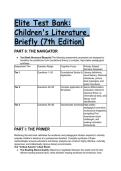
PART 0: THE NAVIGATOR
● Test Bank Structural Blueprint The following assessment parameters are designed to
transition the practitioner from foundational theory to complex, high-stakes pedagogical
synthesis.
Assessment Tier Question Range Cognitive Focus Primary Subject
Domains Assessed
Tier 1 Questions 1–28 Foundational Syntax & Literary definitions,
Application visual literacy, historical
milestones, picture
book typologies, and
poetic structures.
Tier 2 Questions 29–58 Complex Application & Genre differentiation,
Simulation evaluation criteria for
historical fiction vs.
informational texts, and
literary motif
identification.
Tier 3 Questions 59–88 Grandmaster Synthesis High-stakes
pedagogical scenarios,
multicultural integration,
navigating First
Amendment book
challenges, and
reading motivation
frameworks.
PART I: THE PRIMER
Mastering this test bank calibrates the academic and pedagogical intuition required to critically
evaluate children's literature at a professional standard. Complete synthesis of these
methodologies ensures educators and literary analysts can construct highly effective, culturally
responsive, and intellectually rigorous literary environments.
The "Critical Axioms" Cheat Sheet:
● The Reading Stance Duality: Meaning is negotiated between the reader and the text;
efferent reading extracts facts, while aesthetic reading prioritizes the emotional, lived
, experience of the narrative.
● The Didacticism Directive: Literature must primarily serve as an aesthetic or narrative
experience; texts that sacrifice story to preach an overt lesson suffer from the flaw of
didacticism.
● The Visual Literacy Law: Illustrations do not merely decorate; they carry equal narrative
weight by establishing mood, extending the plot, or providing a differing viewpoint.
● The Motif Mandate: Modern fantasy is anchored by six core motifs (Magic, Other Worlds,
Good vs. Evil, Heroism, Special Character Types, Fantastical Objects); the presence of
Magic is the fundamental differentiator from realistic fiction.
● The Authentic Evaluation Metric: Informational books and biographies must be
evaluated rigorously for Accuracy, Organization, Design, and Style, avoiding fictionalized
dialogue unless historically verified.
● The First Amendment Axiom: Book challenges must be handled systematically via an
institution's established materials selection policy and grievance procedure to reduce
emotional tension and protect intellectual freedom.
Genre Classification Defining Characteristic Core Evaluation Criterion
Contemporary Realistic Events are physically possible Credibility of plot and absence
Fiction on modern Earth. of extreme hopelessness.
Historical Fiction Set in the past, often utilizing Absolute historical accuracy
invented protagonists. regarding setting and societal
norms.
Traditional Fantasy Oral tradition, featuring flat Adherence to the cultural
characters and rapid plots. storytelling style and universal
themes.
Authentic Biography True accounts of a person's life. Strict factual documentation
with zero invented dialogue.
Informational Books Expository texts delivering Accuracy, organization, and
factual data. freedom from
anthropomorphism.
PART II: THE ELITE TEST BANK
Tier 1: Foundational Syntax & Application
Q1: An educator evaluates a manuscript where the protagonist routinely halts the narrative to
deliver overt moral lectures regarding honesty. Based on the principles of literary quality, which
element of weak writing is PRIMARILY demonstrated? A) Condescension B) Didacticism C)
Self-censorship D) Tokenism
● The Answer: B (Didacticism)
● Distractor Analysis:
○ A is incorrect: Condescension involves underestimating the reader's intelligence via
oversimplified language, not necessarily preaching.
○ C is incorrect: Self-censorship is the internal suppression of controversial material.
○ D is incorrect: Tokenism is the superficial inclusion of minority characters.
The Mentor's Analysis: High-quality literature allows readers to extract meaning organically.
Texts designed primarily to instruct violate narrative integrity. Professional/Academic Intuition:
Overt moral instruction masquerading as narrative constitutes fatal didacticism.
Q2: An author deliberately uses the term "food tube" instead of "esophagus" in a non-fiction
, book intended for fifth graders, assuming the correct anatomical term is too complex. Which
element of weak writing is MOST ACCURATE? A) Didacticism B) Xenophobia C)
Condescension D) Fictionalization
● The Answer: C (Condescension)
● Distractor Analysis:
○ A is incorrect: The text is not preaching a moral lesson.
○ B is incorrect: Xenophobia is an irrational fear of foreigners.
○ D is incorrect: Simplification of vocabulary is not the invention of historical events.
The Mentor's Analysis: Authors must respect the cognitive capacity of their audience. Dumbing
down vocabulary disrupts the natural speaking tone. Professional/Academic Intuition:
Underestimating the reader's ability through artificial simplification is condescension.
Q3: In a picture book, the text describes a child walking happily to the park, but the illustrations
show dark, looming shadows and the child looking nervously over their shoulder. Which function
of illustrations is PRIMARILY utilized here? A) Reinforcing the text B) Establishing the setting C)
Providing a differing viewpoint D) Providing interesting asides
● The Answer: C (Providing a differing viewpoint)
● Distractor Analysis:
○ A is incorrect: The imagery directly contradicts the happy tone of the text.
○ B is incorrect: While the setting is shown, the primary function is the contradiction.
○ D is incorrect: Asides are subplots, not direct contradictions of the main narrative.
The Mentor's Analysis: Visual literacy requires recognizing when illustrations tell a parallel or
opposing story to the text. Professional/Academic Intuition: When text and imagery clash, the
illustration is providing a differing viewpoint to create dramatic irony.
Q4: A student reads a textbook to memorize the dates of the American Revolution for an
upcoming exam. According to Louise Rosenblatt's transactional theory, which reading stance is
the student IMMEDIATELY taking? A) Aesthetic reading B) Efferent reading C) Engaged
reading D) Visual literacy
● The Answer: B (Efferent reading)
● Distractor Analysis:
○ A is incorrect: Aesthetic reading focuses on the experiential and emotional journey
of reading.
○ C is incorrect: While the student may be engaged, efferent specifically denotes the
extraction of facts.
○ D is incorrect: Visual literacy involves analyzing images, not a reading stance.
The Mentor's Analysis: The reader's purpose defines the interaction with the text. Reading to
extract information to be used later is purely functional. Professional/Academic Intuition:
Efferent reading is the extraction of facts; aesthetic reading is the lived experience of the
story.
Q5: When analyzing the visual elements of a picture book, an illustrator utilizes heavy, jagged,
and chaotic marks across the page. Which visual element is MOST ACCURATELY being
manipulated to convey tension? A) Texture B) Color C) Line D) Shape
● The Answer: C (Line)
● Distractor Analysis:
○ A is incorrect: Texture refers to the tactile impression (e.g., smooth or rough surface
appearance).
○ B is incorrect: Color involves hue, value, and saturation.
○ D is incorrect: Shape refers to two-dimensional enclosed spaces.
The Mentor's Analysis: Artists use strokes to guide the eye and establish underlying emotional
Children's Literature,
Briefly (7th Edition)
PART 0: THE NAVIGATOR
● Test Bank Structural Blueprint The following assessment parameters are designed to
transition the practitioner from foundational theory to complex, high-stakes pedagogical
synthesis.
Assessment Tier Question Range Cognitive Focus Primary Subject
Domains Assessed
Tier 1 Questions 1–28 Foundational Syntax & Literary definitions,
Application visual literacy, historical
milestones, picture
book typologies, and
poetic structures.
Tier 2 Questions 29–58 Complex Application & Genre differentiation,
Simulation evaluation criteria for
historical fiction vs.
informational texts, and
literary motif
identification.
Tier 3 Questions 59–88 Grandmaster Synthesis High-stakes
pedagogical scenarios,
multicultural integration,
navigating First
Amendment book
challenges, and
reading motivation
frameworks.
PART I: THE PRIMER
Mastering this test bank calibrates the academic and pedagogical intuition required to critically
evaluate children's literature at a professional standard. Complete synthesis of these
methodologies ensures educators and literary analysts can construct highly effective, culturally
responsive, and intellectually rigorous literary environments.
The "Critical Axioms" Cheat Sheet:
● The Reading Stance Duality: Meaning is negotiated between the reader and the text;
efferent reading extracts facts, while aesthetic reading prioritizes the emotional, lived
, experience of the narrative.
● The Didacticism Directive: Literature must primarily serve as an aesthetic or narrative
experience; texts that sacrifice story to preach an overt lesson suffer from the flaw of
didacticism.
● The Visual Literacy Law: Illustrations do not merely decorate; they carry equal narrative
weight by establishing mood, extending the plot, or providing a differing viewpoint.
● The Motif Mandate: Modern fantasy is anchored by six core motifs (Magic, Other Worlds,
Good vs. Evil, Heroism, Special Character Types, Fantastical Objects); the presence of
Magic is the fundamental differentiator from realistic fiction.
● The Authentic Evaluation Metric: Informational books and biographies must be
evaluated rigorously for Accuracy, Organization, Design, and Style, avoiding fictionalized
dialogue unless historically verified.
● The First Amendment Axiom: Book challenges must be handled systematically via an
institution's established materials selection policy and grievance procedure to reduce
emotional tension and protect intellectual freedom.
Genre Classification Defining Characteristic Core Evaluation Criterion
Contemporary Realistic Events are physically possible Credibility of plot and absence
Fiction on modern Earth. of extreme hopelessness.
Historical Fiction Set in the past, often utilizing Absolute historical accuracy
invented protagonists. regarding setting and societal
norms.
Traditional Fantasy Oral tradition, featuring flat Adherence to the cultural
characters and rapid plots. storytelling style and universal
themes.
Authentic Biography True accounts of a person's life. Strict factual documentation
with zero invented dialogue.
Informational Books Expository texts delivering Accuracy, organization, and
factual data. freedom from
anthropomorphism.
PART II: THE ELITE TEST BANK
Tier 1: Foundational Syntax & Application
Q1: An educator evaluates a manuscript where the protagonist routinely halts the narrative to
deliver overt moral lectures regarding honesty. Based on the principles of literary quality, which
element of weak writing is PRIMARILY demonstrated? A) Condescension B) Didacticism C)
Self-censorship D) Tokenism
● The Answer: B (Didacticism)
● Distractor Analysis:
○ A is incorrect: Condescension involves underestimating the reader's intelligence via
oversimplified language, not necessarily preaching.
○ C is incorrect: Self-censorship is the internal suppression of controversial material.
○ D is incorrect: Tokenism is the superficial inclusion of minority characters.
The Mentor's Analysis: High-quality literature allows readers to extract meaning organically.
Texts designed primarily to instruct violate narrative integrity. Professional/Academic Intuition:
Overt moral instruction masquerading as narrative constitutes fatal didacticism.
Q2: An author deliberately uses the term "food tube" instead of "esophagus" in a non-fiction
, book intended for fifth graders, assuming the correct anatomical term is too complex. Which
element of weak writing is MOST ACCURATE? A) Didacticism B) Xenophobia C)
Condescension D) Fictionalization
● The Answer: C (Condescension)
● Distractor Analysis:
○ A is incorrect: The text is not preaching a moral lesson.
○ B is incorrect: Xenophobia is an irrational fear of foreigners.
○ D is incorrect: Simplification of vocabulary is not the invention of historical events.
The Mentor's Analysis: Authors must respect the cognitive capacity of their audience. Dumbing
down vocabulary disrupts the natural speaking tone. Professional/Academic Intuition:
Underestimating the reader's ability through artificial simplification is condescension.
Q3: In a picture book, the text describes a child walking happily to the park, but the illustrations
show dark, looming shadows and the child looking nervously over their shoulder. Which function
of illustrations is PRIMARILY utilized here? A) Reinforcing the text B) Establishing the setting C)
Providing a differing viewpoint D) Providing interesting asides
● The Answer: C (Providing a differing viewpoint)
● Distractor Analysis:
○ A is incorrect: The imagery directly contradicts the happy tone of the text.
○ B is incorrect: While the setting is shown, the primary function is the contradiction.
○ D is incorrect: Asides are subplots, not direct contradictions of the main narrative.
The Mentor's Analysis: Visual literacy requires recognizing when illustrations tell a parallel or
opposing story to the text. Professional/Academic Intuition: When text and imagery clash, the
illustration is providing a differing viewpoint to create dramatic irony.
Q4: A student reads a textbook to memorize the dates of the American Revolution for an
upcoming exam. According to Louise Rosenblatt's transactional theory, which reading stance is
the student IMMEDIATELY taking? A) Aesthetic reading B) Efferent reading C) Engaged
reading D) Visual literacy
● The Answer: B (Efferent reading)
● Distractor Analysis:
○ A is incorrect: Aesthetic reading focuses on the experiential and emotional journey
of reading.
○ C is incorrect: While the student may be engaged, efferent specifically denotes the
extraction of facts.
○ D is incorrect: Visual literacy involves analyzing images, not a reading stance.
The Mentor's Analysis: The reader's purpose defines the interaction with the text. Reading to
extract information to be used later is purely functional. Professional/Academic Intuition:
Efferent reading is the extraction of facts; aesthetic reading is the lived experience of the
story.
Q5: When analyzing the visual elements of a picture book, an illustrator utilizes heavy, jagged,
and chaotic marks across the page. Which visual element is MOST ACCURATELY being
manipulated to convey tension? A) Texture B) Color C) Line D) Shape
● The Answer: C (Line)
● Distractor Analysis:
○ A is incorrect: Texture refers to the tactile impression (e.g., smooth or rough surface
appearance).
○ B is incorrect: Color involves hue, value, and saturation.
○ D is incorrect: Shape refers to two-dimensional enclosed spaces.
The Mentor's Analysis: Artists use strokes to guide the eye and establish underlying emotional


