

ESOL ASSESSMENT QUIZ WITH
COMPLETE SOLUTIONS 100%
CORRECT RATED A+
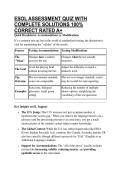
Quick Breakdown: Accommodations vs. Modifications
It’s a common mix-up, but in the world of standardized testing, the distinction is
vital for maintaining the "validity" of the results.
Feature Testing Accommodations Testing Modifications
The Changes how a student Changes what the test actually
"What" accesses the test. measures.
Level the playing field Adjust the difficulty to match a
The Goal
without lowering the bar. student's level.
The The test remains standard; The test is no longer standard; scores
Outcome scores are comparable. may be invalid for state reporting.
Extra time, bilingual Reducing the number of multiple-
Examples glossaries, small group choice options, simplifying the
setting. vocabulary of the test questions.
Key Insights on EL Support
The 13% Jump: That 13% increase isn't just a random number; it
represents the "access gap." When you remove the language barrier (via a
glossary) and the processing pressure (via extra time), you get a much
clearer picture of the student's actual subject-matter knowledge.
The Global Context: While the U.S. has robust frameworks like ESSA
(Every Student Succeeds Act), countries like Canada, Australia, and the UK
also have specific (though different) protocols for "EAL" (English as an
Additional Language) students.
Support for Accommodations: The "All of the above" usually includes
reasons like increasing validity, reducing anxiety, and providing
equitable access to the curriculum.
COMPLETE SOLUTIONS 100%
CORRECT RATED A+
Quick Breakdown: Accommodations vs. Modifications
It’s a common mix-up, but in the world of standardized testing, the distinction is
vital for maintaining the "validity" of the results.
Feature Testing Accommodations Testing Modifications
The Changes how a student Changes what the test actually
"What" accesses the test. measures.
Level the playing field Adjust the difficulty to match a
The Goal
without lowering the bar. student's level.
The The test remains standard; The test is no longer standard; scores
Outcome scores are comparable. may be invalid for state reporting.
Extra time, bilingual Reducing the number of multiple-
Examples glossaries, small group choice options, simplifying the
setting. vocabulary of the test questions.
Key Insights on EL Support
The 13% Jump: That 13% increase isn't just a random number; it
represents the "access gap." When you remove the language barrier (via a
glossary) and the processing pressure (via extra time), you get a much
clearer picture of the student's actual subject-matter knowledge.
The Global Context: While the U.S. has robust frameworks like ESSA
(Every Student Succeeds Act), countries like Canada, Australia, and the UK
also have specific (though different) protocols for "EAL" (English as an
Additional Language) students.
Support for Accommodations: The "All of the above" usually includes
reasons like increasing validity, reducing anxiety, and providing
equitable access to the curriculum.


