BYU Nurs 300 Exam 1 (Weeks 1-4) – Correct
Solutions For Every Question
Save
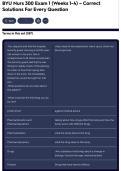
Terms in this set (287)
•You respond and find the hospital vitals, head to toe assessment, warm up pt, check her
security guard carrying a mid 20-year- blood glucose
old woman in his arms. She is
unresponsive to all stimuli except pain.
The security guard said that he was
doing his nightly check of the parking
lot when he found her laying face
down in the snow. He immediately
picked her up and brought her into
you.
•What questions do you have about
this patient?
•What would be the first thing you do
for her?
pt left AMA? against medical advice
Pharmacokinetics and talking about how drugs effect the body and how the
Pharmacodynamics body works with different drugs.
Pharmcokinetics what the body does to the drug
Pharmacodynamics what the drug does to the body
Drugs •Any substance that brings about a change in
biologic function through chemical actions
Poisons Drugs that have harmful effects
,Drugs or medications synthetic or chemical extraction
Biologics Hormones, antibodies, vaccines, blood products
Alternative therapies Herbals preparations, vitamins
t/f any drugs can be a poison? true
Prescription Require order by licensed health care provider
Over-the-Counter No order required
Therapeutic Identifies medication according to usefulness in
treating specific disease
Pharmacologic Describes how medication works in the body
Prototype Drug A well-understood drug model—other drugs
compared to and modeled after the prototype drug
for a class are very similar
Therapeutic Classification Anticoagulant
Examples within Cardiovascular Antihyperlipidemic
System? Antihypertensive
Antidysrhythmic
Antianginal
Anticoagulant Influences blood clotting
Antihyperlipidemic Lowers blood cholesterol
Antihypertensive Lowers blood pressure
Antidysrhythmic Restore/improves cardiac rhythm
Antianginal Treat angina
,generic med name •Assigned, less complicated
•ondansetron
Trade/Brand name •Assigned by marketing company
•Zofran or Atossa
schedule 1 drug - marijuana, LSD, Ecstasy, Heroin.
schedule 1 drug Classified by the Drug Enforcement Administration as
a drug that has high potential for abuse and no
currently accepted medical use.
Schedule 2 meds - cocaine, opium, high grade morphine, oxycodone,
adderall (methanphetamines)
Schedule 2 drugs High potential for abuse and have medical use with
severe restrictions - accepted in US
Schedule 3 meds low grade morphine, anabolic steroids, ketamine,
certain codeine mixtures
Schedule 3 drugs • Less abuse potential than schedule 1&2 drugs
• Accepted medical uses
• Moderate or low physical dependence
• High psychological dependence
schedule 4 drugs • Lower abuse potential than schedule 3 drugs
• Accepted medical uses
• Limited physical or psychological dependence
Teratogenic Drug Classification •Traditionally there were five categories of risk that a
drug poses to a fetus in the case of a pregnant
woman taking the drug
- •A, B, C, D, and X
•This classification system went out of use in 2014
•You may still see this classification
, •We now use the Pregnancy and •This system provides a summary of the literature
Lactation Labeling rule (PLLR) regarding safety in pregnancy and lactation for the
medication
•Bioavailability •Amount of drug (unchanged) reaching the systemic
circulation following administration by any route. Oral
is less than 100% (will depend on many factors), IV is
100%
•Half Life •The time required to reduce the amount of drug in
the body by one half during elimination
MEC? minimum effective concentration
therapeutic range that concentration of drug in the blood serum that
produces the desired effect without causing toxicity
toxic zone (MTC) area when drug is given incorrectly way too much
and passes above therapeutic range
low spot where medication lowers its trough
power after its first half life is met
(AUC) (AREA UNDER THE CURVE)
Peak vs Through highest concentration of med x lowest concentration
of med in an individual
medication half life The time it take for one half of the medicine to be
excreated from the body
Solutions For Every Question
Save
Terms in this set (287)
•You respond and find the hospital vitals, head to toe assessment, warm up pt, check her
security guard carrying a mid 20-year- blood glucose
old woman in his arms. She is
unresponsive to all stimuli except pain.
The security guard said that he was
doing his nightly check of the parking
lot when he found her laying face
down in the snow. He immediately
picked her up and brought her into
you.
•What questions do you have about
this patient?
•What would be the first thing you do
for her?
pt left AMA? against medical advice
Pharmacokinetics and talking about how drugs effect the body and how the
Pharmacodynamics body works with different drugs.
Pharmcokinetics what the body does to the drug
Pharmacodynamics what the drug does to the body
Drugs •Any substance that brings about a change in
biologic function through chemical actions
Poisons Drugs that have harmful effects
,Drugs or medications synthetic or chemical extraction
Biologics Hormones, antibodies, vaccines, blood products
Alternative therapies Herbals preparations, vitamins
t/f any drugs can be a poison? true
Prescription Require order by licensed health care provider
Over-the-Counter No order required
Therapeutic Identifies medication according to usefulness in
treating specific disease
Pharmacologic Describes how medication works in the body
Prototype Drug A well-understood drug model—other drugs
compared to and modeled after the prototype drug
for a class are very similar
Therapeutic Classification Anticoagulant
Examples within Cardiovascular Antihyperlipidemic
System? Antihypertensive
Antidysrhythmic
Antianginal
Anticoagulant Influences blood clotting
Antihyperlipidemic Lowers blood cholesterol
Antihypertensive Lowers blood pressure
Antidysrhythmic Restore/improves cardiac rhythm
Antianginal Treat angina
,generic med name •Assigned, less complicated
•ondansetron
Trade/Brand name •Assigned by marketing company
•Zofran or Atossa
schedule 1 drug - marijuana, LSD, Ecstasy, Heroin.
schedule 1 drug Classified by the Drug Enforcement Administration as
a drug that has high potential for abuse and no
currently accepted medical use.
Schedule 2 meds - cocaine, opium, high grade morphine, oxycodone,
adderall (methanphetamines)
Schedule 2 drugs High potential for abuse and have medical use with
severe restrictions - accepted in US
Schedule 3 meds low grade morphine, anabolic steroids, ketamine,
certain codeine mixtures
Schedule 3 drugs • Less abuse potential than schedule 1&2 drugs
• Accepted medical uses
• Moderate or low physical dependence
• High psychological dependence
schedule 4 drugs • Lower abuse potential than schedule 3 drugs
• Accepted medical uses
• Limited physical or psychological dependence
Teratogenic Drug Classification •Traditionally there were five categories of risk that a
drug poses to a fetus in the case of a pregnant
woman taking the drug
- •A, B, C, D, and X
•This classification system went out of use in 2014
•You may still see this classification
, •We now use the Pregnancy and •This system provides a summary of the literature
Lactation Labeling rule (PLLR) regarding safety in pregnancy and lactation for the
medication
•Bioavailability •Amount of drug (unchanged) reaching the systemic
circulation following administration by any route. Oral
is less than 100% (will depend on many factors), IV is
100%
•Half Life •The time required to reduce the amount of drug in
the body by one half during elimination
MEC? minimum effective concentration
therapeutic range that concentration of drug in the blood serum that
produces the desired effect without causing toxicity
toxic zone (MTC) area when drug is given incorrectly way too much
and passes above therapeutic range
low spot where medication lowers its trough
power after its first half life is met
(AUC) (AREA UNDER THE CURVE)
Peak vs Through highest concentration of med x lowest concentration
of med in an individual
medication half life The time it take for one half of the medicine to be
excreated from the body