NRS316 Final Exam Review – Questions With
Trusted Solutions
Save
Terms in this set (110)
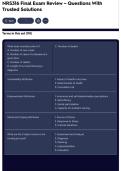
What does mortality refer to? C. Number of deaths
A. Number of new cases
B. Number of cases of a disease at a
given time
C. Number of deaths
D. Length of survival following a
diagnosis
Vulnerability Attributes 1. Impact of health outcomes
2. Determinants of health
3. Cumulative risk
Empowerment Attributes 1. Autonomy and self-determination perceptions
2. Self-efficacy
3. Social participation
4. Capacity for problem solving
Stress and Coping Attributes 1. Source of Stress
2. Response to Stress
3. Cultural Variations
What are the 5 steps involve in the 1. Assessment and Analysis
nursing process? 2. Diagnosis
3. Planning
4. Implementation
5. Evaluation
,A nurse is looking to increase access B. System level focused
to feminine hygiene products in state
prisons by advocating for a state
policy that would provide free
hygiene products in prisons.
According to the Minnesota
Intervention Wheel, what level of
intervention would this be
considered?
A. Community level focused
B. System level focused
C. Individual or family-focused
D. Case finding
Myth vs Fact: Myth:
You shouldn't ask people if they're 1. asking does not give them the idea
thinking about suicide because you 2. it gives them an opportunity to share
might put the idea in their head. 3. it can give them hope that you care enough to ask
4. asking can help diffuse some tension causing these
thought
True or False: False
Community organizing and coalition-
building can occur on an individual
level
Health Disparities Preventable differences in the burden of disease,
injury, violence, or opportunities to achieve optimal
health that are experienced by socially
disadvantaged populations
Health Inequities Differences in health status or in the distribution of
health resources between populations
Social Determinants of Health The conditions in which people are born, grow, live,
work, and age, that effect a wide range of health,
functioning, and quality of life outcomes
,Myth vs Fact: Myth:
People who are suicidal definitely 1. The vast majority of suicidal people do not actually
want to die. want to die
2. They are in pain and want to stop the pain
3. They typically have a lot of ambivalence
What color tag would be used for this Tag Red
patient?
You see a patient who is a 50 year old
welder with partial amputation of RLE
at the ankle. No radial pulses are
noted. RR 28/min.
Which of the following is the best B. Differences in health outcomes across different
example of a health disparity? zipcodes.
A. Differences in genetic makeup
across different groups.
B. Differences in health outcomes
across different zipcodes.
C. Variations in health status solely
attributed to genetic factors.
D. Health improvements achieved
through advancements in medical
technology.
Incidence Number of new cases
Myth vs Fact: Myth:
Once a person decides to die by Suicide can be prevented
suicide, there is nothing we can do to
stop them.
Prevenlence Number of cases at a given time
, What color tag would be used for this Tag Green
patient?
A 36 year old pipe fitter with a
fracture of the humerus. States they
are in pain, but no other obvious
distress or injuries noted. Rates pain of
8/10 when prompted and able to walk.
These are all effects of what Cortisol
hormones?
1. Increased protein synthesis
2. Increased blood glucose
3. Increased blood pressure
4. Increased cardiac output
5. Anti-inflammatory response
6. Immunosuppression
A patient admitted with depression B. Initiating one-on-one monitoring
and suicidal ideation has been
assessed to have a moderate risk of
suicide. What is the priority nursing
intervention?
A. Administering PRN sedative meds
B. Initiating one-on-one monitoring
for the patient
C. Teaching the patient relaxation
techniques
D. Organizing group therapy sessions
for the patient
Survival rate Length of survival following diagnosis
Trusted Solutions
Save
Terms in this set (110)
What does mortality refer to? C. Number of deaths
A. Number of new cases
B. Number of cases of a disease at a
given time
C. Number of deaths
D. Length of survival following a
diagnosis
Vulnerability Attributes 1. Impact of health outcomes
2. Determinants of health
3. Cumulative risk
Empowerment Attributes 1. Autonomy and self-determination perceptions
2. Self-efficacy
3. Social participation
4. Capacity for problem solving
Stress and Coping Attributes 1. Source of Stress
2. Response to Stress
3. Cultural Variations
What are the 5 steps involve in the 1. Assessment and Analysis
nursing process? 2. Diagnosis
3. Planning
4. Implementation
5. Evaluation
,A nurse is looking to increase access B. System level focused
to feminine hygiene products in state
prisons by advocating for a state
policy that would provide free
hygiene products in prisons.
According to the Minnesota
Intervention Wheel, what level of
intervention would this be
considered?
A. Community level focused
B. System level focused
C. Individual or family-focused
D. Case finding
Myth vs Fact: Myth:
You shouldn't ask people if they're 1. asking does not give them the idea
thinking about suicide because you 2. it gives them an opportunity to share
might put the idea in their head. 3. it can give them hope that you care enough to ask
4. asking can help diffuse some tension causing these
thought
True or False: False
Community organizing and coalition-
building can occur on an individual
level
Health Disparities Preventable differences in the burden of disease,
injury, violence, or opportunities to achieve optimal
health that are experienced by socially
disadvantaged populations
Health Inequities Differences in health status or in the distribution of
health resources between populations
Social Determinants of Health The conditions in which people are born, grow, live,
work, and age, that effect a wide range of health,
functioning, and quality of life outcomes
,Myth vs Fact: Myth:
People who are suicidal definitely 1. The vast majority of suicidal people do not actually
want to die. want to die
2. They are in pain and want to stop the pain
3. They typically have a lot of ambivalence
What color tag would be used for this Tag Red
patient?
You see a patient who is a 50 year old
welder with partial amputation of RLE
at the ankle. No radial pulses are
noted. RR 28/min.
Which of the following is the best B. Differences in health outcomes across different
example of a health disparity? zipcodes.
A. Differences in genetic makeup
across different groups.
B. Differences in health outcomes
across different zipcodes.
C. Variations in health status solely
attributed to genetic factors.
D. Health improvements achieved
through advancements in medical
technology.
Incidence Number of new cases
Myth vs Fact: Myth:
Once a person decides to die by Suicide can be prevented
suicide, there is nothing we can do to
stop them.
Prevenlence Number of cases at a given time
, What color tag would be used for this Tag Green
patient?
A 36 year old pipe fitter with a
fracture of the humerus. States they
are in pain, but no other obvious
distress or injuries noted. Rates pain of
8/10 when prompted and able to walk.
These are all effects of what Cortisol
hormones?
1. Increased protein synthesis
2. Increased blood glucose
3. Increased blood pressure
4. Increased cardiac output
5. Anti-inflammatory response
6. Immunosuppression
A patient admitted with depression B. Initiating one-on-one monitoring
and suicidal ideation has been
assessed to have a moderate risk of
suicide. What is the priority nursing
intervention?
A. Administering PRN sedative meds
B. Initiating one-on-one monitoring
for the patient
C. Teaching the patient relaxation
techniques
D. Organizing group therapy sessions
for the patient
Survival rate Length of survival following diagnosis