

NURS 104 Exam 2 – Questions With Indepth
Solutions
Save
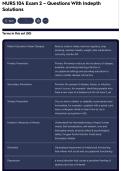
Terms in this set (50)
Patient Education (Heart Disease) Reduce sodium intake, exercise regularly, stop
smoking, maintain healthy weight, take medications
correctly, monitor BP
Primary Prevention Primary Prevention reduces the incidence of disease,
example- promoting hearing prtection in
occupational settings and provding education to
reduce cardiac disease risk factors
Secondary Prevention Prevents the spread of disease, illness, or infection
once it occurs, for example- identifying people who
have a new case of a disease but do not have it yet
Tertiary Prevention Occurs when a defect or disability is permanent and
irreversible, for example- a patient with a spinal cord
injury undergoes rehab to learn how to use a
wheelchair and perform ADL
Maslow's Hierarchy of Needs Understand the interrelationships of basic human
needs, Self-autualization, self-esteem, love and
belonging needs, physical safety & psychological
safety, Oxygen fluids Nutrition Nody temp
Elimination Shelter
Dementia Generalized impairment of intellectual functioning
that inferes with social and occupational functioning
Depression a mood disorder that causes a persistent feeling of
sadness and loss of interest
, Delirium An acute confusional state, is an acute change in
attention and awareness that develops over a short
time
Maintaining safety in older adults
Priorities of care for older adults - maintaining independence, managing multiple
what are they going through in their chronic conditions, and improving quality of life,
life? often centered around housing, family, and mental
health
Age-related changes in the older Reduced kidney function, lung capacity, bone
adult density, muscle mass, vision, hearing.
Care plan considerations related to Managing chronic conditions and medications,
aging adults ensuring home safety (fall prevention), addressing
Activities of Daily Living (ADLs), social engagement,
and legal/financial planning
Ways to help older patients maintain empowering them to make personal choices,
independence when moving into a encouraging active participation in daily care, and
nursing home customizing their environment to promote mobility
Teaching strategies for older adults focus on accommodating age-related sensory,
cognitive, and physical changes
Urinary tract infections (UTIs) - what sudden confusion, delirium, increased agitation, or
effects do they have on older adults? rapid functional decline like falls
What manifestations might we see?
Subjective data consists of information directly reported by the
patient, including their feelings, perceptions,
symptoms, and experiences, such as pain levels or
dizziness
Objective data observable, measurable, and verifiable information
collected during a patient assessment, such as vital
signs, lab results, and physical examination findings
Solutions
Save
Terms in this set (50)
Patient Education (Heart Disease) Reduce sodium intake, exercise regularly, stop
smoking, maintain healthy weight, take medications
correctly, monitor BP
Primary Prevention Primary Prevention reduces the incidence of disease,
example- promoting hearing prtection in
occupational settings and provding education to
reduce cardiac disease risk factors
Secondary Prevention Prevents the spread of disease, illness, or infection
once it occurs, for example- identifying people who
have a new case of a disease but do not have it yet
Tertiary Prevention Occurs when a defect or disability is permanent and
irreversible, for example- a patient with a spinal cord
injury undergoes rehab to learn how to use a
wheelchair and perform ADL
Maslow's Hierarchy of Needs Understand the interrelationships of basic human
needs, Self-autualization, self-esteem, love and
belonging needs, physical safety & psychological
safety, Oxygen fluids Nutrition Nody temp
Elimination Shelter
Dementia Generalized impairment of intellectual functioning
that inferes with social and occupational functioning
Depression a mood disorder that causes a persistent feeling of
sadness and loss of interest
, Delirium An acute confusional state, is an acute change in
attention and awareness that develops over a short
time
Maintaining safety in older adults
Priorities of care for older adults - maintaining independence, managing multiple
what are they going through in their chronic conditions, and improving quality of life,
life? often centered around housing, family, and mental
health
Age-related changes in the older Reduced kidney function, lung capacity, bone
adult density, muscle mass, vision, hearing.
Care plan considerations related to Managing chronic conditions and medications,
aging adults ensuring home safety (fall prevention), addressing
Activities of Daily Living (ADLs), social engagement,
and legal/financial planning
Ways to help older patients maintain empowering them to make personal choices,
independence when moving into a encouraging active participation in daily care, and
nursing home customizing their environment to promote mobility
Teaching strategies for older adults focus on accommodating age-related sensory,
cognitive, and physical changes
Urinary tract infections (UTIs) - what sudden confusion, delirium, increased agitation, or
effects do they have on older adults? rapid functional decline like falls
What manifestations might we see?
Subjective data consists of information directly reported by the
patient, including their feelings, perceptions,
symptoms, and experiences, such as pain levels or
dizziness
Objective data observable, measurable, and verifiable information
collected during a patient assessment, such as vital
signs, lab results, and physical examination findings


