

Solutions for Math 100 2007 Midterm
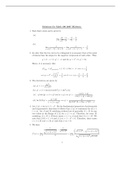
1. Each limit exists and is given by
(a)
1
x3 4 3 3
lim p = = :
x!1 x 8 7 7
(b)
x x 1
lim = lim = :
x!0 jx 1j jx + 1j x!0 1 x x 1 2
2. In order that the two curves be orthogonal it is necessary that at the point
of intersection the slopes be the negative reciprocals of each other. Thus
y=k x =) y 0 = 1 and for y = x2 =) y 0 = 2x:
Hence, it is necessary that
1
y 0 jline y 0 jparab ola = ( 1) (2x) = 1 () x =
2
2
1 1 1 1 3
=) y = x2 = = =) k = x + y = + = :
2 4 2 4 4
3. The derivatives are given by
2e2x
(a) y 0 = 1 + ;
1 + e2x
(b) y 0 = (1 + sin (2x)) sech2 x + sin2 (x) ;
cos (x + y)
(c) y 0 sin (y) = (1 + y 0 ) cos (x + y) =) y 0 = ;
cos (x + y) + sin (y)
y + xy 0 y
(d) ln (2) 2y y 0 = 0
2 =) y = ln (2) 2y (2 + 2xy + x2 y 2 ) :
1 + (1 + xy) x
4. Let f (x) = sin (x) + 1 x2 . By the fundamental properties of polynomials
and trigonometric functions it follows that f (x) is continuous for all x 2
[ ; ]. Let A and B, satisfying without loss of generality A < B, be any
two values in the Range of f (x) for x 2 [ ; ]. Therefore, for every M
satisfying A M B there exists c 2 [ ; ] such that f (c) = M . We
2
note that f (0) = 1 > 0 and f ( ) = 1 < 0. Therefore, there exists
c 2 [ ; 0] and c 2 [0; ] such that f (c) = 0.
5. We have
1 1 q
q p p 2
1 + (x + h)
2 1 + x2 1 + x2 1 + (x + h)
f 0 (x) = lim = lim q
h!0 h h!0 2p
h 1 + (x + h) 1 + x2
1
1. Each limit exists and is given by
(a)
1
x3 4 3 3
lim p = = :
x!1 x 8 7 7
(b)
x x 1
lim = lim = :
x!0 jx 1j jx + 1j x!0 1 x x 1 2
2. In order that the two curves be orthogonal it is necessary that at the point
of intersection the slopes be the negative reciprocals of each other. Thus
y=k x =) y 0 = 1 and for y = x2 =) y 0 = 2x:
Hence, it is necessary that
1
y 0 jline y 0 jparab ola = ( 1) (2x) = 1 () x =
2
2
1 1 1 1 3
=) y = x2 = = =) k = x + y = + = :
2 4 2 4 4
3. The derivatives are given by
2e2x
(a) y 0 = 1 + ;
1 + e2x
(b) y 0 = (1 + sin (2x)) sech2 x + sin2 (x) ;
cos (x + y)
(c) y 0 sin (y) = (1 + y 0 ) cos (x + y) =) y 0 = ;
cos (x + y) + sin (y)
y + xy 0 y
(d) ln (2) 2y y 0 = 0
2 =) y = ln (2) 2y (2 + 2xy + x2 y 2 ) :
1 + (1 + xy) x
4. Let f (x) = sin (x) + 1 x2 . By the fundamental properties of polynomials
and trigonometric functions it follows that f (x) is continuous for all x 2
[ ; ]. Let A and B, satisfying without loss of generality A < B, be any
two values in the Range of f (x) for x 2 [ ; ]. Therefore, for every M
satisfying A M B there exists c 2 [ ; ] such that f (c) = M . We
2
note that f (0) = 1 > 0 and f ( ) = 1 < 0. Therefore, there exists
c 2 [ ; 0] and c 2 [0; ] such that f (c) = 0.
5. We have
1 1 q
q p p 2
1 + (x + h)
2 1 + x2 1 + x2 1 + (x + h)
f 0 (x) = lim = lim q
h!0 h h!0 2p
h 1 + (x + h) 1 + x2
1


