Introduction and organizational issues, valuation recap
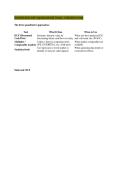
The three quantitative approaches:
Tool What It Does When to Use
DCF (Discounted Estimates intrinsic value by When you have projected CFs
Cash Flow) discounting future cash flows to today and a discount rate (WACC)
Multiples / Values a firm by comparing ratios When market comparables are
Comparable Analysis (P/E, EV/EBITDA, etc.) with peers available
Use regression or event studies to When analyzing data trends or
Statistical tools
identify or forecast value impacts event-driven effects
Main tool: DCF
,The Discounted Cash Flow formula expresses the Net Present Value (NPV):
Each dollar earned int the future is worth less today because of time value of money.
Example
Project requires $100 000 now and gives expected CFs of 40 000 per year for 3 years.
Discount rate = 10%
On
FC
PRESS ON:
CF = insert initial investment (negative)
Flesh going down
CO1: CF
FO1: HOW MANY TIME THE CF OF SAME AMOUNT PASS
Or
CO2: CF (if different cf)
Press NPV
I = rate
Flesh going down
Cpt NPV
1. Cash Flows (CFs)
Use Unlevered Free Cash Flow (UCF) – cash available to all capital providers:
UCF = EBIT(1−T) + Depreciation – CapEx − ΔNWC
Explanation Example
Component
EBIT(1–T) Operating profit after tax EBIT = 50 000, T = 30% → 35 000
Depreciation Non-cash charge added back + 5 000
, Explanation Example
Component
CapEx Capital expenditures (equipment) – 10 000
ΔNWC Change in net working capital. – 2 000
UCF = 28 000
So, CF₁ = 28 000.
In DCF, you almost always use the unlevered free cash flow (UCF)
2. Cost of Capital (WACC) rwacc
Defining r (Cost of Equity & Debt)
(a) Cost of Equity via CAPM
Term Meaning Example
(r_f) Risk-free rate (e.g., 5-yr Gov’t bond) 3%
(r_M - r_f) Market risk premium 6%
β Firm’s sensitivity to market 1.2
→ (r_S = 3% + 1.2×6% = 10.2%)
Market beta = cov(ri,rm)/var(rm)
(b) Cost of Debt
Example:
AAA bond ≈ 4%, BBB ≈ 6%. If tax = 30%, after-tax cost = 6 × (1 – 0.3) = 4.2%.
Estimating Beta
We estimate beta by regressing stock returns on market returns:
, • β = covariance (stock, market) / variance(market).
• Use peer group beta if company not traded.
• Remember: β increases with financial leverage and business risk.
Example
Suppose:
• Firm A returns: [1%, 3%, –2%, 4%]
• Market: [0.5%, 2%, –1%, 3%]
→ Regression gives β ≈ 1.1.
If leverage doubles, β might rise to 1.5.
Operational Cash Flows (OCF)
UCF = OCF – CapEx - ΔNWC
These are the cash flows from running the business (before investments):
🔹 Bottom-Up Approach:
OCF = Net Income + Depreciation
Use this when you already know net income (after tax).
You add back depreciation because it’s a non-cash expense.
Ex:
Net income = $80,000
Depreciation = $10,000
OCF = 80,000 + 10,000 = 90,000
🔹 Top-Down Approach:
OCF = Sales – Cash Costs – Taxes
Use this when you forecast sales and expenses directly
Example:
• Sales = $500 000
• Cash operating costs = $350 000
The three quantitative approaches:
Tool What It Does When to Use
DCF (Discounted Estimates intrinsic value by When you have projected CFs
Cash Flow) discounting future cash flows to today and a discount rate (WACC)
Multiples / Values a firm by comparing ratios When market comparables are
Comparable Analysis (P/E, EV/EBITDA, etc.) with peers available
Use regression or event studies to When analyzing data trends or
Statistical tools
identify or forecast value impacts event-driven effects
Main tool: DCF
,The Discounted Cash Flow formula expresses the Net Present Value (NPV):
Each dollar earned int the future is worth less today because of time value of money.
Example
Project requires $100 000 now and gives expected CFs of 40 000 per year for 3 years.
Discount rate = 10%
On
FC
PRESS ON:
CF = insert initial investment (negative)
Flesh going down
CO1: CF
FO1: HOW MANY TIME THE CF OF SAME AMOUNT PASS
Or
CO2: CF (if different cf)
Press NPV
I = rate
Flesh going down
Cpt NPV
1. Cash Flows (CFs)
Use Unlevered Free Cash Flow (UCF) – cash available to all capital providers:
UCF = EBIT(1−T) + Depreciation – CapEx − ΔNWC
Explanation Example
Component
EBIT(1–T) Operating profit after tax EBIT = 50 000, T = 30% → 35 000
Depreciation Non-cash charge added back + 5 000
, Explanation Example
Component
CapEx Capital expenditures (equipment) – 10 000
ΔNWC Change in net working capital. – 2 000
UCF = 28 000
So, CF₁ = 28 000.
In DCF, you almost always use the unlevered free cash flow (UCF)
2. Cost of Capital (WACC) rwacc
Defining r (Cost of Equity & Debt)
(a) Cost of Equity via CAPM
Term Meaning Example
(r_f) Risk-free rate (e.g., 5-yr Gov’t bond) 3%
(r_M - r_f) Market risk premium 6%
β Firm’s sensitivity to market 1.2
→ (r_S = 3% + 1.2×6% = 10.2%)
Market beta = cov(ri,rm)/var(rm)
(b) Cost of Debt
Example:
AAA bond ≈ 4%, BBB ≈ 6%. If tax = 30%, after-tax cost = 6 × (1 – 0.3) = 4.2%.
Estimating Beta
We estimate beta by regressing stock returns on market returns:
, • β = covariance (stock, market) / variance(market).
• Use peer group beta if company not traded.
• Remember: β increases with financial leverage and business risk.
Example
Suppose:
• Firm A returns: [1%, 3%, –2%, 4%]
• Market: [0.5%, 2%, –1%, 3%]
→ Regression gives β ≈ 1.1.
If leverage doubles, β might rise to 1.5.
Operational Cash Flows (OCF)
UCF = OCF – CapEx - ΔNWC
These are the cash flows from running the business (before investments):
🔹 Bottom-Up Approach:
OCF = Net Income + Depreciation
Use this when you already know net income (after tax).
You add back depreciation because it’s a non-cash expense.
Ex:
Net income = $80,000
Depreciation = $10,000
OCF = 80,000 + 10,000 = 90,000
🔹 Top-Down Approach:
OCF = Sales – Cash Costs – Taxes
Use this when you forecast sales and expenses directly
Example:
• Sales = $500 000
• Cash operating costs = $350 000