View all 20 notes for Microeconomics, written by Michael Parkin, Robin Bade. All Microeconomics notes, flashcards, summaries and study guides are written by your fellow students or tutors. Get yourself a Microeconomics summary or other study material that matches your study style perfectly, and studying will be a breeze.
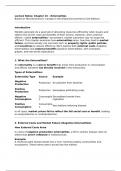
These lecture notes from Chapter 15 of Microeconomics: Canada in the Global Environment (11th Edition) explore how externalities—costs or benefits affecting third parties—lead to market failure. Negative externalities like pollution result in overproduction, while positive externalities like vaccinations cause underproduction. Graphs illustrate the gaps between private and social costs or benefits, highlighting resulting deadweight losses. The notes explain corrective tools such as Pigovian ...
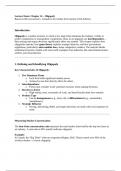
These lecture notes from Chapter 14 of *Microeconomics: Canada in the Global Environment (11th Edition)* explore oligopoly, a market structure characterized by few dominant firms and strategic interdependence. The notes explain how game theory, including payoff matrices and the prisoner’s dilemma, helps predict firm behavior regarding price, output, advertising, and R&D. The kinked demand curve model illustrates price rigidity in oligopolies. Real-world examples from airlines, telecoms, and su...
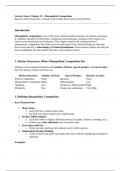
These lecture notes from Chapter 13 of *Microeconomics: Canada in the Global Environment (11th Edition)* explore monopolistic competition, a common market structure characterized by many firms offering differentiated products. The notes explain how firms set prices and output in the short run—earning profits or losses—and how long-run entry erodes economic profit. Graphs illustrate equilibrium conditions and inefficiencies such as excess capacity. The chapter also explains why firms spend he...
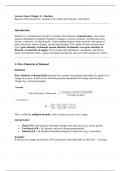
These lecture notes from Chapter 4 of *Microeconomics: Canada in the Global Environment (11th Edition)* explore elasticity, a key concept in understanding how quantity demanded or supplied responds to changes in price, income, or related goods' prices. The notes define, calculate, and interpret price elasticity of demand, income elasticity, cross-price elasticity, and price elasticity of supply, using real-world examples for clarity. Factors influencing elasticity—such as time, necessity, a...
These lecture notes from Chapter 7 of *Microeconomics: Canada in the Global Environment (11th Edition)* explore the mechanics and impacts of international trade. The notes explain how trade allows countries to specialize based on comparative advantage, increasing overall efficiency and consumer choice. They analyze the gains from trade and identify both winners and losers in domestic markets. Key trade barriers such as tariffs, quotas, and non-tariff regulations are examined for their economic e...
These lecture notes from Chapter 3 of *Microeconomics: Canada in the Global Environment (11th Edition)* explore how prices and quantities are determined in competitive markets using the demand and supply model. Key concepts include opportunity cost, the law of demand and supply, and the factors that shift each curve. The notes explain how market equilibrium is achieved and how surpluses and shortages influence price changes. Detailed graph descriptions help students visualize market dynamics. Re...
These lecture notes explore Chapter 2 of *Microeconomics: Canada in the Global Environment (11th Edition)*, focusing on the economic problem of scarcity and choice. Key concepts include the Production Possibilities Frontier (PPF), opportunity cost, and allocative efficiency, with graphs described to help students visualize trade-offs. The notes explain how specialization and trade allow economies to consume beyond their limits and how current production choices affect future growth and employmen...
These lecture notes provide a comprehensive introduction to economics, based on *Microeconomics: Canada in the Global Environment* (11th Edition). They explore the definition of economics and distinguish between microeconomics and macroeconomics, while addressing the two big economic questions: what to produce and how self-interest aligns with social interest. Key concepts such as opportunity cost, marginal analysis, and incentives are explained with real-world examples. The notes also highlight...
These lecture notes from Chapter 6 of Microeconomics: Canada in the Global Environment (11th Edition) explore the effects of government intervention in markets. Key policies analyzed include rent ceilings, minimum wage laws, taxes, production quotas, subsidies, and prohibitions on illegal goods. The notes explain how these interventions impact supply, demand, prices, and quantities, often creating unintended consequences like shortages, unemployment, or black markets. Graphs are described to hel...
mattcochrane
CA$5.99
More Info
Class notes
microeconomics principles econ 2613 partial notes
-
-
-
64
October 2024
2024/2025
these notes are from start of class until near the end of second month of the semester.