Page |1
PHM 350 Final Questions and Correct
Answers/ Latest Update / Already Graded
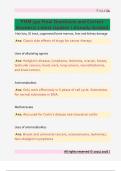
Hair loss, GI tract, suppressed bone marrow, liver and kidney damage
Ans: Classic side effects of drugs for cancer therapy
Uses of alkylating agents
Ans: Hodgkin's disease, lymphoma, leukemia, ovarian, breast,
testicular cancers, head, neck, lung cancers, neuroblastomas,
and brain tumors.
Antimetabolites
Ans: Only work effectively in S phase of cell cycle. Substitutes
for normal substrates in DNA.
Methotrexate
Ans: Also used for Crohn's disease and ulcerative colitis
Uses of antimetabolites
Ans: Breast and colorectal cancers, osteosarcoma, leukemias,
Non-Hodgkin's lymphoma
All rights reserved © 2025/ 2026 |
, Page |2
Mitotic inhibitors
Ans: Target microtubules so they cannot separate DNA during
replication. Can cause neuropathy. Vinblastine, vincristine, and
paclitaxel.
Steroid hormone agonist
Ans: Slows replication
Steroid hormone antagonist
Ans: Enhances replication
-tinib
Ans: Tyrosine kinase inhibitor
Monoclonal antibody
Ans: Drug meant to carry alpha radioisotope directly to
cancerous cells. Do not cause hair loss nor simply target quickly
replicating cells.
All rights reserved © 2025/ 2026 |
, Page |3
-mab
Ans: Monoclonal antibody
Uticaria
Ans: Skin rash
Bacteriostatic
Ans: Inhibits bacterial growth
Sulfonamides and trimethoprim
Ans: Competitively block bacterial intermediary metabolism
Penicillins cephalosporins and vancomycin
Ans: Cell wall disruption, inhibition of cell wall synthesis
Erythromycin and clindamycin
Ans: Bacteriostatic inhibition of protein synthesis
Tetracyclines and aminoglycosides
All rights reserved © 2025/ 2026 |
PHM 350 Final Questions and Correct
Answers/ Latest Update / Already Graded
Hair loss, GI tract, suppressed bone marrow, liver and kidney damage
Ans: Classic side effects of drugs for cancer therapy
Uses of alkylating agents
Ans: Hodgkin's disease, lymphoma, leukemia, ovarian, breast,
testicular cancers, head, neck, lung cancers, neuroblastomas,
and brain tumors.
Antimetabolites
Ans: Only work effectively in S phase of cell cycle. Substitutes
for normal substrates in DNA.
Methotrexate
Ans: Also used for Crohn's disease and ulcerative colitis
Uses of antimetabolites
Ans: Breast and colorectal cancers, osteosarcoma, leukemias,
Non-Hodgkin's lymphoma
All rights reserved © 2025/ 2026 |
, Page |2
Mitotic inhibitors
Ans: Target microtubules so they cannot separate DNA during
replication. Can cause neuropathy. Vinblastine, vincristine, and
paclitaxel.
Steroid hormone agonist
Ans: Slows replication
Steroid hormone antagonist
Ans: Enhances replication
-tinib
Ans: Tyrosine kinase inhibitor
Monoclonal antibody
Ans: Drug meant to carry alpha radioisotope directly to
cancerous cells. Do not cause hair loss nor simply target quickly
replicating cells.
All rights reserved © 2025/ 2026 |
, Page |3
-mab
Ans: Monoclonal antibody
Uticaria
Ans: Skin rash
Bacteriostatic
Ans: Inhibits bacterial growth
Sulfonamides and trimethoprim
Ans: Competitively block bacterial intermediary metabolism
Penicillins cephalosporins and vancomycin
Ans: Cell wall disruption, inhibition of cell wall synthesis
Erythromycin and clindamycin
Ans: Bacteriostatic inhibition of protein synthesis
Tetracyclines and aminoglycosides
All rights reserved © 2025/ 2026 |