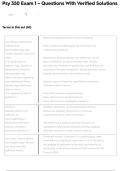
Psy 350 Exam 1 – Questions With Verified Solutions
Save
Terms in this set (60)
Behavioral definitions have serious problems:
According to behavioral
definitions of Many consensus pathologies do not involve any
psychopathology (aka characteristic behavior
"mental disorder"), this term
refers Depression, people behave very differently. Its not
to a certain kind of about a behavior its about a mental state. Anxiety
behavior (e.g., deviant or disorders don't behave in a particular way and don't all
maladaptive behavior). experience the same symptoms. Sexual disorders, some
What position was people cannot perform the behavior at all.
taken in lecture regarding
such definitions? What Specific types of behavior specified by behavioral
specific arguments were definitions don't hold up.
raised in favor
of or against this kind of Many don't involve unusual behavior
definition? Many don't involve deviant behavior
Many don't involve maladaptive behavior
What is a Disability definitions: psychopathology refers to
disability/dysfunction behavioral disability (dysfunction, functional
definition of impairment), not to a kind of behavior
psychopathology?
What is the difference The difference is behavioral theory focuses on
between this and a maladaptive and deviant behavior and the disability
behavioral definition? definition focuses on what a person cant do
Preferred version: "a person is in a pathological state
How does Ossorio define
when there is a significant restriction in his or her ability
psychopathology? Be sure
too engage in deliberate action and, equivalently, to
you know what the
participate in the social practices of the community" Dr.
definition means.
Ossorio 2006
,According to Ossorio's No, there is not enough information to determine this.
definition, if you knew that Jill could be starving herself for unknown reasons.
Jill was starving herself,
should
you conclude on this basis
that she has a
psychopathological
condition (mental
disorder)? Why or why not?
a) Normality: not abnormal, not pathological, simply
According to Ossorio, (a)
absent of pathology
what is "normality" and (b)
b) Positive mental health: person is not in a pathological
what is "positive mental
state, but beyond this, is very capable of participating in
health?"
life in meaningful and fulfilling ways
A persistent and unreasonable fear of a particular
object, activity, or situation
Must be debilitating or disabling
Physical and emotional reaction to something i.e.
What is a phobia? What are
spiders and small spaces
some typical kinds of
phobia?
Typical kinds of phobia would be:
Agorapobia- afraid to leave home base
Specific phobia- animals or inanimate objects
Social phobia- performance anxiety
Behavioral theory is because of classical conditioning.
What is the behavioral Some neutral stimulus gets paired with another stimulus
explanation of phobias? that naturally elicits an intense fear response and
What causes them in the thereby acquires the ability to elicit that fear response
first place
and what causes them to Example: someone has a phobia of snow—once loved
persist for a long time? snow but was almost buried alive in the show at age 11
and has caused her to now become afraid of the snow
, Does the behavioral It explains what triggered Hildas snow phobia but it
explanation explain doesn't explain why it is as debilitating as it is for her and
everything about Hilda's why it has continued for this long
snow phobia? What
does it explain? What, if
anything, doesn't it explain?
What explanation was Patient represses something, later in life stressors occur,
offered in class for the patient cant maintain repression, repressed contents
delayed onset of many emerge with symptoms
phobias?
A psychological syndrome that is triggered by a specific
traumatic event or ongoing traumatic situation
(terrifying or life-threatening events occur. Car
accidents, floods, combat, physically or sexually
assaulted, robbery/burglary, infidelity)
Characterized by symptoms of
Chronic anxious arousal and hypervigilance
Re-experiencing the traumatic event(s)
What is post-traumatic In dreams, intrusive memories or images, flashbacks
stress disorder (PTSD)?
What are its symptoms? Avoidance
The person avoids the traumatic situation both in
actuality as well as thoughts
Reduced responsiveness ("emotional numbing")
Emotionally numb from all the joy and sorrows in life.
Emotionally detached. Anxiety is pretty much the only
emotion
Survivor guilt (sometimes)
Flood, concentration camp; feeling guilty because you
feel that you've done something wrong or failed to do
something; you survived and someone else did not
Save
Terms in this set (60)
Behavioral definitions have serious problems:
According to behavioral
definitions of Many consensus pathologies do not involve any
psychopathology (aka characteristic behavior
"mental disorder"), this term
refers Depression, people behave very differently. Its not
to a certain kind of about a behavior its about a mental state. Anxiety
behavior (e.g., deviant or disorders don't behave in a particular way and don't all
maladaptive behavior). experience the same symptoms. Sexual disorders, some
What position was people cannot perform the behavior at all.
taken in lecture regarding
such definitions? What Specific types of behavior specified by behavioral
specific arguments were definitions don't hold up.
raised in favor
of or against this kind of Many don't involve unusual behavior
definition? Many don't involve deviant behavior
Many don't involve maladaptive behavior
What is a Disability definitions: psychopathology refers to
disability/dysfunction behavioral disability (dysfunction, functional
definition of impairment), not to a kind of behavior
psychopathology?
What is the difference The difference is behavioral theory focuses on
between this and a maladaptive and deviant behavior and the disability
behavioral definition? definition focuses on what a person cant do
Preferred version: "a person is in a pathological state
How does Ossorio define
when there is a significant restriction in his or her ability
psychopathology? Be sure
too engage in deliberate action and, equivalently, to
you know what the
participate in the social practices of the community" Dr.
definition means.
Ossorio 2006
,According to Ossorio's No, there is not enough information to determine this.
definition, if you knew that Jill could be starving herself for unknown reasons.
Jill was starving herself,
should
you conclude on this basis
that she has a
psychopathological
condition (mental
disorder)? Why or why not?
a) Normality: not abnormal, not pathological, simply
According to Ossorio, (a)
absent of pathology
what is "normality" and (b)
b) Positive mental health: person is not in a pathological
what is "positive mental
state, but beyond this, is very capable of participating in
health?"
life in meaningful and fulfilling ways
A persistent and unreasonable fear of a particular
object, activity, or situation
Must be debilitating or disabling
Physical and emotional reaction to something i.e.
What is a phobia? What are
spiders and small spaces
some typical kinds of
phobia?
Typical kinds of phobia would be:
Agorapobia- afraid to leave home base
Specific phobia- animals or inanimate objects
Social phobia- performance anxiety
Behavioral theory is because of classical conditioning.
What is the behavioral Some neutral stimulus gets paired with another stimulus
explanation of phobias? that naturally elicits an intense fear response and
What causes them in the thereby acquires the ability to elicit that fear response
first place
and what causes them to Example: someone has a phobia of snow—once loved
persist for a long time? snow but was almost buried alive in the show at age 11
and has caused her to now become afraid of the snow
, Does the behavioral It explains what triggered Hildas snow phobia but it
explanation explain doesn't explain why it is as debilitating as it is for her and
everything about Hilda's why it has continued for this long
snow phobia? What
does it explain? What, if
anything, doesn't it explain?
What explanation was Patient represses something, later in life stressors occur,
offered in class for the patient cant maintain repression, repressed contents
delayed onset of many emerge with symptoms
phobias?
A psychological syndrome that is triggered by a specific
traumatic event or ongoing traumatic situation
(terrifying or life-threatening events occur. Car
accidents, floods, combat, physically or sexually
assaulted, robbery/burglary, infidelity)
Characterized by symptoms of
Chronic anxious arousal and hypervigilance
Re-experiencing the traumatic event(s)
What is post-traumatic In dreams, intrusive memories or images, flashbacks
stress disorder (PTSD)?
What are its symptoms? Avoidance
The person avoids the traumatic situation both in
actuality as well as thoughts
Reduced responsiveness ("emotional numbing")
Emotionally numb from all the joy and sorrows in life.
Emotionally detached. Anxiety is pretty much the only
emotion
Survivor guilt (sometimes)
Flood, concentration camp; feeling guilty because you
feel that you've done something wrong or failed to do
something; you survived and someone else did not