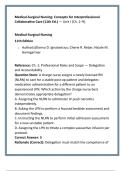
Medical-Surgical Nursing: Concepts for Interprofessional
Collaborative Care (11th Ed.),
Unit II: Emergency Care & Disaster Preparedness.
Medical-Surgical Nursing
11th Edition
• Author(s)Donna D. Ignatavicius; Cherie R. Rebar; Nicole M.
Heimgartner
Reference: Ch. 10: Concepts of Emergency and Trauma Nursing
— Triage and Prioritization
Question Stem: An ED triage nurse receives three incoming
patients: (1) a 68-year-old with chest pain and diaphoresis, (2) a
24-year-old with an isolated closed femur fracture after a fall,
and (3) a 40-year-old complaining of mild sore throat and low-
grade fever. Which patient should be triaged to receive
immediate evaluation first?
A. 68-year-old with chest pain and diaphoresis
B. 24-year-old with closed femur fracture
C. 40-year-old with sore throat and fever
D. All should be seen simultaneously
,Correct Answer: A
Rationales:
• Correct (A): Chest pain with diaphoresis suggests possible
acute coronary syndrome; immediate evaluation and
treatment (ECG, aspirin, oxygen as indicated) reduce
morbidity and mortality. Triage prioritizes
airway/breathing/circulation threats.
• B: Femur fracture is urgent for analgesia and stabilization
but not immediately life-threatening if airway and
breathing intact.
• C: Mild sore throat/low-grade fever is low acuity and can
wait.
• D: Resource triage requires prioritization; simultaneous
evaluation of all is impractical and unsafe.
Teaching Point: Prioritize potential life-threatening conditions
(ABC + major ischemia).
Citation: Ignatavicius, Rebar, & Heimgartner, 2024, Ch. 10:
Concepts of Emergency and Trauma Nursing
2
Reference: Ch. 10: Concepts of Emergency and Trauma Nursing
— Primary/Secondary Survey (ABCDE)
Question Stem: A trauma patient arrives after a motor vehicle
crash. During the primary survey the nurse notes weak
,peripheral pulses and cool, pale skin with tachycardia. What
action should the nurse perform next?
A. Complete a full head-to-toe secondary survey
B. Apply two large-bore IVs and begin isotonic fluid
resuscitation
C. Obtain a CT scan of the head and chest
D. Administer analgesic for pain control
Correct Answer: B
Rationales:
• Correct (B): Signs suggest hypovolemia/shock; during the
primary survey, immediate establishment of large-bore IV
access and isotonic crystalloid (or blood as indicated) to
restore perfusion takes priority.
• A: Secondary survey is done after stabilization of airway,
breathing, and circulation.
• C: Imaging is deferred until patient is hemodynamically
stable.
• D: Analgesia is important but circulatory stabilization is
higher priority in shock.
Teaching Point: In trauma, secure perfusion (C) before
diagnostic evaluation.
Citation: Ignatavicius et al., 2024, Ch. 10: Primary and
Secondary Surveys
, 3
Reference: Ch. 10: Concepts of Emergency and Trauma Nursing
— Burns and Fluid Management
Question Stem: A 35-year-old with partial- and full-thickness
burns of the anterior torso (18% TBSA) arrives. Which initial
nursing intervention most directly reduces risk of burn shock?
A. Apply topical silver sulfadiazine to burned areas
B. Start fluid resuscitation using Parkland formula calculation
and 2 large-bore IVs
C. Cover burns with dry sterile dressings only
D. Give oral ibuprofen for pain control
Correct Answer: B
Rationales:
• Correct (B): Burn injuries >15% TBSA risk hypovolemia;
Parkland formula guides early crystalloid resuscitation and
requires prompt IV access to prevent burn shock.
• A: Topical antimicrobial is appropriate but not first line to
prevent shock.
• C: Covering burns protects from contamination but doesn't
address systemic hypovolemia.
• D: Oral analgesia insufficient; IV analgesia/airway/fluids
prioritized.
Teaching Point: Large TBSA burns need immediate fluid
resuscitation to prevent burn shock.
Collaborative Care (11th Ed.),
Unit II: Emergency Care & Disaster Preparedness.
Medical-Surgical Nursing
11th Edition
• Author(s)Donna D. Ignatavicius; Cherie R. Rebar; Nicole M.
Heimgartner
Reference: Ch. 10: Concepts of Emergency and Trauma Nursing
— Triage and Prioritization
Question Stem: An ED triage nurse receives three incoming
patients: (1) a 68-year-old with chest pain and diaphoresis, (2) a
24-year-old with an isolated closed femur fracture after a fall,
and (3) a 40-year-old complaining of mild sore throat and low-
grade fever. Which patient should be triaged to receive
immediate evaluation first?
A. 68-year-old with chest pain and diaphoresis
B. 24-year-old with closed femur fracture
C. 40-year-old with sore throat and fever
D. All should be seen simultaneously
,Correct Answer: A
Rationales:
• Correct (A): Chest pain with diaphoresis suggests possible
acute coronary syndrome; immediate evaluation and
treatment (ECG, aspirin, oxygen as indicated) reduce
morbidity and mortality. Triage prioritizes
airway/breathing/circulation threats.
• B: Femur fracture is urgent for analgesia and stabilization
but not immediately life-threatening if airway and
breathing intact.
• C: Mild sore throat/low-grade fever is low acuity and can
wait.
• D: Resource triage requires prioritization; simultaneous
evaluation of all is impractical and unsafe.
Teaching Point: Prioritize potential life-threatening conditions
(ABC + major ischemia).
Citation: Ignatavicius, Rebar, & Heimgartner, 2024, Ch. 10:
Concepts of Emergency and Trauma Nursing
2
Reference: Ch. 10: Concepts of Emergency and Trauma Nursing
— Primary/Secondary Survey (ABCDE)
Question Stem: A trauma patient arrives after a motor vehicle
crash. During the primary survey the nurse notes weak
,peripheral pulses and cool, pale skin with tachycardia. What
action should the nurse perform next?
A. Complete a full head-to-toe secondary survey
B. Apply two large-bore IVs and begin isotonic fluid
resuscitation
C. Obtain a CT scan of the head and chest
D. Administer analgesic for pain control
Correct Answer: B
Rationales:
• Correct (B): Signs suggest hypovolemia/shock; during the
primary survey, immediate establishment of large-bore IV
access and isotonic crystalloid (or blood as indicated) to
restore perfusion takes priority.
• A: Secondary survey is done after stabilization of airway,
breathing, and circulation.
• C: Imaging is deferred until patient is hemodynamically
stable.
• D: Analgesia is important but circulatory stabilization is
higher priority in shock.
Teaching Point: In trauma, secure perfusion (C) before
diagnostic evaluation.
Citation: Ignatavicius et al., 2024, Ch. 10: Primary and
Secondary Surveys
, 3
Reference: Ch. 10: Concepts of Emergency and Trauma Nursing
— Burns and Fluid Management
Question Stem: A 35-year-old with partial- and full-thickness
burns of the anterior torso (18% TBSA) arrives. Which initial
nursing intervention most directly reduces risk of burn shock?
A. Apply topical silver sulfadiazine to burned areas
B. Start fluid resuscitation using Parkland formula calculation
and 2 large-bore IVs
C. Cover burns with dry sterile dressings only
D. Give oral ibuprofen for pain control
Correct Answer: B
Rationales:
• Correct (B): Burn injuries >15% TBSA risk hypovolemia;
Parkland formula guides early crystalloid resuscitation and
requires prompt IV access to prevent burn shock.
• A: Topical antimicrobial is appropriate but not first line to
prevent shock.
• C: Covering burns protects from contamination but doesn't
address systemic hypovolemia.
• D: Oral analgesia insufficient; IV analgesia/airway/fluids
prioritized.
Teaching Point: Large TBSA burns need immediate fluid
resuscitation to prevent burn shock.