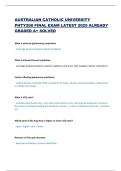
AUSTRALIAN CATHOLIC UNIVERSITY
PHTY208 FINAL EXAM LATEST 2025 ALREADY
GRADED A+ SOLVED
What is external (pulmonary) respiration
- exchange of gases between alveoli and blood
What is internal (tissue) respiration
- exchange of gases between systemic capillaries and tissue cells (supplies cellular respiration)
Factors affecting pulmonary ventilation
- surface tension of alveolar fluid, compliance of lungs , disease, airway resistance, obstruction
or collapse of airways
What is V/Q ratio?
- ventilation/perfusion ratio = the ratio of the amount of air reaching the alveoli per minute to
the amount of blood reaching the alveoli per minute—a ratio of volumetric flow rate - normal is
0.8
Which parts of the lung have a higher or lower V/Q ratio?
- apex = higher, base = lower
Reasons of V/Q ratio decrease
- decrease ventilation, increase blood flow
,What does low V/Q ratio indicate?
- ventilation is not able to keep up with perfusion
Reasons for V/Q ratio increase
- increased ventilation, decreased blood flow
What does high V/Q ratio indicate?
- ventilation in excess of metabolic needs being met by perfusion
What is Dalton's Law?
- Each gas in a mixture of gases exerts its own pressure
as if no other gases were present. Pressure of a specific gas = partial pressure, pressure of all
gases = total pressure
Factors affecting the rate of gas exchange
- partial pressure difference of gases, surface area available for gas exchange, molecular weight
and solubility of gases, diffusion distance
What is inspiratory capacity
- total amount of air capable of being inspirated (TV + inspiratory reserve)
What is functional residual capacity
- total amount of air capable of being expired from the lungs (residual volume + expiratory
reserve volume)
,What is vital capacity
- amount of air capable of bring inspired and expired from the lungs consciously (tidal volume +
inspiratory reserve volume + expiratory reserve volume)
Total lung capacity
- total amount of air capable of bring inspired and expired from the lungs consciously and
unconsciously (vital capacity + residual volume)
What is pulmonary ventilation
- inhalation and exhalation of air between the atmosphere and the alveoli
What is Henry's Law?
- Quantity of a gas that will dissolve in a liquid is proportional to the partial pressures of the gas
and its solubility
Where is the location of diffusion of oxygen and carbon dioxide in pulmonary gas exchange?
- oxygen from air in alveoli to blood in pulmonary capillaries, carbon dioxide from pulmonary
capillaries to alveoli
Normal alveolar oxygen partial pressure
- 105mmHg
Normal pulmonary capillary oxygen partial pressure
- 40mmHg
, Normal pulmonary vein oxygen partial pressure
- 100mmHg
Normal deoxygenated blood carbon dioxide partial pressure
- 45mmHg
Normal alveolar air carbon dioxide partial pressure
- 40mmHg
Normal oxygenated blood of pulmonary veins carbon dioxide partial pressure
- 40mmHg
What is a diffusion capacity test (Dlco)?
- test to determine transfer of oxygen from alveoli to bloodstream used with carbon monoxide.
Normal range is less than 80% of predicted value
What does a Dlco test measure?
- the difference between inspired and expired carbon monoxide
What would constitute a lowered Dlco test?
- decreased surface area of the alveolar (fibrosis, inflammation, lung disease, COPD, pulmonary
embolism, cardiac insufficiency, pulmonary hypertension, chronic heart failure, anemia)
What would constitute and increased Dlco test?
PHTY208 FINAL EXAM LATEST 2025 ALREADY
GRADED A+ SOLVED
What is external (pulmonary) respiration
- exchange of gases between alveoli and blood
What is internal (tissue) respiration
- exchange of gases between systemic capillaries and tissue cells (supplies cellular respiration)
Factors affecting pulmonary ventilation
- surface tension of alveolar fluid, compliance of lungs , disease, airway resistance, obstruction
or collapse of airways
What is V/Q ratio?
- ventilation/perfusion ratio = the ratio of the amount of air reaching the alveoli per minute to
the amount of blood reaching the alveoli per minute—a ratio of volumetric flow rate - normal is
0.8
Which parts of the lung have a higher or lower V/Q ratio?
- apex = higher, base = lower
Reasons of V/Q ratio decrease
- decrease ventilation, increase blood flow
,What does low V/Q ratio indicate?
- ventilation is not able to keep up with perfusion
Reasons for V/Q ratio increase
- increased ventilation, decreased blood flow
What does high V/Q ratio indicate?
- ventilation in excess of metabolic needs being met by perfusion
What is Dalton's Law?
- Each gas in a mixture of gases exerts its own pressure
as if no other gases were present. Pressure of a specific gas = partial pressure, pressure of all
gases = total pressure
Factors affecting the rate of gas exchange
- partial pressure difference of gases, surface area available for gas exchange, molecular weight
and solubility of gases, diffusion distance
What is inspiratory capacity
- total amount of air capable of being inspirated (TV + inspiratory reserve)
What is functional residual capacity
- total amount of air capable of being expired from the lungs (residual volume + expiratory
reserve volume)
,What is vital capacity
- amount of air capable of bring inspired and expired from the lungs consciously (tidal volume +
inspiratory reserve volume + expiratory reserve volume)
Total lung capacity
- total amount of air capable of bring inspired and expired from the lungs consciously and
unconsciously (vital capacity + residual volume)
What is pulmonary ventilation
- inhalation and exhalation of air between the atmosphere and the alveoli
What is Henry's Law?
- Quantity of a gas that will dissolve in a liquid is proportional to the partial pressures of the gas
and its solubility
Where is the location of diffusion of oxygen and carbon dioxide in pulmonary gas exchange?
- oxygen from air in alveoli to blood in pulmonary capillaries, carbon dioxide from pulmonary
capillaries to alveoli
Normal alveolar oxygen partial pressure
- 105mmHg
Normal pulmonary capillary oxygen partial pressure
- 40mmHg
, Normal pulmonary vein oxygen partial pressure
- 100mmHg
Normal deoxygenated blood carbon dioxide partial pressure
- 45mmHg
Normal alveolar air carbon dioxide partial pressure
- 40mmHg
Normal oxygenated blood of pulmonary veins carbon dioxide partial pressure
- 40mmHg
What is a diffusion capacity test (Dlco)?
- test to determine transfer of oxygen from alveoli to bloodstream used with carbon monoxide.
Normal range is less than 80% of predicted value
What does a Dlco test measure?
- the difference between inspired and expired carbon monoxide
What would constitute a lowered Dlco test?
- decreased surface area of the alveolar (fibrosis, inflammation, lung disease, COPD, pulmonary
embolism, cardiac insufficiency, pulmonary hypertension, chronic heart failure, anemia)
What would constitute and increased Dlco test?