Created with Coconote - https://coconote.app
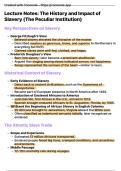
Lecture Notes: The History and Impact of
Slavery (The Peculiar Institution)
Key Perspectives on Slavery
• George Fitzhugh’s View
• Believed slavery elevated the character of the master.
• Described masters as generous, brave, and superior to Northerners in
everything but thrift.
• Claimed slaves were well-fed, clothed, and happy.
• Frederick Douglass’s View
• Born into slavery; later became a prominent abolitionist.
• Argued that singing among slaves indicated sorrow, not happiness.
• Songs represented the sorrows of the heart—similar to tears.
Historical Context of Slavery
• Early Evidence of Slavery
• Dates back to ancient civilizations, such as the Sumerians of
Mesopotamia.
• Became part of European presence in North America after 1492.
• Introduction of Enslaved Africans to America
• Juan Garrido, first African in the U.S., arrived in 1513.
• Spanish brought enslaved Africans to St. Augustine, Florida, by 1565.
• 1619 and the Beginning of African Slavery in English Colonies
• 20 Africans brought to Jamestown, Virginia aboard the White Lion.
• Often classified as indentured servants initially, later recognized as
enslaved.
The Atlantic Slave Trade
• Scope and Experience
• Estimated 12 million Africans transported.
• Enslaved people faced leg irons, cramped conditions, and unsanitary
environments.
• Middle Passage
• 12-15% mortality rate during voyages.
Lecture Notes: The History and Impact of
Slavery (The Peculiar Institution)
Key Perspectives on Slavery
• George Fitzhugh’s View
• Believed slavery elevated the character of the master.
• Described masters as generous, brave, and superior to Northerners in
everything but thrift.
• Claimed slaves were well-fed, clothed, and happy.
• Frederick Douglass’s View
• Born into slavery; later became a prominent abolitionist.
• Argued that singing among slaves indicated sorrow, not happiness.
• Songs represented the sorrows of the heart—similar to tears.
Historical Context of Slavery
• Early Evidence of Slavery
• Dates back to ancient civilizations, such as the Sumerians of
Mesopotamia.
• Became part of European presence in North America after 1492.
• Introduction of Enslaved Africans to America
• Juan Garrido, first African in the U.S., arrived in 1513.
• Spanish brought enslaved Africans to St. Augustine, Florida, by 1565.
• 1619 and the Beginning of African Slavery in English Colonies
• 20 Africans brought to Jamestown, Virginia aboard the White Lion.
• Often classified as indentured servants initially, later recognized as
enslaved.
The Atlantic Slave Trade
• Scope and Experience
• Estimated 12 million Africans transported.
• Enslaved people faced leg irons, cramped conditions, and unsanitary
environments.
• Middle Passage
• 12-15% mortality rate during voyages.