100% de satisfacción garantizada Inmediatamente disponible después del pago Tanto en línea como en PDF No estas atado a nada 4.2 TrustPilot
logo-home
Examen

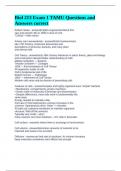
Biol 213 Exam 1 TAMU Questions and Answers correct

Puntuación
-
Vendido
-
Páginas
13
Grado
A+
Subido en
19-07-2025
Escrito en
2024/2025

Biol 213 Exam 1 TAMU Questions and Answers correct Robert Hooke (English engineer/architect) first saw and named cells in 1665 in slice of cork. "Cellula" = little rooms. Antony van Leeuwenhoek (Dutch businessman), late 17th Century. Extensive discoveries and descriptions of protozoa, bacteria, and many plant and animal cells. Cell Theory Early 19th Century Advances in optics theory, glass technology and construction allowed better understanding of cells Mattias Schleiden — Botanist Theodor Schwann — Zoologist 1839 — first formulation of Cell Theory: All organisms made of cells Cell is fundamental unit of life Rudolf Virchow — Pathologist 1855 — refinement of Cell Theory: Modern cells arise only by division of preexisting cells Features of cells Complex and highly organized even "simple" bacteria • Membranes, compartments, protein machines. • Small, realm of molecules (Chemistry and biochemistry) • Despite differences, most cells work in fundamentally the same ways Energy needed to maintain order 2nd Law of Thermodynamics--entropy increases in the universe. Spontaneous drive: Order --> disorder. All cells use a plasma membrane to maintain organized structure. Wall off the universe. Typically very small -- why? many reasons, but most important -- S/V ratio is favorable. Cell surface is where there is exchange w/ environment. Cell volume determines amounts of nutrients to be imported and waste to be excreted. Diffusion can limit rate of reactions. As volume increases large molecules sometimes can't diffuse fast enough. Concentration of chemicals As volume increases must raise concentrations of reactants to keep reactions going as fast as needed. How do cells cope with surface/volume issues? Develop New shapes RBC adaptation to ! increase surface area Adsorptive cells add structures! that increase adsorptive surfaces! microvilli Create internal compartments Concentrate molecules in! specific membranous ! compartments. Plants and protozoans Vacuoles! reduce internal volume. Develop means to move molecules w/o relying on diffusion Molecular motors to transport large molecules and organelles Two major cell types Prokaryotic cells. Typically small, relatively simple structure.! ! Eukaryotic cells. Typically larger, more complex structures.! Sense of scale —important to have an understanding of cellular scale and powers of ten 1 Å = 0.1 nm 1 nm = 10 Å 1 μ = 10-6 m Carl Woese sequencing cytosolic rRNA discovered Three (not two) distinct lineages of life Two Prokaryotic Domains One Eukaryotic Domain From sequencing organelle rRNAs Woese found confirmation of endosymbiotic theory. The ribosomes in your mitochondria are more closely related to those in your gut bacteria than to those in your own cytosol. Water molecule Covalent bonds electrons shared strong ~ 100 kcal/mole Polar covalent bonds electrons not equally shared Oxygen nucleus more electronegative. Attracts shared electrons more effectively than H nucleus So... water is a Polar molecule polar -- uneven distribution of charge Hydrogen bonds are collectively strong Water -- cohesive due to H-bonding network high surface tension -- capillary action; water striders high specific heat -- absorbs heat released from biochemical reactions high heat of vaporization -- cooling, sweating, panting. Polarity based on relative electronegativity values of atoms in bond. Unequal values produces polar bond: unequal sharing of pair. Size of partial charge depends upon relative electronegativity values of atoms. Roughly equal electronegativity values produces non-polar bond: equal sharing of electron pair. H-bonds with polar solutes Allows hydrophilic molecules to go into solution in water water is an excellent solvent due to extensive H-bonding Other properties of water — dissociation Acids and bases H2O ↔ OH- + H+ 2 H2O ↔ OH- + H3O+ in water 10-7 M [H3O+] pH = 7 neutral pH O! ||! R-C-OH O! ||! ↔ R-C-O- + H+ Acids easily lose a proton Bases pick up a proton R-NH2 + H+ ↔ R-NH3+ Acids and bases Acids easily lose a proton Bases pick up a proton pKa or pKb = concentration at which half the molecules are protonated Non-polar molecules -- Hydrophobic solutes water in an organized "cage" like structure Order is bad--2nd Law of thermodynamics Hydrophobic Interactions "Water fearing" — non-polar molecules cause ordering of water, or other polar molecules, so excluded from aqueous environments. Attraction of non-polar molecules is primarily caused by repulsion from water rather than attraction between hydrophic molecules. Van der Waals forces effective at close range of ~ 1 angstrom 0.1nm weak ~ 0.1- 0.3 kcal/mole So some attraction between hydrophobic molecules Chemistry of Life--the molecules 2 categories: small & large small molecules & macromolecules a continuum -- not a sharp distinction small < 500 daltons ~ 50 atoms large < 5,000 daltons ~ 500 atoms Building macromolecules complex interlocking structure? like some plastics No, simple long linear polymers of repeating units Nomenclature: monomers dimers trimers tetramers oligomers polymers Views of α-glucose Flat ring view Chair view C1 -OH C1 -H C2 -OH C2 -H down up down up down (axial) out (equatorial) out (equatorial) up (axial) Two different glucose polymers — starch and cellulose cellulose has straight chain β-linkages; starch has bent chain α-linkages Lipids and fats heterogeneous group defined as extractable in organic solvents insoluble in water extensive non-polar regions Most important biological form -- fatty acids Not really polymers, but often formed by dehydration synthesis Functions: energy storage: fats, triglycerides structural: membrane lipids fatty acids Long, (mostly) unbranched hydrocarbon chains with single carboxyl group on the end. fatty acids are "amphipathic" molecules know phosphatidyl choline structure for test. Phosphatidyl serine as well. archaea membranes Isoprene-based lipids Cholesterol Characteristic 4 ring structure; side groups vary with type ■ Mostly hydrophobic structure; only a hydroxyl or ketone group on one end ■ Functions: ■ Membrane components of eukaryotes — tend to stabilize fluidity; a "buffer" of membrane structure ■ Animal hormones Know--memorize the structures of:! ! valine (val, V), ! serine (ser, S), ! cysteine (cys, C),! glycine (gly, G),! phenylalanine (phe, F),! lysine (lys, K), ! aspartic acid (asp, D) 20 different amino acids -- Many possible combinations How many? Consider a tetrapeptide 4 residues 20 possibilities each 4^20 or 20^4 ? Can't remember? Go to an extreme--1 residue is it 1^20 or 20^1? 1^20 = 1 20^1= 20 so 20^4 possible tetrapeptides = 160,000 "typical" proteins are > 500 amino acids Primarily oxidation reactions Oxidation means loss of electrons 1st Law of Themodynamics change in internal system energy = Eproducts - Ereactants converting energy = heat (enthalpy H) ! ΔH = Hproducts - Hreactants so if heat is released, ΔH is negative the system loses heat. ! When ΔH <0 products have less heat than reactants and heat is available to do work 2nd Law of Themodynamics entropy (randomness, disorder) in the universe increases but biological systems are open so energy can be put in to create order change in system entropy = Sproducts - Sreactants ! ΔS = Sproducts - Sreactants so if more disorder (entropy) ΔS is positive if products have less order (more disorder) than reactants, ΔSrxn > 0 then energy due to gain in entropy can be exploited to do work Gibb's free energy (ΔG) is amount of energy potentially available to do work ΔG = ΔH - TΔS ΔG = loss of heat from reactants (ΔH) - gain in disorder (ΔS) ΔG is negative for a favorable (spontaneous) reaction Properties of catalyst (enzyme) Speeds reaction -- by lower transition state energy Can't change equilibrium -- Keq set by thermodynamics Can't change direction -- set by thermodynamics Enzyme catalysts can do something else Steer the reaction towards producing the right products How can enzymes be so specific? Their 3D structures define precise binding sites for specific substrates -HC=CH- → -H2C-CH2- Contrast w/ general catalyst Pt make margarine, peanut butter from oils any fat works ! works on almost any C=C ΔG and equilibrium constants Keq =[C] [D] --------- [A] [B] If large Keq reaction goes to right If reaction goes to right is ΔG < 0 or > 0? ΔG and equilibrium constants (cont) Study book's treatment on your own. Look at Table 3-1, Fig 3-19, Fig 3-20. Get a qualitative feel for relationship between ΔG values and equilibrium constants. Remember log (ln) scale Primary energy source is ATP. ! ATP ADP + Pi →→ - 7.3 kcal/mole Cells also use electron carriers NADPH or NADH as source of reducing power Several reactions in breakdown of glucose release enough energy to drive ATP synthesis Coupled reactions Coupled reaction is favorable. ATP →→ ADP + Pi ΔG = -7.3 kcal/mole Pi + glucose →→ glucose-6-P ΔG = 3.6 kcal/mole glucose + ATP→→glucose-6-P + ADP -3.7 kcal/mole but ... how are reactions coupled? The phosphate is transferred directly from ATP to glucose 2nd energy carrier NADH (NADPH) carries reducing power (electrons). A lot of energy can be stored as reducing power. NADH carries 2 e- to transfer energy from catabolism for use in anabolism when 2nd Law is working against you Enzyme kinetics Rates of reaction Vmax = maximum velocity turnover # = maximum S to P / time for 1 enzyme molecule turnover # varies succinate DH 19 / sec "slow" (1/20 sec to reduce C=C) CO2 + H2O --> H2CO3 Carbonic anhydrase 600,000 / sec "fast" Km -- Michaelis constant Km = [S] at which velocity is ½ Vmax Km is constant for any enzyme Km represents affinity of enzyme for substrate low Km= high affinity for substrate high Km= low affinity for substrate Bricklayers lot of Bricklayers, few bricks -- slow more bricks, they go faster, but only to a point double # bricklayers, more work, Vmax goes up but turnover # remains the same (max bricks layed / worker) Enzyme inhibition Enzyme inhibitors, useful tools, enormous medical applications antibiotics penicillin, kanamycin Others Celebrex -- arthritis prozac -- depression viagra -- Aids drugs AZT, ddC, protease inhibitors, integrase inhibitors Irreversible inhibitors -- shoot the bricklayers Reversible inhibitors -- trick the bricklayers to slow 'em down Competitive inhibitors Act as mimics of the substrate (or better yet, the transition state) Block or delay real substrate from getting in. Block or delay real substrate from getting into active site Spread styrofoam bricks -- same size, shape, color as real bricks At low [I] not much effect, but as [I] increases layers spend most of the time picking up fakes Can improve things by adding more real bricks (S) Competitive inhibitors increase Km but no effect on Vmax Bricklayer analogy Competitive inhibitors increase Km but no effect on Vmax Km = [S] at ½ Vmax -- takes more substrate to reach ½ Vmax Non-Competitive inhibitors Don't compete with substrate for binding Inhibitor binding induces conformational change in protein so it can no longer bind substrate. "Allosteric change" Bind to another site. "2nd site inhibitors." Don't compete with substrate for binding Tie bricklayers' shoe laces together -- can't move to pick up any new bricks until untied. At low [I] not much effect, but as [I] increases only a few bricklayers can pick up bricks and work. Can't improve things by adding more bricks (S) Non-competitive inhibitors decrease Vmax but have no effect on Km Bind to another site. "2nd site inhibitors." Bricklayer analogy Non-competitive inhibitors decrease Vmax but have no effect on Km reduced Vmax same Km uninhibited enzymes reach 1/2 (reduced) Vmax at normal [S] amino acids L-form occurs in proteins Convention NH3 to left R group is aa side chain R groups -- Amino acids side chains character of aa largely determined by side chains ionic + or - polar non-polar large small other side chains largely determine structure & function of proteins solubility (membrane v. solution) shape (rule of thumb -- hydrophobic inside hydrophilic outside) Know structures of asp, lys, ser, ala, gly, val, phe, cys) 2017 facts about amino acids MW range 75 to 203 Know structures of hydrophobic, acidic, basic, polar uncharged, other glycine R = H MW = 75 tryptophan R = indole ring MW = 203 avg MW = 120 but weighted avg in proteins is 110 Daltons so 100 aa = 11,000 Daltons or 11 kDa small protein 1,000 aa = 110,000 Daltons or 110 kDa big protein 10,000 aa = 1,100,000 Daltons or 1.1 MDa giant protein -CH2CH2(CH3)2 -CH2-OH -(CH2)4NH3+-OH -CH2-COO- aa's & protein identity and structure Each & every protein in cell has identity defined by its sequence of amino acids E. coli 3 X 10⁶ proteins but only 3,000 different kinds Each protein contains a polypeptide w/ a particular sequence of aa's (usually all 20, but not in equal amounts) No obvious repeat structure or subsequence (unlike polysaccharides) [there are exceptions] Linear arrangement of aa residues is termed the primary sequence or 1° structure. All molecules of a particular protein have the same linear 1° structure. Primary (1°) sequence the linear aa chain Native 3D conformation Tertiary (3°) or quaternary (4°) structure 1 polypeptide 3° structure >1 polypeptide 4° structure What forces hold proteins in their 3D shapes? electrostatic attractions: between charged side chains Van Der Waals attractions: between nonpolar side chains hydrogen bonding: backbone to backbone- hydrogen bond between the atoms of two peptide bonds; backbone to sidechain hydrogen bond between the atoms of a peptide bond and a side chain; sidechain to side chain- hydrogen bonding between two amino acid side chains What forces hold proteins in their 3D shapes? hydrophobic groups found in the interior of the protein Secondary (2°) structure 2° structures are folded substructures. ! higher order than 1° sequence but less ordered ! than 3°.! ! Held together by backbone/backbone interactions ! ! examples: ! ! alpha helix! Beta sheet! various defined turns ex. beta turns.! A special feature of the peptide bond—rigidity partial charges Confers partial double bond character. Locks six atoms in a plane. The alpha helix Alpha helix 3.6 aa / turn C=O of residue #1 H-bonds to H-N of residue #5 intra chain H-bonding The alpha helix (cont) H-bonding: C=O #1 to H-N #5; C=O #2 to H-N #6; C=O #3 to H-N #7; C=O #4 to H-N #8; etc. etc.

Mostrar más Leer menos
Institución
TAMU BIOLOGY
Grado
TAMU BIOLOGY


Ups! No podemos cargar tu documento ahora. Inténtalo de nuevo o contacta con soporte.

Escuela, estudio y materia

Institución
TAMU BIOLOGY
Grado
TAMU BIOLOGY

Información del documento

Subido en
19 de julio de 2025
Número de páginas
13
Escrito en
2024/2025
Tipo
Examen
Contiene
Preguntas y respuestas

Temas

Vista previa del contenido

Biol 213 Exam 1 TAMU Questions and
Answers correct
Robert Hooke - answer(English engineer/architect) first
saw and named cells in 1665 in slice of cork.
"Cellula" = little rooms.

Antony van Leeuwenhoek - answer(Dutch businessman),
late 17th Century. Extensive discoveries and
descriptions of protozoa, bacteria, and many plant
and animal cells.

Cell Theory - answerEarly 19th Century Advances in optics theory, glass technology
and construction allowed better understanding of cells
Mattias Schleiden — Botanist
Theodor Schwann — Zoologist
1839 — first formulation of Cell Theory:
All organisms made of cells
Cell is fundamental unit of life
Rudolf Virchow — Pathologist
1855 — refinement of Cell Theory:
Modern cells arise only by division of preexisting cells

Features of cells - answerComplex and highly organized even "simple" bacteria
• Membranes, compartments, protein machines.
• Small, realm of molecules (Chemistry and biochemistry)
• Despite differences, most cells work in fundamentally the
same ways
Energy needed to maintain order
2nd Law of Thermodynamics--entropy increases in the
universe. Spontaneous drive: Order --> disorder.
All cells use a plasma membrane to maintain organized
structure. Wall off the universe.
Typically very small -- why?
many reasons, but most important -- S/V ratio is favorable.

Cell surface - answeris where there is exchange w/ environment.

Cell volume - answerdetermines amounts of nutrients to be
imported and waste to be excreted.

Diffusion - answercan limit rate of reactions. As volume increases
large molecules sometimes can't diffuse fast enough.

, Concentration of chemicals - answerAs volume
increases must raise concentrations of reactants to keep
reactions going as fast as needed.

How do cells cope with surface/volume issues? - answerDevelop New shapes
RBC adaptation to !
increase surface area
Adsorptive cells add structures!
that increase adsorptive surfaces!
microvilli
Create internal compartments
Concentrate molecules in!
specific membranous !
compartments.
Plants and protozoans Vacuoles!
reduce internal volume.
Develop means to move molecules w/o relying on
diffusion
Molecular motors to transport large molecules and
organelles

Two major cell types - answerProkaryotic cells. Typically small, relatively
simple structure.!
!
Eukaryotic cells. Typically larger, more
complex structures.!

Sense of scale —important to have an
understanding of cellular scale and powers of ten - answer1 Å = 0.1 nm
1 nm = 10 Å
1 μ = 10-6 m

Carl Woese sequencing cytosolic rRNA discovered - answerThree (not two) distinct
lineages of life
Two Prokaryotic Domains One Eukaryotic Domain
From sequencing organelle rRNAs Woese found confirmation
of endosymbiotic theory.
The ribosomes in your mitochondria are more closely related to
those in your gut bacteria than to those in your own cytosol.

Water molecule - answerCovalent bonds
electrons shared
strong ~ 100 kcal/mole

Polar covalent bonds - answerelectrons not equally shared
Oxygen nucleus more

$15.99
Accede al documento completo:

100% de satisfacción garantizada
Inmediatamente disponible después del pago
Tanto en línea como en PDF
No estas atado a nada


Documento también disponible en un lote

Thumbnail
Package deal
TAMU BIOLOGY EXAM BUNDLE
-
63 2025
$ 1,015.17 Más información

Conoce al vendedor

Seller avatar
Los indicadores de reputación están sujetos a la cantidad de artículos vendidos por una tarifa y las reseñas que ha recibido por esos documentos. Hay tres niveles: Bronce, Plata y Oro. Cuanto mayor reputación, más podrás confiar en la calidad del trabajo del vendedor.
Pogba119 Harvard University
Ver perfil
Seguir Necesitas iniciar sesión para seguir a otros usuarios o asignaturas
Vendido
48
Miembro desde
1 año
Número de seguidores
2
Documentos
4859
Última venta
3 semanas hace
NURSING TEST

BEST EDUCATIONAL RESOURCES FOR STUDENTS

3.9

9 reseñas

5
4
4
2
3
2
2
0
1
1

Recientemente visto por ti

Por qué los estudiantes eligen Stuvia

Creado por compañeros estudiantes, verificado por reseñas

Calidad en la que puedes confiar: escrito por estudiantes que aprobaron y evaluado por otros que han usado estos resúmenes.

¿No estás satisfecho? Elige otro documento

¡No te preocupes! Puedes elegir directamente otro documento que se ajuste mejor a lo que buscas.

Paga como quieras, empieza a estudiar al instante

Sin suscripción, sin compromisos. Paga como estés acostumbrado con tarjeta de crédito y descarga tu documento PDF inmediatamente.

Student with book image

“Comprado, descargado y aprobado. Así de fácil puede ser.”

Alisha Student

Preguntas frecuentes