1 Exampromax - Stuvia US
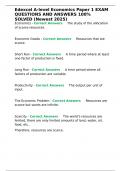
Edexcel A-level Economics Paper 1 Questions
and Answers 100% Correct Answers Already
Graded A+
Q: Economics
Ans: The study of the allocation of scarce resources.
Q: Economic Goods
Ans: Resources that are scarce.
Exampromax - Stuvia US
Q: Short Run
Ans: A time period where at least one factor of production is fixed.
Q: Long Run
Ans: A time period where all factors of production are variable.
Q: Productivity
Ans: The output per unit of input.
Q: The Economic Problem
Ans: Resources are scarce but wants are infinite.
Q: Scarcity
Ans: The world's resources are limited, there are only limited amounts of land,
water, oil, food, etc..
Therefore, resources are scarce.
Q: Free Goods
Ans: Goods that are unlimited in supply and therefore have no opportunity cost.
, 2 Exampromax - Stuvia US
Q: Economic Agents
Ans: Consumer, Business and Governments.
Agents involved in Economic transactions.
Q: Production Possibility Frontier
Ans: The maximum potential output of a combination of goods an economy can
achieve when all its resources are fully and efficiently employed, given the level of
technology.
Q: Opportunity Cost
Ans: The next best alternative foregone.
Q: Economic Growth
Exampromax - Stuvia US
Ans: Increase an economy's productive potential.
Q: Capital Goods
Ans: Goods intended for use in production, rather than by consumers.
Q: Consumer Goods
Ans: Goods designed for use by final consumers.
Q: Renewable Resources
Ans: A resource whose stock level can be replenished naturally over a period of
time.
Q: Non-renewable Resources
Ans: A resource whose stock level decreases over time as it is consumed.
Q: Ceteris Paribus
Ans: 'All other things (factors) remaining the same'
The assumption that all other variables within a model remain constant whilst the
change is being considered.
Q: Positive Statement
, 3 Exampromax - Stuvia US
Ans: A statement based on facts which can be tested as true or false and are
value-free.
Q: Normative Statement
Ans: A statement based on value judgements which cannot be tested as true or
false.
Q: Adam Smith
Ans: The Father of Economics;
- The Invisible Hand (workings of the Price Mechanism)
- Specialisation
- Division of Labour
Q: Division of Labour
Exampromax - Stuvia US
Ans: Specialisation of workers on specific tasks in the production process.
Q: Specialisation
Ans: The process of breaking down the production process into steps and then
each worker is assigned a step. This would then increase labour productivity
(Output per Worker).
Q: Barter
Ans: An exchange of goods/services for other goods/services.
- Does not involve money.
- Double coincidence of wants.
Q: Money
Ans: Anything which is acceptable to a wide number of people and
organisations as payment for goods and services.
Q: Free Market Economy
Ans: Where all resources are privately owned and allocated via the price
mechanism. There is minimal government intervention.
Q: Command Economy
Edexcel A-level Economics Paper 1 Questions
and Answers 100% Correct Answers Already
Graded A+
Q: Economics
Ans: The study of the allocation of scarce resources.
Q: Economic Goods
Ans: Resources that are scarce.
Exampromax - Stuvia US
Q: Short Run
Ans: A time period where at least one factor of production is fixed.
Q: Long Run
Ans: A time period where all factors of production are variable.
Q: Productivity
Ans: The output per unit of input.
Q: The Economic Problem
Ans: Resources are scarce but wants are infinite.
Q: Scarcity
Ans: The world's resources are limited, there are only limited amounts of land,
water, oil, food, etc..
Therefore, resources are scarce.
Q: Free Goods
Ans: Goods that are unlimited in supply and therefore have no opportunity cost.
, 2 Exampromax - Stuvia US
Q: Economic Agents
Ans: Consumer, Business and Governments.
Agents involved in Economic transactions.
Q: Production Possibility Frontier
Ans: The maximum potential output of a combination of goods an economy can
achieve when all its resources are fully and efficiently employed, given the level of
technology.
Q: Opportunity Cost
Ans: The next best alternative foregone.
Q: Economic Growth
Exampromax - Stuvia US
Ans: Increase an economy's productive potential.
Q: Capital Goods
Ans: Goods intended for use in production, rather than by consumers.
Q: Consumer Goods
Ans: Goods designed for use by final consumers.
Q: Renewable Resources
Ans: A resource whose stock level can be replenished naturally over a period of
time.
Q: Non-renewable Resources
Ans: A resource whose stock level decreases over time as it is consumed.
Q: Ceteris Paribus
Ans: 'All other things (factors) remaining the same'
The assumption that all other variables within a model remain constant whilst the
change is being considered.
Q: Positive Statement
, 3 Exampromax - Stuvia US
Ans: A statement based on facts which can be tested as true or false and are
value-free.
Q: Normative Statement
Ans: A statement based on value judgements which cannot be tested as true or
false.
Q: Adam Smith
Ans: The Father of Economics;
- The Invisible Hand (workings of the Price Mechanism)
- Specialisation
- Division of Labour
Q: Division of Labour
Exampromax - Stuvia US
Ans: Specialisation of workers on specific tasks in the production process.
Q: Specialisation
Ans: The process of breaking down the production process into steps and then
each worker is assigned a step. This would then increase labour productivity
(Output per Worker).
Q: Barter
Ans: An exchange of goods/services for other goods/services.
- Does not involve money.
- Double coincidence of wants.
Q: Money
Ans: Anything which is acceptable to a wide number of people and
organisations as payment for goods and services.
Q: Free Market Economy
Ans: Where all resources are privately owned and allocated via the price
mechanism. There is minimal government intervention.
Q: Command Economy