BSW License Exam Study Guide Test.
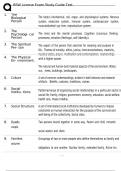
1. The
Biological The body's biochemical, cell, organ, and physiological systems. Nervous
Person system, endocrine system, immune system, cardiovascular system,
musculoskeletal sys- tem, reproductive system.
2. The
Psychologi- cal The mind and the mental processes. Cognition (conscious thinking
Person processes), emotion (feelings), self (identity).
3. The Spiritual The aspect of the person that searches for meaning and purpose in
Per- son
life,. Themes of morality, ethics, justice, interconnectedness, creativity,
mystical states, prayer, meditation and contemplation, relationships
4. The Physical with a higher power.
En- vironment:
The natural and human-built material aspects of the environment. Water,
sun, trees, buildings, landscapes.
5. Culture A set of common understandings, evident in both behavior and material
artifacts. Beliefs, customs, traditions, values.
6. Social Patterned ways of organizing social relationships in a particular sector of
Institu- tions
social life, Family, religion, government, economy, education, social welfare,
health care, mass media.
7. Social Structure A set of interrelated social institutions developed by humans to impose
constraints on human interaction for the purpose of the survival and
well being of the collectivity. Social class.
8. Dyads Two persons bound together in some way. Parent and child, romantic
couple,
social worker and client.
9. Families Groupings of two or more people who define themselves as family and
assume
obligations to one another. Nuclear family, extended family, fictive kin.
, BSW License Exam Study Guide Test.
10. Small Group Collections of people who interact with each other, perceive themselves as
be-
longing to a group, are interdependent, join together to accomplish a
goal, fulfill a need through joint association or are influenced by a set
of rules and
, BSW License Exam Study Guide Test.
norms. Friendship group, self help group, therapy group, committee task
group, interdisciplinary team.
11. Formal Organiza- Collectivities of people, with a high degree of formality of structure, workin
tions together to meet a goal or goals. Civic and social service organizations,
business organizations, professional associations.
12. Communities People bound either by geography or by network links (webs of
communication), sharing common ties, and interacting with one
another. Territorial communities such as neighborhoods, relational
communities such as the social work commu- nity, the disability
community, a faith community, a soccer league.
13. Social Large scale collective actions to make change or resist change, in
Move-
ments specific social in- stitutions, Civil rights movement, poor people's
movements, disability movement, gay rights movement.
14. Trends Long term patterns of change that move in a general direction. Trend
toward
greater ethnic diversity in the United States, trend toward delayed
childbearing in advanced industrial countries, trend toward greater income
inequality between sub-Saharan Africa and the rest of the world.
15. Cycles Short term patterns of change that reverse direction repetitively. A weekly
cycle of work interspersed with rest and relaxation. Economic
downturns and upturns.
16. Shifts Sudden abrupt changes of direction. Changes in patterns of living
following a
major loss. Changes in the physical and social environment following a
natural disaster (hurricane, flood, earthquake) or human made
disaster such as Septem- ber 11, 2001.
17. Linear Time Time in terms of a straight line. Past, present, future.
1. The
Biological The body's biochemical, cell, organ, and physiological systems. Nervous
Person system, endocrine system, immune system, cardiovascular system,
musculoskeletal sys- tem, reproductive system.
2. The
Psychologi- cal The mind and the mental processes. Cognition (conscious thinking
Person processes), emotion (feelings), self (identity).
3. The Spiritual The aspect of the person that searches for meaning and purpose in
Per- son
life,. Themes of morality, ethics, justice, interconnectedness, creativity,
mystical states, prayer, meditation and contemplation, relationships
4. The Physical with a higher power.
En- vironment:
The natural and human-built material aspects of the environment. Water,
sun, trees, buildings, landscapes.
5. Culture A set of common understandings, evident in both behavior and material
artifacts. Beliefs, customs, traditions, values.
6. Social Patterned ways of organizing social relationships in a particular sector of
Institu- tions
social life, Family, religion, government, economy, education, social welfare,
health care, mass media.
7. Social Structure A set of interrelated social institutions developed by humans to impose
constraints on human interaction for the purpose of the survival and
well being of the collectivity. Social class.
8. Dyads Two persons bound together in some way. Parent and child, romantic
couple,
social worker and client.
9. Families Groupings of two or more people who define themselves as family and
assume
obligations to one another. Nuclear family, extended family, fictive kin.
, BSW License Exam Study Guide Test.
10. Small Group Collections of people who interact with each other, perceive themselves as
be-
longing to a group, are interdependent, join together to accomplish a
goal, fulfill a need through joint association or are influenced by a set
of rules and
, BSW License Exam Study Guide Test.
norms. Friendship group, self help group, therapy group, committee task
group, interdisciplinary team.
11. Formal Organiza- Collectivities of people, with a high degree of formality of structure, workin
tions together to meet a goal or goals. Civic and social service organizations,
business organizations, professional associations.
12. Communities People bound either by geography or by network links (webs of
communication), sharing common ties, and interacting with one
another. Territorial communities such as neighborhoods, relational
communities such as the social work commu- nity, the disability
community, a faith community, a soccer league.
13. Social Large scale collective actions to make change or resist change, in
Move-
ments specific social in- stitutions, Civil rights movement, poor people's
movements, disability movement, gay rights movement.
14. Trends Long term patterns of change that move in a general direction. Trend
toward
greater ethnic diversity in the United States, trend toward delayed
childbearing in advanced industrial countries, trend toward greater income
inequality between sub-Saharan Africa and the rest of the world.
15. Cycles Short term patterns of change that reverse direction repetitively. A weekly
cycle of work interspersed with rest and relaxation. Economic
downturns and upturns.
16. Shifts Sudden abrupt changes of direction. Changes in patterns of living
following a
major loss. Changes in the physical and social environment following a
natural disaster (hurricane, flood, earthquake) or human made
disaster such as Septem- ber 11, 2001.
17. Linear Time Time in terms of a straight line. Past, present, future.