Chem 103 Fina edition2025
E E E
E
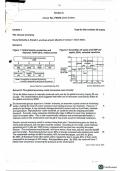
1. In the reaction of gaseous N2O5 to yield NO2 gas and O2 gas as shown below, the following data table is obtained: 2 N2O5 (g) ’
NO2 (g) + O2 (g)
1. Using the [O2] data from the table, show the calculation of the average
rateover the measured time interval from 0 to 3000 secs.
2. Using the [O2] data from the table, show the calculation of the
instantaneous rate early in the reaction (0 secs to 300 sec).
3. Explain the relative values of the average rate and the early
instantaneous rate.: 1. The average rate over the measured time interval from 0
to 3000 secs is: rate = [O2] / t = (0.046 - 0) / 3000 - 0 = 1.53 x 10⁻⁵mol/L•s
2. The early instantaneous rate over the measured time interval from 0 to 300
secs is:
rate = [O2] / t = (0.009 - 0) / 300 - 0 = 3.00 x 10⁻⁵mol/L•s
3. The early instantaneous rate is larger since the concentrations of reactants is
higher during the earliest stages of the reaction.
2. The following rate data was obtained for the hypothetical reaction:
A+D’X+Y
Experiment # [A] [D] rate
1 0.50 0.50 2.1
2 1.00 0.50 8.4
3 1.00 1.00 33.6
1. Determine the reaction order with respect to [A].
2. Determine the reaction order with respect to [D].
3. Write the rate law in the form rate = k [A]n [D]m (filling in the correct
exponents).
4. Show the calculation of the rate constant, k.: 1. 2nd order with respect to [A]
:
8.4/2.1 =k (1.00)n (0.50)m / k (0.50)n(0.50)m : n = 2
2. 2nd order with respect to [D] : 33.6/8.4 =k (1.00)n (1.00)m / k (1.00)n(0.50)m : m
=2
3. rate = k [A]2 [D]2
4. k = 2.1 / (0.50)2 (0.50)2 = 33.6
3. ln [A] - ln [A]0 = - k t 0.693 = k t1/2
An ancient sample of paper was found to contain 19.8 % 14C content as
compared to a present-day sample. The t1/2 for 14C is 5720 yrs. Show the
, Chem 103 Fina edition2025
E E E
E
calculation of the decay constant (k) and the age of the paper.: 0.693 = k (5720)
k = 0.693/5720 = 1.2115 x 10 -4 ln [A] - ln [A]0 = - k t
ln 19.8 - ln 100 = -(1.2115 x 10⁻⁴) t
t = -1.6195 / -(1.2115 x 10⁻⁴) = 13,368 years
4. Using the potential energy diagram below, state whether the reaction
described by the diagram is endothermic or exothermic and spontaneous or
nonspontaneous, being sure to explain your answer.: Large Eact =
nonspontaneous H- = exothermic
5. Show the calculation of Kc for the following reaction if an initial
reaction mixture of 0.900 mole of CO and 2.70 mole of H2 in a 9.00 liter
container forms an equilibrium mixture containing 0.346 mole of H2O and
corresponding amounts of CO, H2, and CH4.
CO (g) + 3 H2 (g) CH4 (g) + H2O (g): At equilibrium
H2O = 0.346 mole (as stated)
CH4 = 0.346 mole (1 mole of CH4 forms for every mole of H2O that is formed)
CO = 0.900 - 0.346 mole (1 mole of CO reacts for every mole of H2O that is
formed)
H2 = 2.70 - 3 x 0.346 mole (3 mole of H2 reacts for every mole of H2O that is
formed)
Change all amounts to moles/L before entering in Kc expression:
H2O = 0.346 mole / 9.00 L = 0.0384 M
CH4 = 0.346 mole / 9.00 L = 0.0384 M
CO = 0.554 mole / 9.00 L = 0.0616 M
H2 = 1.662 mole / 9.00 L = 0.185 M
Kc = [CH4] [H2O] = [0.0384] [0.0384] = 3.78
[CO] [H2]3 [0.0616] [0.185]3
6. Explain the terms substrate and active site in regard to an enzyme.: The
substrate is the substance whose reaction rate is increased by an enzyme. The
active site is the group of atoms on the surface of an enzyme where the substrate
binds to undergo the reaction catalyzed by the enzyme.
7. The reaction below has the indicated equilibrium constant. Is the
equilibrium mixture made up of predominately reactants, predominately
, Chem 103 Fina edition2025
E E E
E
products or significant amounts of both products and reactants. Be sure to
explain your answer.
2 H2 (g) + S2 (g) 2 H2S (g) Kc = 9.39 x 10⁻⁵: The very small Kc indicates that this
equilibrium mixture will be composed of mostly reactants.
8. The equilibrium reaction below has the following equilibrium mixture
concentrations:
H2O = [0.0380], CH4 = [0.0380], CO = [0.0620] and H2 = [0.186] with Kc= 3.62.
If the concentration of H2O at equilibrium is increased to [0.100], how and
for what reason will the equilibrium shift? Be sure to calculate the value of
the reaction quotient, Q, and use this to confirm your answer.
CO (g) + 3 H2 (g) CH4 (g) + H2O (g): Kc = 3.62 when H2O = [0.0380], CH4 =
[0.0380], CO = [0.0620] and H2 = [0.186 M]
When H2O = [0.100], Q = [0.100] [0.0380] = 9.52[0.0620] [0.186]3
The reaction must shift briefly in the reverse direction to decrease the [H2O] to come
back to equilibrium.This is in agreement with Qc > Kcwhich also predicts the
reaction will proceed to the left.
9. The equilibrium reaction below has the Kc = 3.93. If the volume of the
system at equilibrium is decreased from 6.00 liters to 2.00 liters, how and for
what reason will the equilibrium shift? Be sure to calculate the value of the
reaction quotient, Q, and use this to confirm your answer.
CO (g) + 3 H2 (g) CH4 (g) + H2O (g): When volume decreases from 6.00 to 2.00,
the pressure triples and the concentration of all gases (CO, H2, CH4, and H2O)
triples so:
(at equilibrium) Qc =Kc = [CH4] [H2O] = 3.93[CO] [H2]3
(volume 1/3 = pressure tripled = conc tripled) Qc = [3 CH4] [3 H2O] = Kc [3 CO] [3
H2]3 9
The reaction must shift briefly in the direction that decreases the pressure by going
toward the side with the lesser moles of gas (forward direction : 4 moles of gas
yields 2 moles of gas) to come back to equilibrium. This is in agreement with Qc <
Kc: the reaction will proceed to the right (in the direction of the products).
10. The equilibrium reaction below has the Kc = 0.254 at 25oC. If the
temperature of the system at equilibrium is decreased to 0oC, how and for
what reason will the equilibrium shift? Also show and explain how and why
the Kc value will change.
E E E
E
1. In the reaction of gaseous N2O5 to yield NO2 gas and O2 gas as shown below, the following data table is obtained: 2 N2O5 (g) ’
NO2 (g) + O2 (g)
1. Using the [O2] data from the table, show the calculation of the average
rateover the measured time interval from 0 to 3000 secs.
2. Using the [O2] data from the table, show the calculation of the
instantaneous rate early in the reaction (0 secs to 300 sec).
3. Explain the relative values of the average rate and the early
instantaneous rate.: 1. The average rate over the measured time interval from 0
to 3000 secs is: rate = [O2] / t = (0.046 - 0) / 3000 - 0 = 1.53 x 10⁻⁵mol/L•s
2. The early instantaneous rate over the measured time interval from 0 to 300
secs is:
rate = [O2] / t = (0.009 - 0) / 300 - 0 = 3.00 x 10⁻⁵mol/L•s
3. The early instantaneous rate is larger since the concentrations of reactants is
higher during the earliest stages of the reaction.
2. The following rate data was obtained for the hypothetical reaction:
A+D’X+Y
Experiment # [A] [D] rate
1 0.50 0.50 2.1
2 1.00 0.50 8.4
3 1.00 1.00 33.6
1. Determine the reaction order with respect to [A].
2. Determine the reaction order with respect to [D].
3. Write the rate law in the form rate = k [A]n [D]m (filling in the correct
exponents).
4. Show the calculation of the rate constant, k.: 1. 2nd order with respect to [A]
:
8.4/2.1 =k (1.00)n (0.50)m / k (0.50)n(0.50)m : n = 2
2. 2nd order with respect to [D] : 33.6/8.4 =k (1.00)n (1.00)m / k (1.00)n(0.50)m : m
=2
3. rate = k [A]2 [D]2
4. k = 2.1 / (0.50)2 (0.50)2 = 33.6
3. ln [A] - ln [A]0 = - k t 0.693 = k t1/2
An ancient sample of paper was found to contain 19.8 % 14C content as
compared to a present-day sample. The t1/2 for 14C is 5720 yrs. Show the
, Chem 103 Fina edition2025
E E E
E
calculation of the decay constant (k) and the age of the paper.: 0.693 = k (5720)
k = 0.693/5720 = 1.2115 x 10 -4 ln [A] - ln [A]0 = - k t
ln 19.8 - ln 100 = -(1.2115 x 10⁻⁴) t
t = -1.6195 / -(1.2115 x 10⁻⁴) = 13,368 years
4. Using the potential energy diagram below, state whether the reaction
described by the diagram is endothermic or exothermic and spontaneous or
nonspontaneous, being sure to explain your answer.: Large Eact =
nonspontaneous H- = exothermic
5. Show the calculation of Kc for the following reaction if an initial
reaction mixture of 0.900 mole of CO and 2.70 mole of H2 in a 9.00 liter
container forms an equilibrium mixture containing 0.346 mole of H2O and
corresponding amounts of CO, H2, and CH4.
CO (g) + 3 H2 (g) CH4 (g) + H2O (g): At equilibrium
H2O = 0.346 mole (as stated)
CH4 = 0.346 mole (1 mole of CH4 forms for every mole of H2O that is formed)
CO = 0.900 - 0.346 mole (1 mole of CO reacts for every mole of H2O that is
formed)
H2 = 2.70 - 3 x 0.346 mole (3 mole of H2 reacts for every mole of H2O that is
formed)
Change all amounts to moles/L before entering in Kc expression:
H2O = 0.346 mole / 9.00 L = 0.0384 M
CH4 = 0.346 mole / 9.00 L = 0.0384 M
CO = 0.554 mole / 9.00 L = 0.0616 M
H2 = 1.662 mole / 9.00 L = 0.185 M
Kc = [CH4] [H2O] = [0.0384] [0.0384] = 3.78
[CO] [H2]3 [0.0616] [0.185]3
6. Explain the terms substrate and active site in regard to an enzyme.: The
substrate is the substance whose reaction rate is increased by an enzyme. The
active site is the group of atoms on the surface of an enzyme where the substrate
binds to undergo the reaction catalyzed by the enzyme.
7. The reaction below has the indicated equilibrium constant. Is the
equilibrium mixture made up of predominately reactants, predominately
, Chem 103 Fina edition2025
E E E
E
products or significant amounts of both products and reactants. Be sure to
explain your answer.
2 H2 (g) + S2 (g) 2 H2S (g) Kc = 9.39 x 10⁻⁵: The very small Kc indicates that this
equilibrium mixture will be composed of mostly reactants.
8. The equilibrium reaction below has the following equilibrium mixture
concentrations:
H2O = [0.0380], CH4 = [0.0380], CO = [0.0620] and H2 = [0.186] with Kc= 3.62.
If the concentration of H2O at equilibrium is increased to [0.100], how and
for what reason will the equilibrium shift? Be sure to calculate the value of
the reaction quotient, Q, and use this to confirm your answer.
CO (g) + 3 H2 (g) CH4 (g) + H2O (g): Kc = 3.62 when H2O = [0.0380], CH4 =
[0.0380], CO = [0.0620] and H2 = [0.186 M]
When H2O = [0.100], Q = [0.100] [0.0380] = 9.52[0.0620] [0.186]3
The reaction must shift briefly in the reverse direction to decrease the [H2O] to come
back to equilibrium.This is in agreement with Qc > Kcwhich also predicts the
reaction will proceed to the left.
9. The equilibrium reaction below has the Kc = 3.93. If the volume of the
system at equilibrium is decreased from 6.00 liters to 2.00 liters, how and for
what reason will the equilibrium shift? Be sure to calculate the value of the
reaction quotient, Q, and use this to confirm your answer.
CO (g) + 3 H2 (g) CH4 (g) + H2O (g): When volume decreases from 6.00 to 2.00,
the pressure triples and the concentration of all gases (CO, H2, CH4, and H2O)
triples so:
(at equilibrium) Qc =Kc = [CH4] [H2O] = 3.93[CO] [H2]3
(volume 1/3 = pressure tripled = conc tripled) Qc = [3 CH4] [3 H2O] = Kc [3 CO] [3
H2]3 9
The reaction must shift briefly in the direction that decreases the pressure by going
toward the side with the lesser moles of gas (forward direction : 4 moles of gas
yields 2 moles of gas) to come back to equilibrium. This is in agreement with Qc <
Kc: the reaction will proceed to the right (in the direction of the products).
10. The equilibrium reaction below has the Kc = 0.254 at 25oC. If the
temperature of the system at equilibrium is decreased to 0oC, how and for
what reason will the equilibrium shift? Also show and explain how and why
the Kc value will change.