Microbiology HCC 2025/26 Study Pack | High-
Scoring Verified Quizzes and Answers
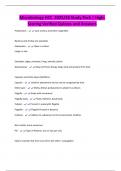
Prokaryotes - Lack nucleus and other organelles
Bacteria and Archae are examples
Eukaryotes - Have a nucleus
Larger in size
Examples: algae, protozoa, fungi, animals, plants
Glycocalyces - Keep cell from drying, helps stick and protect from host
Capsules and slime layers (biofilms)
Capsule - Used for attachment and to not be recognized by host
Slime layer - Sticky; Allows prokaryotes to attach to surfaces
Flagella - Helps with movement
Flagella body - Hook, filament, basal body
Tubulin - Present in eukaryotic flagella
Flagellin - Flagella Present in bacteria
Fimbrae - Adhere to substances in the environment, biofilms
Non motile, more numerous
Pili - Type of fimbrae, one or two per cell,
help to transfer dna from one cell to the other= conjugation
, Bacteria only
Gram positive cell wall - Thick peptidoglycan
Stains purple
Mycolic acid (waxy) helps from drying
Techoic acids
Gram negative cell wall - Thin peptidoglycan layer
May stop treatment of disease
Stains pink
Bilayer: LPS
Bacteria cell walls - Provide shape and protect from osmotic forces
Antibiotics can target for treatment
Can help attach to other cells
Bacterial cytoplasmic membrane functions - Energy storage
Proteins allow substances to cross membrane
Diffusion - Movement of chemical down its concentration gradient
High to low
No energy required
Facilitated diffusion - Proteins facilitate the process by providing a pathway for diffusion
Osmosis - Diffusion of water
Isotonic - Neither a gain or loss of water
Scoring Verified Quizzes and Answers
Prokaryotes - Lack nucleus and other organelles
Bacteria and Archae are examples
Eukaryotes - Have a nucleus
Larger in size
Examples: algae, protozoa, fungi, animals, plants
Glycocalyces - Keep cell from drying, helps stick and protect from host
Capsules and slime layers (biofilms)
Capsule - Used for attachment and to not be recognized by host
Slime layer - Sticky; Allows prokaryotes to attach to surfaces
Flagella - Helps with movement
Flagella body - Hook, filament, basal body
Tubulin - Present in eukaryotic flagella
Flagellin - Flagella Present in bacteria
Fimbrae - Adhere to substances in the environment, biofilms
Non motile, more numerous
Pili - Type of fimbrae, one or two per cell,
help to transfer dna from one cell to the other= conjugation
, Bacteria only
Gram positive cell wall - Thick peptidoglycan
Stains purple
Mycolic acid (waxy) helps from drying
Techoic acids
Gram negative cell wall - Thin peptidoglycan layer
May stop treatment of disease
Stains pink
Bilayer: LPS
Bacteria cell walls - Provide shape and protect from osmotic forces
Antibiotics can target for treatment
Can help attach to other cells
Bacterial cytoplasmic membrane functions - Energy storage
Proteins allow substances to cross membrane
Diffusion - Movement of chemical down its concentration gradient
High to low
No energy required
Facilitated diffusion - Proteins facilitate the process by providing a pathway for diffusion
Osmosis - Diffusion of water
Isotonic - Neither a gain or loss of water