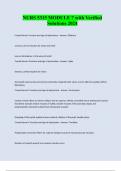
NURS 5315 MODULE 7 with Verified Solutions 2024/2025
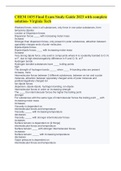
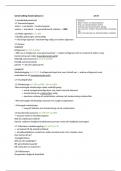
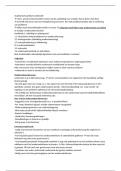
Cranial Nerve I Function and sign of dysfunction - Answer -Olfactory sensory, carries impulses for sense and smell Loss or disturbance in the sense of smell Cranial Nerve II Function and sign of dysfunction - Answer -Optic Sensory, carries impulses for vision decreased visual acuity and contrast sensitivity, impaired color vision, and an afferent pupillary defect. (blindness) Cranial Nerve III Function and sign of dysfunction - Answer -Oculomotor Contains motor fibers to interior oblique and to superior, inferior, ad medial rectus extraocular muscles that direct eye ball; levator muscles of eyelid; smooth muscles of iris and ciliary body; and proprioception (sensory) to brain from extraocular muscles Drooping of the eyelid, eyeball moves outward, dilation of the pupil, double vision. Cranial Nerve IV Function and sign of dysfunction - Answer -Trochlear Propioceptor and motor fibers for superior oblique muscle of eye (extraocular muscles) Rotation of eyeball upward and outward, double visionCranial Nerve V Function and sign of dysfunction - Answer -Trigenimal (facial muscles including chewing, facial sensation) This is the largest cranial nerve Both motor and sensory for face; conducts sensory impulses from mouth, nose, surface of eye, and dura mater; also contains motor fibers that stimulate chewing muscles Sensory root - Pain or loss of sensation in the face, forehead, temple and eyes. Motor root - affecting the jaw, trouble chewing Cranial Nerve VI Function and sign of dysfunction - Answer -Abducems Moves the eyeballs outwards by sending nerve impulses to the lateral rectus muscles Deviation of the eyes outward; double vision Cranial Nerve VII Function and sign of dysfunction - Answer -Facial (taste, tears, saliva and facial expressions); Mixed: 1. Supplies motor fibers to muscles of facial expression and to the lacrimal and salivary glands. 2. Carries sensory fibers from taste buds of anterior part of tongue Paralysis of all the muscles in one side of the face, inability to wrinkle the forehead, close the eye, whistle, deviation of the mouth. Bell's Palsy Cranial Nerve VIII Function and sign of dysfunction - Answer -Vestibulocochlear (acoustic) auditory: Purely sensory; vestibular branch transmits impulses for sense of equilibrium, cochlear branch transmits impulses for sense of hearing Deafness or ringing in the ears, dizziness, nausea and vomitingCranial Nerve IX Function and sign of dysfunction - Answer -Glossopharyngeal (swallowing, saliva, taste) Mixed: 1. Motor fibers serve pharynx and salivary glands. 2. Sensory fibers carry impulses from, pharynx, posterior tongue, and pressure receptor of carotid artery (blood pressure) Disturbance of taste; Difficulty in swallowing Cranial Nerve X Function and sign o
Escuela, estudio y materia
- Institución
- NURS 5315
- Grado
- NURS 5315
Información del documento
- Subido en
- 1 de abril de 2025
- Número de páginas
- 27
- Escrito en
- 2024/2025
- Tipo
- Examen
- Contiene
- Preguntas y respuestas
Temas
-
nurs 5315 module 7 with verified solutions 2025

Documento también disponible en un lote