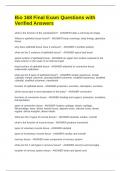
Bio 168 Final Exam Questions with
Verified Answers
what is the function of the cytoskeleton? - ANSWER-helps a cell keep its shape
Where is epithelial tissue found? - ANSWER-body coverings, body linings, glandular
tissue
why does epithelial tissue have 2 surfaces? - ANSWER-it exhibits polarity
what are the 2 surfaces of epithelial tissue? - ANSWER-apical and basal
apical surface of epithelial tissue - ANSWER-an upper free surface exposed to the
body exterior or the cavity of an internal organ
basal surface of epithelial tissue - ANSWER-attached to connective tissue
underneath epithelium
what are the 8 types of epithelial tissue? - ANSWER-simple squamous, simple
cuboidal, simple columnar, pseudostratified columnar, stratified squamous, stratified
cuboidal, stratified columnar, transitional
function of epithelial tissue - ANSWER-protection, secretion, absorption, excretion
which tissue type is most abundant in the body? - ANSWER-connective
functions of connective tissue - ANSWER-binding and support, protection, insulation,
transportation
types of connective tissue - ANSWER-hyaline cartilage, elastic cartilage,
fibrocartilage, bone, blood, areolar loose, adipose loose, reticular loose, dense
regular, dense irregular, dense elastic
What are the 3 types of muscle tissue? - ANSWER-skeletal, cardiac, smooth
what is the function of muscle tissue - ANSWER-produce movement
types of voluntary muscle tissue - ANSWER-skeletal
types of involuntary muscle tissue - ANSWER-cardiac and smooth
nervous tissue - ANSWER-main component of nervous system
what are the 2 cell types in nervous tissue? - ANSWER-neurons and neuroglia
location of nervous system tissue - ANSWER-brain and spinal cord
,where is cardiac muscle tissue found? - ANSWER-walls of the heart
Where is dense regular connective tissue found? - ANSWER-tendons and ligaments
Where is fibrocartilage found? - ANSWER-intervertebral discs, pubic symphysis
where is loose areolar connective tissue found? - ANSWER-directly underneath
most epithelia
where is elastic cartilage found? - ANSWER-external ear, epiglottis
where is dense elastic connective tissue found? - ANSWER-walls of large arteries
Where is hyaline cartilage found? - ANSWER-main component of fetal skeleton and
connects ribs to sternum in adult skeleton
Where is pseudostratified columnar epithelium found? - ANSWER-lining the trachea
and upper respiratory system
Where is transitional epithelium found? - ANSWER-lining the ureters and urinary
bladder
Where is stratified cuboidal epithelium found? - ANSWER-lining the ducts of sweat
and mammary glands
Where is simple squamous epithelium found? - ANSWER-kidney glomeruli and lining
the walls of blood vessels
Where is simple columnar epithelium found? - ANSWER-lining the digestive tract
from the stomach to the rectum
Where is stratified squamous epithelium found? - ANSWER-mouth, vagina, and
esophagus
which tissue type has the capacity to regenerate? - ANSWER-epithelial
Where is reticular connective tissue found? - ANSWER-lymph nodes, spleen, bone
marrow
Where is adipose connective tissue found? - ANSWER-under skin in the
hypodermis; around kidneys and eyeballs; within abdomen; in breasts
Where is dense irregular CT found? - ANSWER-deep layer of the dermis
Where is bone CT located? - ANSWER-intervertebral discs of bony vertebrae
where is blood connective tissue found? - ANSWER-blood vessels
where is skeletal muscle tissue found? - ANSWER-attached to bones
, Where is smooth muscle tissue found? - ANSWER-walls of hollow organs
Where is simple cuboidal epithelium found? - ANSWER-Kidney tubules; ducts and
secretory portions of small glands; ovary surface
basic functions of the skin - ANSWER-protects deeper tissues from physical
damage:(abundant desmosomes), desiccation (abundant tight junctions, contains
lipids), infection (due to acid mantle), and ultraviolet light.
true/false: the skin does not contain sensory structures associated with the nervous
system - ANSWER-false
what are the layers of the epidermis (from superficial to deep) - ANSWER-stratum
corneum, stratum lucidum (ONLY in thick skin), stratum granulosum, stratum
spinosum, and stratum basale
what are the layers of the dermis (from superficial to deep) - ANSWER-papillary
layer, reticular layer
functions/attributes of stratum corneum - ANSWER-contains only dead cells, only
thing remaining is keratin filaments of cytoskeleton
functions/attributes of stratum lucidum - ANSWER-found only on palms of hands or
plantar surfaces of feet, appears as a gray-ish mass
what type of tissue is the epidermis made up of? - ANSWER-stratified squamous
epithelium
major cell type of the epidermis - ANSWER-keratinocytes
functions/attributes of stratum granulosum - ANSWER-contains 2 types of granules:
keratohyaline (forms keratin from intermediate filaments) and lamellar granules (filled
with a lipid to aid in making the skin water resistant, slowing water loss from our
body). Cells are also preparing for planned cell death
functions/attributes of stratum spinosum - ANSWER-keratinocytes increase their
number of desmosomes and intermediate filaments of the cytoskeleton. receives
nourishment from the dermal blood vessels
functions/attributes of stratum basale - ANSWER-epidermal cells undergo mitosis.
receives nourishment from dermal blood vessels
functions/attributes of papillary layer of dermis - ANSWER-made up of areolar CT,
which functions to nourish the epidermis & defends against any microorganisms that
get through the epidermis. It also contains elastic fibers that give the skin it's ability to
stretch
what attaches the dermis to the epidermis? - ANSWER-dermal papilla
Verified Answers
what is the function of the cytoskeleton? - ANSWER-helps a cell keep its shape
Where is epithelial tissue found? - ANSWER-body coverings, body linings, glandular
tissue
why does epithelial tissue have 2 surfaces? - ANSWER-it exhibits polarity
what are the 2 surfaces of epithelial tissue? - ANSWER-apical and basal
apical surface of epithelial tissue - ANSWER-an upper free surface exposed to the
body exterior or the cavity of an internal organ
basal surface of epithelial tissue - ANSWER-attached to connective tissue
underneath epithelium
what are the 8 types of epithelial tissue? - ANSWER-simple squamous, simple
cuboidal, simple columnar, pseudostratified columnar, stratified squamous, stratified
cuboidal, stratified columnar, transitional
function of epithelial tissue - ANSWER-protection, secretion, absorption, excretion
which tissue type is most abundant in the body? - ANSWER-connective
functions of connective tissue - ANSWER-binding and support, protection, insulation,
transportation
types of connective tissue - ANSWER-hyaline cartilage, elastic cartilage,
fibrocartilage, bone, blood, areolar loose, adipose loose, reticular loose, dense
regular, dense irregular, dense elastic
What are the 3 types of muscle tissue? - ANSWER-skeletal, cardiac, smooth
what is the function of muscle tissue - ANSWER-produce movement
types of voluntary muscle tissue - ANSWER-skeletal
types of involuntary muscle tissue - ANSWER-cardiac and smooth
nervous tissue - ANSWER-main component of nervous system
what are the 2 cell types in nervous tissue? - ANSWER-neurons and neuroglia
location of nervous system tissue - ANSWER-brain and spinal cord
,where is cardiac muscle tissue found? - ANSWER-walls of the heart
Where is dense regular connective tissue found? - ANSWER-tendons and ligaments
Where is fibrocartilage found? - ANSWER-intervertebral discs, pubic symphysis
where is loose areolar connective tissue found? - ANSWER-directly underneath
most epithelia
where is elastic cartilage found? - ANSWER-external ear, epiglottis
where is dense elastic connective tissue found? - ANSWER-walls of large arteries
Where is hyaline cartilage found? - ANSWER-main component of fetal skeleton and
connects ribs to sternum in adult skeleton
Where is pseudostratified columnar epithelium found? - ANSWER-lining the trachea
and upper respiratory system
Where is transitional epithelium found? - ANSWER-lining the ureters and urinary
bladder
Where is stratified cuboidal epithelium found? - ANSWER-lining the ducts of sweat
and mammary glands
Where is simple squamous epithelium found? - ANSWER-kidney glomeruli and lining
the walls of blood vessels
Where is simple columnar epithelium found? - ANSWER-lining the digestive tract
from the stomach to the rectum
Where is stratified squamous epithelium found? - ANSWER-mouth, vagina, and
esophagus
which tissue type has the capacity to regenerate? - ANSWER-epithelial
Where is reticular connective tissue found? - ANSWER-lymph nodes, spleen, bone
marrow
Where is adipose connective tissue found? - ANSWER-under skin in the
hypodermis; around kidneys and eyeballs; within abdomen; in breasts
Where is dense irregular CT found? - ANSWER-deep layer of the dermis
Where is bone CT located? - ANSWER-intervertebral discs of bony vertebrae
where is blood connective tissue found? - ANSWER-blood vessels
where is skeletal muscle tissue found? - ANSWER-attached to bones
, Where is smooth muscle tissue found? - ANSWER-walls of hollow organs
Where is simple cuboidal epithelium found? - ANSWER-Kidney tubules; ducts and
secretory portions of small glands; ovary surface
basic functions of the skin - ANSWER-protects deeper tissues from physical
damage:(abundant desmosomes), desiccation (abundant tight junctions, contains
lipids), infection (due to acid mantle), and ultraviolet light.
true/false: the skin does not contain sensory structures associated with the nervous
system - ANSWER-false
what are the layers of the epidermis (from superficial to deep) - ANSWER-stratum
corneum, stratum lucidum (ONLY in thick skin), stratum granulosum, stratum
spinosum, and stratum basale
what are the layers of the dermis (from superficial to deep) - ANSWER-papillary
layer, reticular layer
functions/attributes of stratum corneum - ANSWER-contains only dead cells, only
thing remaining is keratin filaments of cytoskeleton
functions/attributes of stratum lucidum - ANSWER-found only on palms of hands or
plantar surfaces of feet, appears as a gray-ish mass
what type of tissue is the epidermis made up of? - ANSWER-stratified squamous
epithelium
major cell type of the epidermis - ANSWER-keratinocytes
functions/attributes of stratum granulosum - ANSWER-contains 2 types of granules:
keratohyaline (forms keratin from intermediate filaments) and lamellar granules (filled
with a lipid to aid in making the skin water resistant, slowing water loss from our
body). Cells are also preparing for planned cell death
functions/attributes of stratum spinosum - ANSWER-keratinocytes increase their
number of desmosomes and intermediate filaments of the cytoskeleton. receives
nourishment from the dermal blood vessels
functions/attributes of stratum basale - ANSWER-epidermal cells undergo mitosis.
receives nourishment from dermal blood vessels
functions/attributes of papillary layer of dermis - ANSWER-made up of areolar CT,
which functions to nourish the epidermis & defends against any microorganisms that
get through the epidermis. It also contains elastic fibers that give the skin it's ability to
stretch
what attaches the dermis to the epidermis? - ANSWER-dermal papilla