Intro to Biochemistry
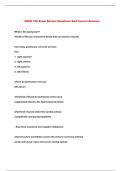
(MURPHY 301) CH 12 - 14,
exam 2 biochem, Biochem
Test 2, Module 3 Biochem
with 100% correct answers
(graded A+)
Anaerobic glycolysis can produce ATP at a much faster rate than
aerobic oxidative phosphorylation.
True or False? - answer True
Which of the following types of reaction does NOT occur in
glycolysis?
A) Isomerization
B) Nucleophilic attack
C) Aldol condensation
D) Oxidation
E) Dehydration - answer Aldol condensation
The standard free energy change of the glycolytic pathway to
pyruvate is -79.9 kJ/mol, while the standard free energy change
associated with gluconeogenesis from pyruvate is -42.7 kJ/mol.
What would the standard free energy change be for a direct reversal
of the glycolytic pathway. - answer +79.9 kJ/mol
Glycolysis is regulated primarily by:
,A) the availability of glucose-6-phosphate.
B) three strongly endergonic, nonequilibrium reactions.
C) three strongly exergonic, nonequilibrium reactions.
D) allosteric effectors of pyruvate kinase.
E) phosphorylation of phosphofructokinase. - answer three strongly
exergonic, nonequilibrium reactions
Which of the following statements about regulation of
phosphofructokinase is FALSE?
A) AMP is an activator.
B) ADP is an activator.
C) Citrate is an inhibitor.
D) Fructose 2,6-bisphosphate is an activator.
E) ATP decreases the apparent Km for fructose-6-phosphate. -
answer ATP decreases the apparent Km for fructose-6-phosphate.
Liver pyruvate kinase is activated by dephosphorylation in response
to glucagon.
True or False - answer False
Hexokinase, phosphofructokinase and pyruvate kinase are each
subject to ________ control. - answer allosteric
Fructose-1,6-bisphosphate is a feedforward ________ activator of liver
pyruvate kinase. - answer allosteric
The oxidation of glucose to lactate has a standard free energy
change of approximately -196 kJ/mol. Calculate the efficiency of
energy conversion if the standard free energy change for the
,production of ATP from ADP and inorganic phosphate is +32.2
kJ/mol. - answer 33.8%
All of the reactions of both glycolysis and gluconeogenesis occur in
the cytosol.
True or False - answer False
The flux rate through the gluconeogenic pathway is directly
proportional to the amount of carbohydrate in the diet.
True or False - answer False
Much of the regulation of gluconeogenesis is a result of the
inhibition of glycolysis
True or False - answer True
Which of the following cannot be used as a precursor for
gluconeogenesis?
A) Glycerol
B) Pyruvate
C) Lactate
D) Leucine
E) Alanine - answer Leucine
Flux through the pentose phosphate pathway is controlled mainly
by the NADP+/NADPH ratio in the cell
, True or False - answer True
The primary gluconeogenic organ in animals is:
A) skeletal muscle.
B) kidney medulla.
C) kidney cortex.
D) liver.
E) heart muscle. - answer Liver
________ from muscle working anaerobically is released to blood and
can be taken up by liver where it is converted to pyruvate by the
enzyme lactate dehydrogenase. - answer Lactate
The Pasteur effect describes the observation that yeast-
metabolizing glucose anaerobically will dramatically increase their
rate of glucose utilization when provided with air
True or False - answer False
Both glycolysis and gluconeogenesis are controlled by fructose 2,6-
bisphosphate in response to hormones.
True or False - answer True
Pyruvate carboxylase and phosphoenolpyruvate carboxykinase
catalyze reactions of gluconeogenesis that bypass the reaction of
glycolysis that is catalyzed by _______ _____. - answer pyruvate kinase
Glycogen is a major energy source for skeletal muscle contraction.
(MURPHY 301) CH 12 - 14,
exam 2 biochem, Biochem
Test 2, Module 3 Biochem
with 100% correct answers
(graded A+)
Anaerobic glycolysis can produce ATP at a much faster rate than
aerobic oxidative phosphorylation.
True or False? - answer True
Which of the following types of reaction does NOT occur in
glycolysis?
A) Isomerization
B) Nucleophilic attack
C) Aldol condensation
D) Oxidation
E) Dehydration - answer Aldol condensation
The standard free energy change of the glycolytic pathway to
pyruvate is -79.9 kJ/mol, while the standard free energy change
associated with gluconeogenesis from pyruvate is -42.7 kJ/mol.
What would the standard free energy change be for a direct reversal
of the glycolytic pathway. - answer +79.9 kJ/mol
Glycolysis is regulated primarily by:
,A) the availability of glucose-6-phosphate.
B) three strongly endergonic, nonequilibrium reactions.
C) three strongly exergonic, nonequilibrium reactions.
D) allosteric effectors of pyruvate kinase.
E) phosphorylation of phosphofructokinase. - answer three strongly
exergonic, nonequilibrium reactions
Which of the following statements about regulation of
phosphofructokinase is FALSE?
A) AMP is an activator.
B) ADP is an activator.
C) Citrate is an inhibitor.
D) Fructose 2,6-bisphosphate is an activator.
E) ATP decreases the apparent Km for fructose-6-phosphate. -
answer ATP decreases the apparent Km for fructose-6-phosphate.
Liver pyruvate kinase is activated by dephosphorylation in response
to glucagon.
True or False - answer False
Hexokinase, phosphofructokinase and pyruvate kinase are each
subject to ________ control. - answer allosteric
Fructose-1,6-bisphosphate is a feedforward ________ activator of liver
pyruvate kinase. - answer allosteric
The oxidation of glucose to lactate has a standard free energy
change of approximately -196 kJ/mol. Calculate the efficiency of
energy conversion if the standard free energy change for the
,production of ATP from ADP and inorganic phosphate is +32.2
kJ/mol. - answer 33.8%
All of the reactions of both glycolysis and gluconeogenesis occur in
the cytosol.
True or False - answer False
The flux rate through the gluconeogenic pathway is directly
proportional to the amount of carbohydrate in the diet.
True or False - answer False
Much of the regulation of gluconeogenesis is a result of the
inhibition of glycolysis
True or False - answer True
Which of the following cannot be used as a precursor for
gluconeogenesis?
A) Glycerol
B) Pyruvate
C) Lactate
D) Leucine
E) Alanine - answer Leucine
Flux through the pentose phosphate pathway is controlled mainly
by the NADP+/NADPH ratio in the cell
, True or False - answer True
The primary gluconeogenic organ in animals is:
A) skeletal muscle.
B) kidney medulla.
C) kidney cortex.
D) liver.
E) heart muscle. - answer Liver
________ from muscle working anaerobically is released to blood and
can be taken up by liver where it is converted to pyruvate by the
enzyme lactate dehydrogenase. - answer Lactate
The Pasteur effect describes the observation that yeast-
metabolizing glucose anaerobically will dramatically increase their
rate of glucose utilization when provided with air
True or False - answer False
Both glycolysis and gluconeogenesis are controlled by fructose 2,6-
bisphosphate in response to hormones.
True or False - answer True
Pyruvate carboxylase and phosphoenolpyruvate carboxykinase
catalyze reactions of gluconeogenesis that bypass the reaction of
glycolysis that is catalyzed by _______ _____. - answer pyruvate kinase
Glycogen is a major energy source for skeletal muscle contraction.