Time-Sharing Operating System
Introduction:
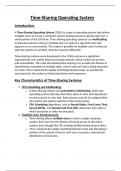
A Time-Sharing Operating System (TSOS) is a type of operating system that allows
multiple users to access a computer system simultaneously by giving each user a
small portion of the CPU time. Time-sharing operating systems use multitasking
to allocate processor time to multiple users or tasks in a way that each task
appears to run concurrently. This makes it possible for multiple users to interact
with the system in real-time, sharing resources efficiently.
Time-sharing systems were developed in the 1960s and were a significant
improvement over earlier batch processing systems, which could only process
jobs sequentially. The main idea behind time-sharing is to provide the illusion of
simultaneous execution of multiple tasks, even if only one task is being executed
at a time. This is achieved by rapidly switching between tasks, so quickly that
users perceive the system as being interactive and responsive.
Key Characteristics of Time-Sharing Systems:
1. CPU Scheduling and Multitasking:
o A time-sharing system uses preemptive multitasking, where the
operating system allocates fixed time slices or time slots (quantum)
to each process or user task. Each process runs for its assigned time
slice before the system switches to the next process.
o CPU Scheduling algorithms, such as Round Robin, First-Come, First-
Served (FCFS), and Shortest Job First (SJF), determine the order in
which processes or tasks are executed.
2. Multiple Users Simultaneously:
o Time-sharing allows multiple users to share a single computer
system. Each user has the illusion of having access to the entire
system, even though the CPU is being divided among several tasks.
o This is achieved by rapidly switching between tasks and allocating a
portion of the system's time to each user or process, ensuring fair
distribution of resources.
, 3. Interactivity:
o A key feature of time-sharing systems is the ability to interact with
the computer in real-time. Users can issue commands, receive
feedback, and run programs without having to wait for the
completion of long-running jobs, as the system responds to inputs
and outputs almost instantly.
o The system prioritizes user input and ensures that tasks or processes
that require user interaction receive CPU time quickly.
4. Resource Allocation:
o The system allocates resources, such as memory, CPU time, and I/O
devices, to multiple tasks or users in an efficient and fair manner. It
ensures that no single task monopolizes system resources, and that
each task gets a fair share of processing time.
o Memory management techniques like virtual memory allow time-
sharing systems to give the illusion of a larger amount of memory
than is physically available, allowing for more efficient execution of
concurrent tasks.
5. Multitasking and Process Switching:
o In a time-sharing system, tasks or processes are interleaved through
rapid switching. The operating system saves the current state of a
task (called context switching) and restores the state of the next
task.
o This ensures that multiple tasks run "concurrently" without
interfering with one another. The task switching is so fast that users
perceive a smooth, interactive experience, even though only one task
is running at any given moment.
6. Efficiency and Responsiveness:
o Time-sharing systems are designed for efficient resource utilization.
The CPU time is divided among all active tasks or users, reducing idle
time and making the system highly responsive.
o These systems aim to reduce turnaround time (the time from
submitting a task to receiving the output), ensuring that tasks are
completed quickly while allowing for multiple tasks to be processed
simultaneously.
Introduction:
A Time-Sharing Operating System (TSOS) is a type of operating system that allows
multiple users to access a computer system simultaneously by giving each user a
small portion of the CPU time. Time-sharing operating systems use multitasking
to allocate processor time to multiple users or tasks in a way that each task
appears to run concurrently. This makes it possible for multiple users to interact
with the system in real-time, sharing resources efficiently.
Time-sharing systems were developed in the 1960s and were a significant
improvement over earlier batch processing systems, which could only process
jobs sequentially. The main idea behind time-sharing is to provide the illusion of
simultaneous execution of multiple tasks, even if only one task is being executed
at a time. This is achieved by rapidly switching between tasks, so quickly that
users perceive the system as being interactive and responsive.
Key Characteristics of Time-Sharing Systems:
1. CPU Scheduling and Multitasking:
o A time-sharing system uses preemptive multitasking, where the
operating system allocates fixed time slices or time slots (quantum)
to each process or user task. Each process runs for its assigned time
slice before the system switches to the next process.
o CPU Scheduling algorithms, such as Round Robin, First-Come, First-
Served (FCFS), and Shortest Job First (SJF), determine the order in
which processes or tasks are executed.
2. Multiple Users Simultaneously:
o Time-sharing allows multiple users to share a single computer
system. Each user has the illusion of having access to the entire
system, even though the CPU is being divided among several tasks.
o This is achieved by rapidly switching between tasks and allocating a
portion of the system's time to each user or process, ensuring fair
distribution of resources.
, 3. Interactivity:
o A key feature of time-sharing systems is the ability to interact with
the computer in real-time. Users can issue commands, receive
feedback, and run programs without having to wait for the
completion of long-running jobs, as the system responds to inputs
and outputs almost instantly.
o The system prioritizes user input and ensures that tasks or processes
that require user interaction receive CPU time quickly.
4. Resource Allocation:
o The system allocates resources, such as memory, CPU time, and I/O
devices, to multiple tasks or users in an efficient and fair manner. It
ensures that no single task monopolizes system resources, and that
each task gets a fair share of processing time.
o Memory management techniques like virtual memory allow time-
sharing systems to give the illusion of a larger amount of memory
than is physically available, allowing for more efficient execution of
concurrent tasks.
5. Multitasking and Process Switching:
o In a time-sharing system, tasks or processes are interleaved through
rapid switching. The operating system saves the current state of a
task (called context switching) and restores the state of the next
task.
o This ensures that multiple tasks run "concurrently" without
interfering with one another. The task switching is so fast that users
perceive a smooth, interactive experience, even though only one task
is running at any given moment.
6. Efficiency and Responsiveness:
o Time-sharing systems are designed for efficient resource utilization.
The CPU time is divided among all active tasks or users, reducing idle
time and making the system highly responsive.
o These systems aim to reduce turnaround time (the time from
submitting a task to receiving the output), ensuring that tasks are
completed quickly while allowing for multiple tasks to be processed
simultaneously.