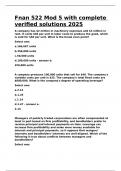
Fnan 522 Mod 5 with complete
verified solutions 2025
A company has $2 million in machinery expenses and $3 million in
rent. It costs $30 per unit in labor costs to produce the good, which
is sold for $50 per unit. What is the break even point?
Select one:
a.166,667 units
b.250,000 units
c.50,000 units
d.100,000 units - answer b.
250,000 units
A company produces 100,000 units that sell for $40. The company's
variable costs per unit is $25. The company's total fixed costs are
$800,000. What is the company's degree of operating leverage?
Select one:
a.2.14
b.1.25
c.1.14
d.1.47 - answer a.
2.14
Managers of publicly traded corporations are often compensated at
least in part based on firm profitability, and bondholders prefer to
receive principal and interest payments on time. Leverage can
increase firm profitability and make more money available for
interest and principal payments, so it appears that mangers'
interests and bondholders' interests are well-aligned. Which of the
following is true about conflicts between managers and
bondholders?
Select one:
, a.Managers may under invest in projects if it appears that all
proceeds will be absorbed by bondholders, hurting both
shareholders and bondholders.
b.Managers' and bondholders' incentives are well aligned only when
firms are 100% equity financed (zero debt financing).
c.Managers' interests and bondholders' interests are well aligned
only when firms are 100% debt financed, but bankruptcy costs
prevent this level of debt financing in practice.
d.There is a cle - answer a.
Managers may under invest in projects if it appears that all
proceeds will be absorbed by bondholders, hurting both
shareholders and bondholders.
If a company with stable earnings wanted to ensure that its
managers' interests are aligned with the company's shareholders,
which of the following capital structures should it use?
Select one:
a.A preferred equity-heavy capital structure that maximizes returns
to shareholders by magnifying ROE, maximizing the tax shield, up to
the point that these benefits are higher than anticipated bankruptcy
costs.
b.An equity-heavy capital structure that maximizes returns to
shareholders by magnifying ROE, maximizing the tax shield, up to
the point that these benefits are higher than anticipated bankruptcy
costs.
c.A debt-heavy capital structure that maximizes returns to
shareholders by magnifying ROE, maximizing the tax shield, up to
the point that these benefits are higher than anticipated bankruptcy
costs.
d.The company's capital structure has no effect on a manager's
interests. - answer c.A debt-heavy capital structure that maximizes
returns to shareholders by magnifying ROE, maximizing the tax
shield, up to the point that these benefits are higher than
anticipated bankruptcy costs.
verified solutions 2025
A company has $2 million in machinery expenses and $3 million in
rent. It costs $30 per unit in labor costs to produce the good, which
is sold for $50 per unit. What is the break even point?
Select one:
a.166,667 units
b.250,000 units
c.50,000 units
d.100,000 units - answer b.
250,000 units
A company produces 100,000 units that sell for $40. The company's
variable costs per unit is $25. The company's total fixed costs are
$800,000. What is the company's degree of operating leverage?
Select one:
a.2.14
b.1.25
c.1.14
d.1.47 - answer a.
2.14
Managers of publicly traded corporations are often compensated at
least in part based on firm profitability, and bondholders prefer to
receive principal and interest payments on time. Leverage can
increase firm profitability and make more money available for
interest and principal payments, so it appears that mangers'
interests and bondholders' interests are well-aligned. Which of the
following is true about conflicts between managers and
bondholders?
Select one:
, a.Managers may under invest in projects if it appears that all
proceeds will be absorbed by bondholders, hurting both
shareholders and bondholders.
b.Managers' and bondholders' incentives are well aligned only when
firms are 100% equity financed (zero debt financing).
c.Managers' interests and bondholders' interests are well aligned
only when firms are 100% debt financed, but bankruptcy costs
prevent this level of debt financing in practice.
d.There is a cle - answer a.
Managers may under invest in projects if it appears that all
proceeds will be absorbed by bondholders, hurting both
shareholders and bondholders.
If a company with stable earnings wanted to ensure that its
managers' interests are aligned with the company's shareholders,
which of the following capital structures should it use?
Select one:
a.A preferred equity-heavy capital structure that maximizes returns
to shareholders by magnifying ROE, maximizing the tax shield, up to
the point that these benefits are higher than anticipated bankruptcy
costs.
b.An equity-heavy capital structure that maximizes returns to
shareholders by magnifying ROE, maximizing the tax shield, up to
the point that these benefits are higher than anticipated bankruptcy
costs.
c.A debt-heavy capital structure that maximizes returns to
shareholders by magnifying ROE, maximizing the tax shield, up to
the point that these benefits are higher than anticipated bankruptcy
costs.
d.The company's capital structure has no effect on a manager's
interests. - answer c.A debt-heavy capital structure that maximizes
returns to shareholders by magnifying ROE, maximizing the tax
shield, up to the point that these benefits are higher than
anticipated bankruptcy costs.