
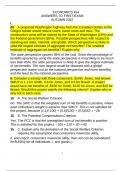
ECONOMICS 454
ANSWERS TO FIRST EXAM
AUTUMN 2022
I.
20 A proposed Washington highway from the Canadian border to the
Oregon border would reduce users’ travel costs and risks. The
construction costs will be shared by the State of Washington (15%) and
the Federal government (85%). Possible perspectives with respect to
standing are state, national, and global. Which perspective is likely to
yield the largest estimate of aggregate net benefits? The smallest
estimate of aggregate net benefits? Explain why.
The state perspective ignores 85% of the cost. Since the percentage of
benefits ignored by using the state perspective is most likely to be much
less than 85%, the state perspective is likely to give the largest estimate
of net benefits. The next largest would be obtained with a global
perspective (same cost as the national perspective and more benefits)
and the least by the national perspective.
II. Consider a society with three consumers, Smith, Jones, and Brown.
SMUY is 1.1 for Smith, 0.6 for Jones, and 0.5 for Brown. A project
would have net benefits of -$100 for Smith, $120 for Jones, and $20 for
Brown. Would this project satisfy the following criteria? Explain why or
why not in each case.
15 A. The Social Welfare Criterion.
No. The SWC is that the weighted sum of net benefits is positive, where
each individual’s weight is equal to their SMUY. This is not satisfied for
this project, because (1.1)(-100) + (0.6)(120) + (0.5)(20) = −28.
15 B. The Potential Compensation Criterion.
Yes. The PCC is that the unweighted sum of net benefits is positive.
This is satisfied for this project, −100 + 120 + 20 = 40.
15 C. Explain why the derivation of the Social Welfare Criterion
requires the assumption that consumers maximize utility.
If, and only if, consumers maximize utility, then λiPj can be substituted
for ∂Ui/∂Xij for all individuals, i, and goods, j.
1
ANSWERS TO FIRST EXAM
AUTUMN 2022
I.
20 A proposed Washington highway from the Canadian border to the
Oregon border would reduce users’ travel costs and risks. The
construction costs will be shared by the State of Washington (15%) and
the Federal government (85%). Possible perspectives with respect to
standing are state, national, and global. Which perspective is likely to
yield the largest estimate of aggregate net benefits? The smallest
estimate of aggregate net benefits? Explain why.
The state perspective ignores 85% of the cost. Since the percentage of
benefits ignored by using the state perspective is most likely to be much
less than 85%, the state perspective is likely to give the largest estimate
of net benefits. The next largest would be obtained with a global
perspective (same cost as the national perspective and more benefits)
and the least by the national perspective.
II. Consider a society with three consumers, Smith, Jones, and Brown.
SMUY is 1.1 for Smith, 0.6 for Jones, and 0.5 for Brown. A project
would have net benefits of -$100 for Smith, $120 for Jones, and $20 for
Brown. Would this project satisfy the following criteria? Explain why or
why not in each case.
15 A. The Social Welfare Criterion.
No. The SWC is that the weighted sum of net benefits is positive, where
each individual’s weight is equal to their SMUY. This is not satisfied for
this project, because (1.1)(-100) + (0.6)(120) + (0.5)(20) = −28.
15 B. The Potential Compensation Criterion.
Yes. The PCC is that the unweighted sum of net benefits is positive.
This is satisfied for this project, −100 + 120 + 20 = 40.
15 C. Explain why the derivation of the Social Welfare Criterion
requires the assumption that consumers maximize utility.
If, and only if, consumers maximize utility, then λiPj can be substituted
for ∂Ui/∂Xij for all individuals, i, and goods, j.
1


