100% de satisfacción garantizada Inmediatamente disponible después del pago Tanto en línea como en PDF No estas atado a nada 4,6 TrustPilot
logo-home
Examen

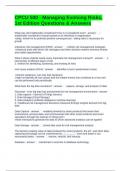
CPCU 500 - Managing Evolving Risks, 1st Edition Questions & Answers

Puntuación
-
Vendido
-
Páginas
9
Grado
A+
Subido en
25-10-2024
Escrito en
2024/2025

CPCU 500 - Managing Evolving Risks, 1st Edition Questions & Answers What was risk traditionally considered? How is it considered now? -traditionally considered a hazard posed to an individual or organization -today, known for its potential positive consequences - taking risks is necessary for growth enterprise risk management (ERM) -holistic risk management strategies -enhanced tools with which risk managers and other decision makers minimize threats and exploit opportunities Previous Play Next Rewind 10 seconds Move forward 10 seconds Unmute 0:00 / 0:15 Full screen Brainpower Read More What 2 ideas underlie nearly every important risk management concept? 1. intersection of different types of risk 2. method for identifying, assessing, and treating all risks root cause analysis (RCA) identifies a loss's predominant cause -inherent weakness: can only look backward -might not identify all root causes and the related events that contribute to a loss and can be performed only periodically What fuels the big data revolution? capture, storage, and analysis of data Flowchart - How big data has transformed the risk management environment 1. Data capture - Internet of Things Sensors 2. Data Storage (Cloud Storage) 3. Data Analytics (Artificial intelligence machine learning) 4. Traditional risk management decisions enhanced through insights derived from big data Data Capture enabled primarily by smart products that sense their environment, process data, and communicate with other smart products and smart operations through the Internet of Things (IoT) -these interactions generate the data to which advanced analytics can be applied Data Storage stored data used for risk management analysis The decision-making value of data produced by smart products, the IoT, and other data-capturing technology can be undermined by _________ - more and faster is not necessarily better. volume, velocity, and veracity database -blockchain's roots like in database technology -collection of structured information stored in discrete units for ease of retrieval, manipulation, combination, or other basic applications - a virtual filing cabinet organized like a spreadshet What is blockchain's primary purpose and how is it used otherwise? -primary purpose: store information -distributed database that serves as a collectively shared ledger ledger -physical or digital -document in which transactions are recorded -common denominator is that all ledgers track the chronology of a particular value's change over time - the results of each recorded transaction -accurate, comprehensive, and independently verifiable If the value being tracked in a ledger is connected to something tangible - cash or inventory- how could it be verified? -verified independently of the ledger by manually counting inventory How is virtual currency (cryptocurrency, Bitcoin) tracked and how are people prevented from spending the same virtual coin in more than one transaction (double-spending problem)? -create the system of verification and confirmation that makes the blockchain a reliable ledger and database -blockchain: distributed database and decentralized ledger that maintains a continuously growing list of records, called blocks, in chronological order; each time a new transaction occurs, a new block is created mining new blocks and the data within are confirmed through a consensus process called mining -verification process removes intermediary validation and establishes trust without a centralized authority -after a block is confirmed and the data within it is verified through the decentralized consensus process, the block is time-stamped and added to the preexisting blocks in the chain, hence the term "blockchain" 2 examples of potential blockchain exploration in the field of insurance 1. travel insurance - if an airline cancels a flight for a covered reason, a smart contract built using blockchain technology could automatically enact payment to those with insurance 2. crop insurance - if insured crops suffer damage from the weather, a smart contract can confirm the loss using weather data and pay claims automatically -show blockchain's ability to lower costs, thereby allowing consumers to realize savings data analytics the collection, storage, and sharing of data that empowers real-time risk management for organizations that use data gleaned from sensors to react immediately to hazardous situations How are the investments that businesses are making in their big data infrastructures laying the groundwork for the continued evolution of the risk management landscape? -empowering organizations and their risk management professionals to better access and analyze data and to more efficiently and quickly conceive, develop, and distribute products Collected and stored data can be used to develop forward-thinking risk management strategies when that data is ______. organized and analyzed through methods that use artificial intelligence, including machine learning and neural network technologies Insurers and risk managers can improve their business results through data-driven decision making in 4 ways: 1. organizing large volumes of data - organizing data according to multiple characteristics (ex: information provided by vehicle telematics, which can include speed, braking patterns, left turns, and distance traveled 2. discovering new relationships in data (ex: risk manager could identify the characteristics of workers who have never had a workplace accident and use that information to identify how to improve safety for all workers) 3. Exploring new sources of data - text mining used to compare documents and analyze notes for various purposes 4. Developing new products- increasingly accurate predictive modeling of hazards, particularly catastrophe modeling, enabled by sources of shared, comprehensive data about the complex interactions of contributing factors has led to product innovation (ex: parametric insurance: coverage that pays a predetermined amount to the insured if a particular set of parameters occur, such as a hurricane's wind speed) big data sets of data that are too large to be gathered and analyzed by traditional methods smart product an innovative item that uses sensors; wireless sensor networks; and data collection, transmission, and analysis to further enable the item to be faster, more useful, or otherwise improved Internet of Things (IoT) a network of objects that transmit data to and from each other without human interaction cloud computing information, technology, and storage services contractually provided from remote locations, through the internet or another network, without a direct server connection Blockchain a distributed digital ledger that facilitates secure transactions without the need for a third party Telematics the use of technological devices in vehicles with wireless communication and GPS tracking that transmit data to businesses or government agencies; some return information for the driver Text mining obtaining information through language recognition risktech risk monitoring and mitigation technology -expands its focus on how to make risk financing more efficient to include how to prevent and mitigate risk in a variety of industries Risktech Ecosystem examples: use of sensors for tracking purposes -application of virtual reality to train workers in an artificial environment, reducing the risks associated with real world settings -Smart products, such as sensors, can be used to transmit information via the Internet -sensors used to track products during the shipping process -Smart operations: allow the supply chain manager of a company to remotely track the location of products, based on the data transmitted from sensors -supply chain decisions can be made automatically based on real time data being received from products in transit -Summary: Emerging technologies embedded in Smart Products or Smart Operations provide data for Big Data Analytics; Big Data Analytics includes continuous risk monitoring and automated actions for Risk Assessment and Risk Control Risktech is largely the result of emerging technologies coupled with ______. smart products The interactions between emerging technologies and smart products generate _______, to which _______ can be applied, ultimately reducing the ______. -big data -advanced analytics uncertainty associated with predicting future events The application of emerging technologies to risk assessment and control is largely being driven by the_________, which consists of _________, primarily through the use of _______. -Internet of Things (IoT) -IoT objects that collect and transmit data through the internet -sensors smart products used in risk management today to assess and control risk -wearables -drones -robots -smartphones wearables ex: helmets that monitor fatigue, wristwatches that measure vital signs and can sense, monitor, report, and analyze workers' health or well-being and their surrounding environments -data may be specific to one employee or aggregated for a project, a team, or an organization Drones can be used in surveillance and aerial photography -unmanned and highly versatile : ideal for assessing conditions or risks in dangerous or unfamiliar areas -data generated by drones relies heavily on other technologies, such as computer vision, image recognition, and artificial intelligence, to mine the data collected and form conclusions about detected objects robots can measure, respond to, and protect data for monitored hazards or changing environmental conditions -by performing certain activities, can reduce the frequency of human error smartphones can measure acceleration, light, temperature, humidity, pressure, proximity, and location - all particularly relevant in transportation and workplace safety What does preventive analytics leverage, and why is it effective? -leverages modern technology, big data, and advanced analytics to identify root causes and their interactions -effective because it continuously monitors activity- whether arising from humans or machines -forward looking (ex: truck's brakes may automatically be applied because a front-facing camera determines that a vehicle has stopped directly in front of the truk) Connected ecosystem -system of interconnected parts -risktech ecosystem: emerging technologies, smart products and smart operations, and big data analytics -emerging technologies and smart products connect the physical and virtual domains, resulting in connected ecosystems for a variety of risk management specialties, including property, supply chain, transportation, catastrophe, and workplace safety -these connections enhance risk management decision making because they allow property managers to detect leaks and malfunctions, transportation managers to respond to drivers' issues in real time, more people to be evacuated before an impending catastrophe, and prevention of countless injuries and damages Connected Ecosystems: Physical Domain -sensors/sensor networks -wearables -drones -robots -autonomous vehicles Connected Ecosystems: ecosystems -property -supply chain -transportation -catastrophe -workplace Connected Ecosystems: Virtual Domain -artificial intelligence -augmented/virtual reality -computer vision -telematics Insurtech the use of emerging technologies in the insurance industry sensor a device that detects and measures stimuli in its environment Preventive analytics statistical and analytical techniques used to influence or prevent future events or behaviors Artificial Intelligence (AI) refers to the ability of machines to simulate human intelligence -enables computers to perform tasks that require critical thinking, such as making decisions for risk assessment and control -allows robots to work collaboratively alongside humans in factories, cars to operate without human drivers, and claims adjusters to be quickly deployed in the event of a natural catastrophe -trains machines on the nuance of sources and the causes of various risks, then it establishes automatic responses based on a set of rules -financial institution can use AI to identify a trader who is committing the institution to excessive financial risk and immediately respond with built-in financial circuit breakers to limit the risk Deep Learning extension of AI, attempts to understand and mimic neural networks in the brain through software that simulates image and speech recognition ex: understanding medical information and its implications to assist medical personnel in crucial decision making; improved voice-search capabilities on smartphones Why is it important for all organizations, including insurers, to explore using artificial intelligence? companies not engaged in newer trends with AI and big data are going to be actively selected against by customers

Mostrar más Leer menos
Institución
CPCU - Chartered Property Casualty Underwriter
Grado
CPCU - Chartered Property Casualty Underwriter


Ups! No podemos cargar tu documento ahora. Inténtalo de nuevo o contacta con soporte.

Escuela, estudio y materia

Institución
CPCU - Chartered Property Casualty Underwriter
Grado
CPCU - Chartered Property Casualty Underwriter

Información del documento

Subido en
25 de octubre de 2024
Número de páginas
9
Escrito en
2024/2025
Tipo
Examen
Contiene
Preguntas y respuestas

Temas

Vista previa del contenido

CPCU 500 - Managing Evolving Risks,
1st Edition Questions & Answers
What was risk traditionally considered? How is it considered now? - answer -
traditionally considered a hazard posed to an individual or organization
-today, known for its potential positive consequences - taking risks is necessary for
growth

enterprise risk management (ERM) - answer -holistic risk management strategies
-enhanced tools with which risk managers and other decision makers minimize threats
and exploit opportunities

What 2 ideas underlie nearly every important risk management concept? - answer 1.
intersection of different types of risk
2. method for identifying, assessing, and treating all risks

root cause analysis (RCA) - answer identifies a loss's predominant cause

-inherent weakness: can only look backward
-might not identify all root causes and the related events that contribute to a loss and
can be performed only periodically

What fuels the big data revolution? - answer capture, storage, and analysis of data

Flowchart - How big data has transformed the risk management environment - answer
1. Data capture - Internet of Things Sensors
2. Data Storage (Cloud Storage)
3. Data Analytics (Artificial intelligence machine learning)
4. Traditional risk management decisions enhanced through insights derived from big
data

Data Capture - answer enabled primarily by smart products that sense their
environment, process data, and communicate with other smart products and smart
operations through the Internet of Things (IoT)
-these interactions generate the data to which advanced analytics can be applied

Data Storage - answer stored data used for risk management analysis

The decision-making value of data produced by smart products, the IoT, and other data-
capturing technology can be undermined by _________ - more and faster is not
necessarily better. - answer volume, velocity, and veracity

database - answer -blockchain's roots like in database technology

, -collection of structured information stored in discrete units for ease of retrieval,
manipulation, combination, or other basic applications - a virtual filing cabinet organized
like a spreadshet

What is blockchain's primary purpose and how is it used otherwise? - answer -
primary purpose: store information
-distributed database that serves as a collectively shared ledger

ledger - answer -physical or digital
-document in which transactions are recorded
-common denominator is that all ledgers track the chronology of a particular value's
change over time - the results of each recorded transaction
-accurate, comprehensive, and independently verifiable

If the value being tracked in a ledger is connected to something tangible - cash or
inventory- how could it be verified? - answer -verified independently of the ledger by
manually counting inventory

How is virtual currency (cryptocurrency, Bitcoin) tracked and how are people prevented
from spending the same virtual coin in more than one transaction (double-spending
problem)? - answer -create the system of verification and confirmation that makes
the blockchain a reliable ledger and database
-blockchain: distributed database and decentralized ledger that maintains a
continuously growing list of records, called blocks, in chronological order; each time a
new transaction occurs, a new block is created

mining - answer new blocks and the data within are confirmed through a consensus
process called mining
-verification process removes intermediary validation and establishes trust without a
centralized authority
-after a block is confirmed and the data within it is verified through the decentralized
consensus process, the block is time-stamped and added to the preexisting blocks in
the chain, hence the term "blockchain"

2 examples of potential blockchain exploration in the field of insurance - answer 1.
travel insurance - if an airline cancels a flight for a covered reason, a smart contract built
using blockchain technology could automatically enact payment to those with insurance
2. crop insurance - if insured crops suffer damage from the weather, a smart contract
can confirm the loss using weather data and pay claims automatically

-show blockchain's ability to lower costs, thereby allowing consumers to realize savings

data analytics - answer the collection, storage, and sharing of data that empowers
real-time risk management for organizations that use data gleaned from sensors to
react immediately to hazardous situations

$14.49
Accede al documento completo:

100% de satisfacción garantizada
Inmediatamente disponible después del pago
Tanto en línea como en PDF
No estas atado a nada


Documento también disponible en un lote

Thumbnail
Package deal
CPCU EXAM BUDLED
-
32 2024
$ 446.68 Más información

Conoce al vendedor

Seller avatar
Los indicadores de reputación están sujetos a la cantidad de artículos vendidos por una tarifa y las reseñas que ha recibido por esos documentos. Hay tres niveles: Bronce, Plata y Oro. Cuanto mayor reputación, más podrás confiar en la calidad del trabajo del vendedor.
Pogba119 Harvard University
Ver perfil
Seguir Necesitas iniciar sesión para seguir a otros usuarios o asignaturas
Vendido
48
Miembro desde
1 año
Número de seguidores
2
Documentos
4967
Última venta
1 mes hace
NURSING TEST

BEST EDUCATIONAL RESOURCES FOR STUDENTS

3.9

9 reseñas

5
4
4
2
3
2
2
0
1
1

Recientemente visto por ti

Por qué los estudiantes eligen Stuvia

Creado por compañeros estudiantes, verificado por reseñas

Calidad en la que puedes confiar: escrito por estudiantes que aprobaron y evaluado por otros que han usado estos resúmenes.

¿No estás satisfecho? Elige otro documento

¡No te preocupes! Puedes elegir directamente otro documento que se ajuste mejor a lo que buscas.

Paga como quieras, empieza a estudiar al instante

Sin suscripción, sin compromisos. Paga como estés acostumbrado con tarjeta de crédito y descarga tu documento PDF inmediatamente.

Student with book image

“Comprado, descargado y aprobado. Así de fácil puede ser.”

Alisha Student

Preguntas frecuentes