

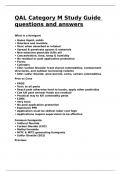
QAL Category M Study Guide
questions and answers
What is a fumigant
• Gases liquid, solids
• Odorless and invisible
• Toxic when absorbed or inhaled
• Spread & penetrate spaces & materials
• Non-selective pesticide (kills all)
• Concentration, time, temp & humidity
• No residual or post application protection
• Forms
• Cylinders
• CO2: Carbon Dioxide: treat stored commodities, containment
structures, and outdoor burrowing rodents
• SO2: sulfur dioxide: wine barrels, corks, certain commodities
Pros vs Cons
• PROS
• Toxic to all pests
• Reach pest otherwise hard to locate, apply other pesticides
• Can kill pest on/near foods w/o residual
• Practical way to kill commodity pests
• CONS
• Very toxic
• No post application protection
• Expensive PPE
• Applicators must be skilled: labor cost high
• Applications require supervision to be effective
Common fumigants:
• Sulfuryl fluoride
• Carbon Dioxide (CO2)
• Methyl bromide
• MITC & MITC generating fumigants
• Sulfur Dioxide (SO2)
Previous
, Play
Next
Rewind 10 seconds
Move forward 10 seconds
Unmute
0:00
/
0:15
Full screen
Brainpower
Read More
Fumigant distribution in a space
• Molecular weight: measure of the weight of the atoms that forma
particular substance
• Specific gravity: ratio of the density of a substance to the density
of a standard
• Standard for gas = 1
• Greater then 1 = heavier than air, sinks
• Less then 1 = lighter than air, rises
• MW and SG: tell you
• SF = 3.52
• Labeled required fans to evenly distribute AI
Volatility & Vapor pressure
• Volatility: describes how a substance turns to vapor
• Vapor: measurement of the push against the atmosphere
• Vapor pressure: pressure stabilize at a constant value
• Higher vapor pressure = more concentrated = better fumigant
Solubility, Flammability, Reactivity
• Solubility: measure of how gas will dissolve into other materials
• Highly soluble fumes will dissolve in high moisture/oil content
commodities
• Flammability: capacity to catch fire
• Reactivity: reaction with products
questions and answers
What is a fumigant
• Gases liquid, solids
• Odorless and invisible
• Toxic when absorbed or inhaled
• Spread & penetrate spaces & materials
• Non-selective pesticide (kills all)
• Concentration, time, temp & humidity
• No residual or post application protection
• Forms
• Cylinders
• CO2: Carbon Dioxide: treat stored commodities, containment
structures, and outdoor burrowing rodents
• SO2: sulfur dioxide: wine barrels, corks, certain commodities
Pros vs Cons
• PROS
• Toxic to all pests
• Reach pest otherwise hard to locate, apply other pesticides
• Can kill pest on/near foods w/o residual
• Practical way to kill commodity pests
• CONS
• Very toxic
• No post application protection
• Expensive PPE
• Applicators must be skilled: labor cost high
• Applications require supervision to be effective
Common fumigants:
• Sulfuryl fluoride
• Carbon Dioxide (CO2)
• Methyl bromide
• MITC & MITC generating fumigants
• Sulfur Dioxide (SO2)
Previous
, Play
Next
Rewind 10 seconds
Move forward 10 seconds
Unmute
0:00
/
0:15
Full screen
Brainpower
Read More
Fumigant distribution in a space
• Molecular weight: measure of the weight of the atoms that forma
particular substance
• Specific gravity: ratio of the density of a substance to the density
of a standard
• Standard for gas = 1
• Greater then 1 = heavier than air, sinks
• Less then 1 = lighter than air, rises
• MW and SG: tell you
• SF = 3.52
• Labeled required fans to evenly distribute AI
Volatility & Vapor pressure
• Volatility: describes how a substance turns to vapor
• Vapor: measurement of the push against the atmosphere
• Vapor pressure: pressure stabilize at a constant value
• Higher vapor pressure = more concentrated = better fumigant
Solubility, Flammability, Reactivity
• Solubility: measure of how gas will dissolve into other materials
• Highly soluble fumes will dissolve in high moisture/oil content
commodities
• Flammability: capacity to catch fire
• Reactivity: reaction with products

