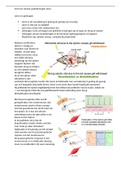
Anatomy Lower Limb Study Guide / Summary
Serial Homology in limbs
Lower limb Upper Limb
- Pelvic girdle - pectoral girdle
o Os coxae - scapula and clavicle
- Femur - humerus
- Tibia -radius
- Fibula -carpals
- Tarsals -metacarpals
- Metatarsals -phalanges
- Phalanges
*Different types of LIMB JOINTS allow different types of MUSCLE ACTIONS
* know which muscles belong to each compartment / group
LIMB MUSCLES:
- Develop from somites
- Composed of hypaxial muscles (skeletal) general somatic efferent
- Innervated by ventral rami of spinal nerves
MUSCLE GROUPS:
- Share common developmental history*
- Often have the same motor innervation
- Often share similar origins and insertions
- Often share similar muscle actions
ANTERIOR COMPARTMENT: hip, thigh, and knee
Pelvic Girdle:
- Sacrum + Os Coxae
- Os Coxae= ilium + ischium + pubis
Femur:
Composed of:
- Head of femur
- Neck
- Lesser trochanter
- Greater trochanter
- gluteal tuberosity
- linea aspera (length of body/shaft)
- medial epicondyle
, - lateral epicondyle
- medial condyle (articulates with tibia)
- lateral condyle (articulates with tibia)
Joints:
Hip
- pubic symphysis
o cartilaginous joint
- sacroiliac joint
o synovial / gliding (little motion)
- ligaments (syndesmoses)
o ant/post sacroiliac
o sacrospinous
o Sacrotuberous
- Coxal (hip)
o Synovial: ball and socket
- Coxal joint
o Reinforcing ligaments
Knee
- Two articulations!
o Hinge joint b/w femur and tibia
o Gliding joint b/w patella and femur
o Provides flexion and extension as actions as well as some rotation
- Menisci
o Medial and lateral
o They are fibrocartilage discs
o They match the articulating surfaces
o They are shock absorbing
o Provide joint stability
- Ligaments for knee stability (extracapsular)
o Patellar tendon
o Medial collateral ligament (MCL)
o Lateral collateral ligament (LCL)
- Intracapsular
o Anterior cruciate ligament (ACL)
Weaker, prevents hyperextension, prevents anterior displacement (tibial)
o Posterior cruciate ligament (PCL)
Stronger, prevents hyperflexion, prevents posterior displacement (tibial)
MUSCLES
Anterior compartment:
Serial Homology in limbs
Lower limb Upper Limb
- Pelvic girdle - pectoral girdle
o Os coxae - scapula and clavicle
- Femur - humerus
- Tibia -radius
- Fibula -carpals
- Tarsals -metacarpals
- Metatarsals -phalanges
- Phalanges
*Different types of LIMB JOINTS allow different types of MUSCLE ACTIONS
* know which muscles belong to each compartment / group
LIMB MUSCLES:
- Develop from somites
- Composed of hypaxial muscles (skeletal) general somatic efferent
- Innervated by ventral rami of spinal nerves
MUSCLE GROUPS:
- Share common developmental history*
- Often have the same motor innervation
- Often share similar origins and insertions
- Often share similar muscle actions
ANTERIOR COMPARTMENT: hip, thigh, and knee
Pelvic Girdle:
- Sacrum + Os Coxae
- Os Coxae= ilium + ischium + pubis
Femur:
Composed of:
- Head of femur
- Neck
- Lesser trochanter
- Greater trochanter
- gluteal tuberosity
- linea aspera (length of body/shaft)
- medial epicondyle
, - lateral epicondyle
- medial condyle (articulates with tibia)
- lateral condyle (articulates with tibia)
Joints:
Hip
- pubic symphysis
o cartilaginous joint
- sacroiliac joint
o synovial / gliding (little motion)
- ligaments (syndesmoses)
o ant/post sacroiliac
o sacrospinous
o Sacrotuberous
- Coxal (hip)
o Synovial: ball and socket
- Coxal joint
o Reinforcing ligaments
Knee
- Two articulations!
o Hinge joint b/w femur and tibia
o Gliding joint b/w patella and femur
o Provides flexion and extension as actions as well as some rotation
- Menisci
o Medial and lateral
o They are fibrocartilage discs
o They match the articulating surfaces
o They are shock absorbing
o Provide joint stability
- Ligaments for knee stability (extracapsular)
o Patellar tendon
o Medial collateral ligament (MCL)
o Lateral collateral ligament (LCL)
- Intracapsular
o Anterior cruciate ligament (ACL)
Weaker, prevents hyperextension, prevents anterior displacement (tibial)
o Posterior cruciate ligament (PCL)
Stronger, prevents hyperflexion, prevents posterior displacement (tibial)
MUSCLES
Anterior compartment: