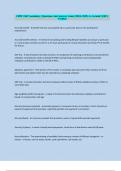
CRPC Full Vocabulary | Questions And Answers Latest {2024- 2025} A+ Graded | 100%
Verified
Accrued benefit - A benefit that has accumulated up to a particular point in the participant's
employment
Accrued benefit method - A method of calculating and funding DB plan liabilities accruing in a particular
yr. Look at plan's benefit accrual for yr for each participant at normal retirement and funds PV of benefit
for that yr.
ACP test - A discrimination test that involves a % comparison of matching contributions and nonelective
employer contributions made on behalf of NHCEs w/matching contributions and nondeductible
employee contributions made on behalf of HCEs.
Adoption agreement - That portion of the master or prototype plan document that contains all of the
alternatives and options that may be selected by an adopting employer
ADP test - A nondiscrimination test that compares deferral rates of NHCEs w/deferral arates of HCEs in
same 401k plan
Age-weighted profit sharing plan - A type of Q retirement plan that allocates employer contributions
based on compensation and age
Annuity (insurance product) - A periodic payment. In insurance terms, an annuity is a form of policy or
payout arrangement that provides a specified periodic cash payment to annuitant.
Annuity (fixed) - An insurance product that provides a series of equal dollar periodic payments
Annuity (Q plans) - A series of equal period payments. Usual form of distribution used by DB plans.
Asset allocation - The apportioning of available funds among a number of different categories - or
classes - of assets, such as stocks, bonds, cash equivalents, real estate, etc.
, Barbell strategy (bonds) - Splits bond portion of portfolio b/wn ST and LT bonds. On short end - as 1 yr
bonds mature, proceeds are invested in 5 yrs, maintaining the maturity structure. On long end - after 1
yr, 16 yr becomes 15, sold and reinvested in 20 yr, maintaining the maturity structure.
Beta coefficient - Or simply "Beta" - a measure of a security's systematic (i.e., nondiversifiable) risk). A
measure of the volatility of an individual asset relative to the volatility of an appropriate benchmark
index. Most often applied to common stocks and MFs.
Brother-sister controlled group - Two tests must be met: (1) 5 or fewer persons must own at least 80%
of the stock of 2 or more corporations and (2) based upon the ownership of each S/H and only to the
extent that it is identical in each corporation, the 5 or fewer persons must own > 50% of the combined
voting power or value of the corporations
C Corporation - Synonymous with "corporation." When a biz incorporates, it does so as a C corp unless a
special tax election is made to become an S corp.
Cash balance pension plan - A DB plan that provides for specific annual employer contributions that
accumulate at a guaranteed rate of investment return
Cash or deferred arrangement (CODA) - An arrangement whereby a participating employee can choose
b/wn taking compensation in the form of cash or deferring a portion of it until the future
Catch-up provision - A provision found in both 403(b) and 457 plans that allows an eligible employee to
make higher annual contributions in the yrs just prior to retirement.
Coefficient of variation - Coefficient of variation (CV) is the standard deviation divided by mean return. A
relative measure of risk (risk per unit of return) and allows risk comparison among different
investments.
Combined controlled group - 3 or more corporations, each of which is a member of a parent-subsidiary
group or a brother-sister group, and one of which is both a parent of a parent-subsidiary group and a
member of a brother-sister group
Verified
Accrued benefit - A benefit that has accumulated up to a particular point in the participant's
employment
Accrued benefit method - A method of calculating and funding DB plan liabilities accruing in a particular
yr. Look at plan's benefit accrual for yr for each participant at normal retirement and funds PV of benefit
for that yr.
ACP test - A discrimination test that involves a % comparison of matching contributions and nonelective
employer contributions made on behalf of NHCEs w/matching contributions and nondeductible
employee contributions made on behalf of HCEs.
Adoption agreement - That portion of the master or prototype plan document that contains all of the
alternatives and options that may be selected by an adopting employer
ADP test - A nondiscrimination test that compares deferral rates of NHCEs w/deferral arates of HCEs in
same 401k plan
Age-weighted profit sharing plan - A type of Q retirement plan that allocates employer contributions
based on compensation and age
Annuity (insurance product) - A periodic payment. In insurance terms, an annuity is a form of policy or
payout arrangement that provides a specified periodic cash payment to annuitant.
Annuity (fixed) - An insurance product that provides a series of equal dollar periodic payments
Annuity (Q plans) - A series of equal period payments. Usual form of distribution used by DB plans.
Asset allocation - The apportioning of available funds among a number of different categories - or
classes - of assets, such as stocks, bonds, cash equivalents, real estate, etc.
, Barbell strategy (bonds) - Splits bond portion of portfolio b/wn ST and LT bonds. On short end - as 1 yr
bonds mature, proceeds are invested in 5 yrs, maintaining the maturity structure. On long end - after 1
yr, 16 yr becomes 15, sold and reinvested in 20 yr, maintaining the maturity structure.
Beta coefficient - Or simply "Beta" - a measure of a security's systematic (i.e., nondiversifiable) risk). A
measure of the volatility of an individual asset relative to the volatility of an appropriate benchmark
index. Most often applied to common stocks and MFs.
Brother-sister controlled group - Two tests must be met: (1) 5 or fewer persons must own at least 80%
of the stock of 2 or more corporations and (2) based upon the ownership of each S/H and only to the
extent that it is identical in each corporation, the 5 or fewer persons must own > 50% of the combined
voting power or value of the corporations
C Corporation - Synonymous with "corporation." When a biz incorporates, it does so as a C corp unless a
special tax election is made to become an S corp.
Cash balance pension plan - A DB plan that provides for specific annual employer contributions that
accumulate at a guaranteed rate of investment return
Cash or deferred arrangement (CODA) - An arrangement whereby a participating employee can choose
b/wn taking compensation in the form of cash or deferring a portion of it until the future
Catch-up provision - A provision found in both 403(b) and 457 plans that allows an eligible employee to
make higher annual contributions in the yrs just prior to retirement.
Coefficient of variation - Coefficient of variation (CV) is the standard deviation divided by mean return. A
relative measure of risk (risk per unit of return) and allows risk comparison among different
investments.
Combined controlled group - 3 or more corporations, each of which is a member of a parent-subsidiary
group or a brother-sister group, and one of which is both a parent of a parent-subsidiary group and a
member of a brother-sister group