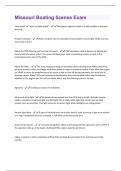
Missouri Boating license Exam "idle speed" or "slow, no wake speed" - The slowest speed at which it is still possible to maintain steering. A Boat's Compass - Boat's compass can be invaluable in bad weather and at night. Make sure you know how to use it. About the PWC Steering and running into boats - PWC operators need to beware of passing too closely behind another vessel. The vessel will block your view of oncoming vessels, as well as the oncoming vessel's view of the PWC. About the PWC: - The most important thing to remember about steering most PWCs (and other jet-drive vessels) is that you always must have power in order to maintain control. If you allow the engine on a PWC or other jet -propelled vessel to return to idle or shut off during operation, you may lose all steering control. Many PWCs will continue in the direction they were headed before the throttle was released or the engine was shut off, no matter which way the steering control is turned. Aground - Touching or stuck on the bottom. All around white light - On power -driven vessels less than 39.4 feet in length, this light may be used to combine a masthead light and sternlight into a single white light that can be seen by other vessels from any direction. This light serves as an anchor light when sidelights ar e extinguished. Anchor Bend Knot - A type of hitching knot, the anchor bend is used to secure a rope to an anchor or a ring. If additional security is needed, a half hitch can be tied at the end. Avoid Jet Ski injuries - -Connect the ignition safety switch lanyard to the operator's wrist or PFD. If the operator ends up in the water, shutting off the engine stops the jet stream. -Wear a wetsuit or other protective clothing that will keep the jet stream from entering your body cavities. -This is recommended for both the operator and any passengers. Passengers could fall off the PWC into the path of the jet stream before the operator can stop the engine. Backfire - Explosion of prematurely ignited fuel or of unburned exhaust gases in an internal combustion engine. Backfire Flame Arrestors: - Because boat engines may backfire, all powerboats (except outboards) that are fueled with gasoline must have an approved backfire flame arrestor on each carburetor. Backfire flame arrestors are designed to prevent the ignition of gasoline vapors in case th e engine backfires. Backfire flame arrestors must be: In good and serviceable condition U.S. Coast Guard -approved (must comply with SAE J -1928 or UL 1111 standards) Periodically clean the flame arrestor(s) and check for any damage. Backfire flame arrestor Bailing - To remove water by scooping it out with a bucket. Beam - Maximum width of a vessel. Bilge - Interior of the hull below the floorboards; lowest part of a vessel's interior where the sides of the vessel curve in to form the bottom Boating Education Law - -All persons born after January 1, 1984, who operate any vessel on the lakes of the state of Missouri must have on board: -A boating safety identification card issued by the Missouri State Highway Patrol (MSHP) and a photo I.D. or... A Missouri driver's license, or a non -driver's license, with a boating safety endorsement. -The boating safety card is obtained by successfully completing a boating safety course approved by the MSHP . -Missouri residents must have and present to a licensing office a boating safety identification card when adding the boating endorsement to the driver's license or non -driver's license. -The boating safety identification card requirement also applies to nonresidents. -Persons who possess a U.S. Coast Guard or Power Squadron boating course certificate may apply for a certificate issued by the Missouri State Highway Patrol. Bow - Front of a vessel. Bow - Front of the vessel. Bowline Knot - The bowline is a multi -purpose knot that is essential for boat operators to know. Forming the knot creates a fixed loop on the end of the rope or line —a loop that can be used for hitching, mooring, or lifting. Can Buoys - These cylindrical -shaped buoys are always marked with green markings and odd numbers. They mark the edge of the channel on your port (left) side when entering from the open sea or heading upstream. Capsize - To turn on the side or turn completely over. Changing Directions sound: - Changing Direction: -One short blast tells other boaters "I intend to pass you on my port (left) side." -Two short blasts tell other boaters "I intend to pass you on my starboard (right) side." -Three short blasts tell other boaters, "I am operating astern propulsion." For some vessels, this tells other boaters, "I am backing up." Chart - Map used for navigation. Class 1 - 16 feet less than 26 feet. Class 2 - 26 feet less than 40 feet. Class 3 - 40 feet to less than 65 feet. Class A - Less than 16 feet. Cleat - Metal fitting on which a rope can be fastened. Cleat - Metal fitting on which a rope can be fastened. Cleating Hitch - Used to attach a line to a cleat on a dock, the cleating hitch is formed by wrapping the line around the base of the cleat, then forming one or more figure eights around the cleat. The knot is secured with a half hitch. Clove Hitch - The clove hitch is handy for temporary fastening, such as when tying up to a piling. It's particularly useful because —with experience —it can be tied with only one hand. For extra fastening power or for longer periods of time, add two half hitches after tyi ng the clove hitch. Common Non - Lateral Markers (Information.) - Squares provide information such as places to find food, supplies, and repairs; and they give directions, distances, and other non -regulatory information. Coupler - The part of the trailer that attaches to the ball hitch on a towing vehicle.
Examen
Missouri Boating license Exam Questions And Answers With Verified Solutions Graded A+
Puntuación
Vendido
-
Páginas
37
Grado
A+
Subido en
27-07-2024
Escrito en
2023/2024
"idle speed" or "slow, no wake speed" - The slowest speed at which it is still possible to maintain steering. A Boat's Compass - Boat's compass can be invaluable in bad weather and at night. Make sure you know how to use it. About the PWC Steering and running into boats - PWC operators need to beware of passing too closely behind another vessel. The vessel will block your view of oncoming vessels, as well as the oncoming vessel's view of the PWC. About the PWC: - The most important thing to remember about steering most PWCs (and other jet-drive vessels) is that you always must have power in order to maintain control. If you allow the engine on a PWC or other jet-propelled vessel to return to idle or shut off during operation, you may lose all steering control. Many PWCs will continue in the direction they were headed before the throttle was released or the engine was shut off, no matter which way the steering control is turned. Aground - Touching or stuck on the bottom. All around white light - On power-driven vessels less than 39.4 feet in length, this light may be used to combine a masthead light and sternlight into a single white light that can be seen by other vessels from any direction. This light serves as an anchor light when sidelights are extinguished. Anchor Bend Knot - A type of hitching knot, the anchor bend is used to secure a rope to an anchor or a ring. If additional security is needed, a half hitch can be tied at the end. Avoid Jet Ski injuries - -Connect the ignition safety switch lanyard to the operator's wrist or PFD. If the operator ends up in the water, shutting off the engine stops the jet stream. -Wear a wetsuit or other protective clothing that will keep the jet stream from entering your body cavities.-This is recommended for both the operator and any passengers. Passengers could fall off the PWC into the path of the jet stream before the operator can stop the engine. Backfire - Explosion of prematurely ignited fuel or of unburned exhaust gases in an internal combustion engine. Backfire Flame Arrestors: - Because boat engines may backfire, all powerboats (except outboards) that are fueled with gasoline must have an approved backfire flame arrestor on each carburetor. Backfire flame arrestors are designed to prevent the ignition of gasoline vapors in case the engine backfires. Backfire flame arrestors must be: In good and serviceable condition U.S. Coast Guard-approved (must comply with SAE J-1928 or UL 1111 standards) Periodically clean the flame arrestor(s) and check for any damage. Backfire flame arrestor Bailing - To remove water by scooping it out with a bucket. Beam - Maximum width of a vessel. Bilge - Interior of the hull below the floorboards; lowest part of a vessel's interior where the sides of the vessel curve in to form the bottom Boating Education Law - -All persons born after January 1, 1984, who operate any vessel on the lakes of the state of Missouri must have on board: -A boating safety identification card issued by the Missouri State Highway Patrol (MSHP) and a photo I.D. or... A Missouri driver's license, or a non-driver's license, with a boating safety endorsement.-The boating safety card is obtained by successfully completing a boating safety course approved by the MSHP. -Missouri residents must have and present to a licensing office a boating safety identification card when adding the boating endorsement to the driver's license or non-driver's license. -The boating safety identification card requirement also applies to nonresidents. -Persons who possess a U.S. Coast Guard or Power Squadron boating course certificate may apply for a certificate issued by the Missouri State Highway Patrol. Bow - Front of a vessel. Bow - Front of the vessel. Bowline Knot - The bowline is a multi-purpose knot that is essential for boat operators to know. Forming the knot creates a fixed loop on the end of the rope or line—a loop that can be used for hitching, mooring, or lifting. Can Buoys - These cylindrical-shaped buoys are always marked with green markings and odd numbers. They mark the edge of the channel on your port (left) side when entering from the open sea or heading upstream.
Mostrar más
Leer menos
Institución
Missouri Boating License
Grado
Missouri Boating license
Ups! No podemos cargar tu documento ahora. Inténtalo de nuevo o contacta con soporte.
Escuela, estudio y materia
- Institución
- Missouri Boating license
- Grado
- Missouri Boating license
Información del documento
- Subido en
- 27 de julio de 2024
- Número de páginas
- 37
- Escrito en
- 2023/2024
- Tipo
- Examen
- Contiene
- Preguntas y respuestas
Temas
Vista previa del contenido
$8.49
Accede al documento completo:
100% de satisfacción garantizada
Inmediatamente disponible después del pago
Tanto en línea como en PDF
No estas atado a nada

Documento también disponible en un lote
Package deal
Missouri Complete Package Deal With Verified Study Solutions Rated A+
29
2024
$ 254.01
Más información