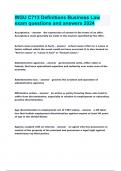
WGU C713: Business Law exam questions and answers 2024
Role of Law in Society Law helps us settle disputes and regulate activity. Stare Decisis Latin for "let the decision stand". Common law Consists of case decisions. Is also called case law or judge-made law. Statutory Law Laws written and passed by legislature and signed by executive. Administrative Law Regulations produced by Federal Agencies. Treaties Agreements between US and foreign country negotiated by president and effective when ratified by 2/3 Vote from the Senate. Court Orders Common Law / Judge Made Laws for specific people, companies, and situations. Civil Law A law that governs relationships between individuals and defines their legal rights. Criminal Law Laws dealing with offenses against society (murder, rape, arson). Prosecuted by the government, violation results in fines or prison sentences. Alternative Dispute Resolution The resolution of legal disputes through methods other than litigation, such as negotiation, mediation, arbitration, summary jury trials, mini-trials, neutral case evaluations, and private trials. Reasons A Business Might Prefer Alternative Dispute Resolution vs. Litigation ADR methods are generally faster and less expensive than litigation. Business may wish to avoid uncertainty associated with a jury decision. Business may wish to avoid setting precedent through court decision. Business may prefer confidential nature of ADR. What are the primary forms of Alternative Dispute Resolution? Negotiation, Mediation, Arbitration Advantages of Mediation Helps disputing parties preserve their professional relationships. Provides possibility of finding creative solutions to dispute. Offers participants high level of autonomy. Advantages of Arbitration More efficient and less expensive than litigation. Parties have more control over the process of dispute resolution (parties choose the arbitrator and determine how formal the process will be). Parties can choose arbitrator with expertise in specific subject matter of dispute. Arbitrator has greater flexibility in decision-making (compared to decision-making authority of judge). What is a Binding Arbitration Clause? A provision in a contract mandating that all disputes arising under a contract must be settled by arbitration. What is the Purpose of a Contract? Contracts exist to make business matters more predictable. Judicial Activism Judicial activism makes the law more flexible but less predictable. Judicial Restraint Judicial restraint makes the law less flexible but more predictable. What are the elements of a contract? Agreement, Consideration, Legality, Capacity. Bilateral Contract Both parties make a promise (to do something) to each other. Unilateral Contract One party makes a promise to the other that the other party can accept only by doing something specific. Express Contract The two parties to the contract explicitly state all of the important terms of their agreement. Implied Contract The words and conduct of the parties indicate that the parties intended to make an agreement. Executory Contract When one or more parties has not fulfilled its obligations under the contract. Executed Contract When all parties to the contract have fulfilled their obligations under the contract. Promissory Estoppel Even when there is no contract, a plaintiff may use promissory estoppel to enforce the defendant's promise if he can show that: the defendant made a promise knowing that the plaintiff would likely rely on it. The plaintiff did rely on the promise; and the only way to avoid injustice is to enforce the promise. Quasi-Contract Even when there is no contract, a court may use quasi-contract to compensate a plaintiff who can show that: He gave some benefit to the defendant. He reasonably expected to be paid for the benefit and the defendant knew this; and the defendant would be unjustly enriched if she did not pay. Quantum Meruit Damages awarded, meaning that the plaintiff gets "as much as he deserved." Sources of Contract Law Common Law, Uniform Commercial Code, Restatement of Contracts. Breach of Contract The failure, without legal excuse, of a promisor to perform the obligations of a contract. Expectation Interest What the non-breaching party reasonably expected to get from the contract. Is the most common interest in a breach of contract case. Reliance Interest Puts injured party in the position he would have been in had the parties never entered into a contract. It focuses on the time and money that the injured party spent performing his part of the agreement. If there was no valid contract, a court might still award reliance damages under a theory of promissory estoppel. Restitution Interest Designed to return to the injured party a benefit he has conferred on the other party. Equitable Interest In some cases, money damages will not suffice to help the injured party. Something more is needed, such as an order to transfer property to the injured party (specific performance) or an order forcing one party to stop doing something (an injunction). Compensatory Damages The damages awarded an injured party in a contract in which the injured party is entitled to compensation. Are the most common monetary awards. Consequential Damages Damages special to this plaintiff that were reasonably foreseeable to the breaching party at the time of the Incidental Damages Costs incurred in dealing with the breach (e.g., costs of storing rejected goods or finding a replacement in a services contract). Always recoverable. Restitution in Cases of a Valid Contract Restitution is a common remedy in contracts involving fraud, misrepresentation,
Escuela, estudio y materia
- Institución
- WGU C713
- Grado
- WGU C713
Información del documento
- Subido en
- 28 de abril de 2024
- Número de páginas
- 10
- Escrito en
- 2023/2024
- Tipo
- Examen
- Contiene
- Preguntas y respuestas
Temas
-
wgu c713 business law exam questions

Documento también disponible en un lote