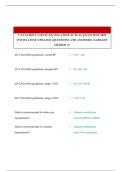
HESI A2 ENTRANCE EXAM ALL SECTION QUESTIONS ANSWERS LATEST UPDATE| 92% FEATURED IN THE REAL EXAM| 2022 UPDATE
ALL THE JAZZ Jazz has been called "the art of expression set to music", and "America's great contribution to music". It has functioned as popular art and enjoyed periods of widespread public response, in the "jazz age" of the 1920s, in the "swing era" of the late 1930s and in the peak popularity of modern jazz in the late 1950s. The standard legend about Jazz is that it originated around the end of the 19th century in New Orleans and moved up the Mississippi River to Memphis, St. Louis, and finally to Chicago. It welded together the elements of Ragtime, marching band music, and the Blues. However, the influences of what led to those early sounds goes back to tribal African drum beats and European musical structures. Buddy Bolden, a New Orleans barber and cornet player, is generally considered to have been the first real Jazz musician, around 1891. What made Jazz significantly different from the other earlier forms of music was the use of improvisation. Jazz displayed a break from traditional music where a composer wrote an entire piece of music on paper, leaving the musicians to break their backs playing exactly what was written on the score. In a Jazz piece, however, the song is simply a starting point, or sort of skeletal guide for the Jazz musicians to improvise around. Many of the early Jazz musicians were bad sight readers and some couldn't even read music at all. These early musicians couldn't make money very much and were stuck working menial jobs to make a living. The second wave of New Orleans Jazz musicians included such memorable players as Joe Oliver, Kid Ory, and Jelly Roll Morton. These men formed small bands and took the music of earlier musicians, improved its complexity, and gained greater success. This music is known as "hot Jazz" due to the enormously fast speeds and rhythmic drive. A young cornet player by the name of Louis Armstrong was discovered by Joe Oliver in New Orleans. He soon grew up to become one of the greatest and most successful musicians of all time, and later one of the biggest stars in the world. The impact of Armstrong and other talented early Jazz musicians changed the way we look at music. 1. Definition of CONFLUENCE. A. Melding B. Influence Intersection C. Coming together 2. Where and when did jazz originate? Southern US. 20th century OR New Orleans 3. How does the author regard Jazz? A real aficionado A. Unable to determine B. Doesn't like it much C. Enjoys it occasionally 4. Derivation of the word “Jazz” West coast slan
Escuela, estudio y materia
- Institución
- Hesi A2 ENTRANCE E
- Grado
- Hesi A2 ENTRANCE E
Información del documento
- Subido en
- 25 de abril de 2024
- Número de páginas
- 10
- Escrito en
- 2023/2024
- Tipo
- Examen
- Contiene
- Preguntas y respuestas
Temas
-
hesi a2 entrance exam actual question and answer
-
hesi a2 entrance exam actual question and answe
-
hesi a2 entrance exam actual question