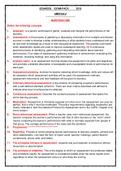
NCCHC-CCHP Exam Study Guide QUESTIONS AND ANSWERS GRADED A+
NCCHC-CCHP Exam Study Guide QUESTIONS AND ANSWERS GRADED A+ Forensic Information - ANSWER - Health services staff are not involved in the collection of forensic information, except when: -Complying with state laws that require blood samples from inmates, so long as there is consent of the inmate and health services staff are not involved in any punitive action taken as a result of an inmate's nonparticipation in the collection process. -Conducting body cavity searches, and blood or urine testing for alcohol or other drugs when done for medical purposes by a physician's order. -Conducting inmate-specific, court-ordered lab test, examinations, or radiology procedures with consent of the inmate, and -In the case of sexual assault, gathering evidence from the inmate victim with his or her consent. Informed Consent and Right to Refuse - ANSWER - -The policy and procedures specify circumstances under which risks and benefits of an intervention are explained to the patient. -For invasive procedures or any treatment where there is risk and benefit to the patient, informed consent is documented on a written form containing the signatures of the patient and health services staff witness. -Any health evaluation and treatment refusal is documented and must include: description of the nature of the services being refused, evidence that the inmate has been made aware of any adverse consequences to health that may occur as a result of the refusal, the signature of the patient, and the signature of the health services staff witness. -In the event the patient does not sign the refusal form, it is to be noted on the form by a health services staff witness. Medical and Other Research - ANSWER - All aspects of the standard are addressed by written policy and defined procedures that specify: --The process for obtaining approval to conduct the research, and --the steps to be taken to preserve the subject's rights. When inmates who are participants in a community-based research protocol are admitted to the facility, procedures provide for: --Continuation of participation, or --Consultation with community researchers so that withdrawal from the research protocol is done without harming the health of the inmate. Executions - ANSWER - -Executions do not occur in the medical unit or area -Health services staff do not assist, supervise, or contribute to the ability of another individual to directly cause the death of an inmate. -Health staff do not participate in competency decisions for execution -Health staff do not pronounce death in an executionAccess to Care - ANSWER - Inmates have access to care to meet their serious medical, dental, and mental health needs. Unreasonable barriers are to be avoided: 1. punishing inmates for seeking care. 2. assessing excessive co-payments that deter inmates 3. deterring inmates by holding sick call at 2 a.m., etc. Estelle v. Gamble (1976) - ANSWER - -Deliberate indifference to serious medical needs of prisoners constitutes the unnecessary and wanton infliction of pain, thus violating the 8th Amendment. -Prison officials have a duty to provide proper inmate medical care CLIA - ANSWER - Clinical Laboratory Improvement Amendments of 1988.
Escuela, estudio y materia
- Institución
- NCCHC-
- Grado
- NCCHC-
Información del documento
- Subido en
- 23 de abril de 2024
- Número de páginas
- 14
- Escrito en
- 2023/2024
- Tipo
- Examen
- Contiene
- Preguntas y respuestas
Temas
- ncchc
- ncchc cchp exam
-
ncchc cchp exam study guide