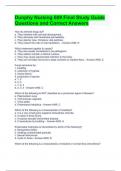
Dunphy Nursing 609 Final Study Guide Questions and Correct Answers
Dunphy Nursing 609 Final Study Guide Questions and Correct Answers Which of the following is normally considered sterile? a. Urine b. Pharynx c. Distal urethra d. Vagina - Answer-ANS: A The term nosocomial infection means: a. transmission involves an insect or animal host. b. acquired in a hospital or medical facility. c. transmitted by a fomite. d. spread by direct contact with secretions from an open lesion. - Answer-ANS: B Transmission of microbes by direct contact includes: a. touching a contaminated countertop. b. sexual intercourse. c. drinking contaminated water. d. inhaling dust-borne microbes. - Answer-ANS: B What does the term carrier mean? a. A person with active infection who acts as a reservoir for microbes b. Animals, insects, objects, or surfaces contaminated by pathogens c. An individual who is contagious through infected secretions on the hands d. An asymptomatic person whose body harbors pathogens and can transmit them to others - Answer-ANS: D Opportunistic infection may develop when: a. pathogens enter the body but cannot colonize the site of entry. b. an imbalance occurs in the normal resident flora. c. host resistance increases, and the balance of resident flora is restored. d. contaminated food or water is unknowingly ingested. - Answer-ANS: B Host resistance is promoted by all of the following EXCEPT: a. prescribed immunizations. b. chronic respiratory disease. c. vitamin and mineral supplements. d. appropriate inflammatory or immune response. - Answer-ANS: B Which of the following factors would NOT increase the virulence of a specific microbe? a. Secretion of endotoxin b. Presence of a bacterial capsule c. Production of interferons
Escuela, estudio y materia
- Institución
- Dunphy
- Grado
- Dunphy
Información del documento
- Subido en
- 10 de marzo de 2024
- Número de páginas
- 18
- Escrito en
- 2023/2024
- Tipo
- Examen
- Contiene
- Preguntas y respuestas
Temas
- applies to yeasts
-
dunphy nursing 609 final study guide questions and
-
how do antiviral drugs act
-
they reduce the rate of viral replication
-
they may cause opportunistic infection in the body

Documento también disponible en un lote