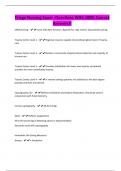
Geography 3 Final Review (UCSB) Questions And Answers Rated A+ New Update Assured Satisfaction
What is the source of almost all energy in the Earth system? - Answer-Solar Radiation (the sun) Explain the Earth's radiation balance at the top of the atmosphere. - Answer-Qin=Qout (incoming energy must equal outgoing energy) Explain the Earth's surface heat budget. What terms are the most important? - Answer-100 units of solar radiation at the top of the atmosphere, approximately 25% is reflected back to space, 25% is absorbed by the atmosphere, and 50% reaches Earth's surface. Of that 50%, some is reflected back to space (based on albedo of surface) and the rest is absorbed by the land or ocean then conduction and convection occur. Explain how and why the seasons occur. - Answer-Earth's axis is tilted 66.5 degrees from the plane of elliptic, and when a region is maximally tilted towards the sun, summer occurs in that region, when it is maximally tilted away, it is winter. What is the composition and vertical structure of the atmosphere? (layers, pressure, temperature etc.) - Answer-The bottom layer is the troposphere, which extends from Earth's surface to 15km, temperature an pressure decrease with altitude. The next layer is the stratosphere, which extends from 15km to 50km, temperature increases with altitude and pressure decreases. Next is the mesosphere, which extends 50-90km, temperature and pressure decrease with height. Last is the thermosphere which extends 90km+, pressure decreases wit heights and temperature increases. Explain how the greenhouse effect works. What are some important greenhouse gases? (see also Unit 3...) - Answer-Greenhouse gases collect in the atmosphere and trap longwave radiation emitted from Earth and re-radiate it back down to Earth, warming the surface. They let shortwave radiation pass through. Some important greenhouse gases are water vapor (H2O), carbon dioxide (CO2), methane (CH4), nitrous oxide (N2O), and ozone (O3) Why is ozone "good up high and bad nearby"? - Answer-Up high (stratosphere) ozone protects Earth from harmful UV radiation emitted from the sun, but nearby (troposphere) it is a dangerous pollutant that kills plants and living tissue. Explain how pressure gradients cause winds. - Answer-When an area of high pressure is next to an area of low pressure, air (winds) are drawn towards the area of low pressure, creating a pressure gradient which produces winds in the direction of the low pressure area.Explain how heating and cooling of the land and sea cause diurnal land/sea breeze patterns. - Answer-Typically, during the day land heats up while ocean remains relatively cool, this causes the area over land to have low pressure while the area over the ocean has higher pressure, this causes a pressure gradient, which forms a sea breeze(towards land). The opposite occurs at night, land cools, ocean remains the same, land breeze (towards ocean) occurs. Explain how the Coriolis force works. Which way does the Coriolis force turn moving objects in the Northern/Southern Hemisphere? - Answer-The Coriolis Force pulls objects in motion to the right in the Northern Hemisphere and to the left in the Southern Hemisphere. This is caused by Earth's rotation. It typically only occurs over long distances (i.e. long, strong winds) Explain the balance of forces in geostrophic balance (see also Unit 2...) e.g. in a hurricane. - AnswerPressure gradient force and Coriolis force eventually balance out, causing winds to stop accelerating and take a straight path. When this occurs around a high pressure center, cyclones form (counterclockwise in northern hemisphere) and when it occurs around low pressure centers, anticyclones occur (clockwise in NH) Explain the Hadley circulation and global surface wind patterns (tradewinds, westerlies etc.) - Answer-At the equator, the air is warm and rises, creating low pressure, this air then travels to 30 degree latitudes north and south and sinks creating low pressure. The pressure gradient and Coriolis force cause geostrophic balance and winds flow from the East (easterly trade winds). Pressure gets low again at about 60 degree latitudes, and geostrophic balance occurs creating westerlies. Poles have high pressure, so winds move toward 60 degree latitudes creating polar easterlies. What are the major regions of high/low pressure on Earth and how does this affect climates at those latitudes - Answer-Equator: low pressure, causes warm, humid temperatures, lots of vegetation 30 degree latitudes: high pressure, colder, drier conditions, deserts 60 degrees: low pressure, warmer and more humid, lots of rainforests poles: high pressure, very dry (basically ice deserts) Compare and contrast the properties of the ocean and atmosphere. - Answer-The ocean is 300x as dense, has a much higher heat capacity, and is much smaller than the atmosphere. The atmosphere is bigger, changes more quickly, and has a lower heat capacity.
Escuela, estudio y materia
- Institución
- Geography 3 UCSB)
- Grado
- Geography 3 UCSB)
Información del documento
- Subido en
- 21 de febrero de 2024
- Número de páginas
- 8
- Escrito en
- 2023/2024
- Tipo
- Examen
- Contiene
- Preguntas y respuestas
Temas

Documento también disponible en un lote