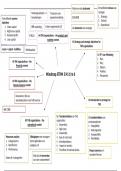
Lectures #1-2
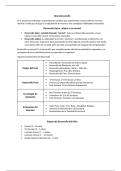
1. What are the anomalies facing behavioural economics?
Basic assumption: People are rational
Framework is based on rationality (Logic – Thinking)
Anomalies: any decisions that deviate from rationality
Flows of in these anomalies: 4 areas
Weakness of will
Heuristic
Perspective
Motivation (Tenacity)
Equilibrium: By optimisation, we try to achieve equilibrium
Fundamental reason of economics: Scarcity
Input is scarce, we try to optimise equilibrium (Best output)
Where are the flows in these anomalies 4 Areas
2. What are the pseudo or apparent anomalies facing behavioural economics?
No deeper level of analysis for any decision that appears to deviate from rationality
e.g. Heuristic can be rational (Optimal heuristics), tenacity can be irrational (too much tenacity may
lead to obsession and misery)
3. What is Area 1 of behavioural economics
Weakness of will (Tempt)
E.g. Procrastinating, over-eating, cheating, recklessness, overconfidence
Effects: Certainty effect, ambiguity effect, regret)
Solution: Pre-commitment (Standard of exercising, souse, government nudge (e.g. force
saving account)
Heuristics and habit
Heuristic is rule, it is the method that you make to live the life. You don’t need to
make choice.
Habit that you develop unconsciously – It influence input
Perspective
People have different perspectives
Motivation
4. What is Area 2 of behavioural economics?
Heuristics: habitual acts that appear to contradict rationality, 90-95% of our behaviours
are habitual.
E.g. Stereotyping, always buy when sales
But it can be optimal – brush teeth
5. What is Area 3 of behavioural economics?
Perspective: people have different perspectives. You either see one shape or another, not
both.
How a scenario is framed, given same fact, with different reference point—people will
react differently
Reference-dependent utility: utility from an outcome depends on comparison to relevant
‘reference level’ and ‘reference points’ Two kinds
i. Relativeness (perception): One uses relativeness to recent experience
ii. Context (Perspective): How to judge the same thing with different frames.
E.g. Rubin Vase, Silver medal and Bronze medal (They expect different things)
,6. What is Area 4 of behavioural economics?
Motivation (Tenacity): another kind of context – a context where you are judging an
aspiration. Perception about oneself
E.g. Passions to choose from. False belief in superiority, obsession on achieving sth
regardless of the costs
It can be subrational and irrational: achieve sth regardless to the cost
i. E.g.: single-minded, fanaticism, delusional behaviour
7. How to make sense of the question: Is the process rational?
Rational is actually empty, we cannot assess decision in the abstract, need to take into
consideration circumstances. E.g. costs and benefits
Rational is one way: input output
Rational – If the input lead to the optimal output
Sub-rational – Can be warranted to get good decision, but not the best, you may need
to pay other things
Irrational – Output change input, change the means, the output you want has gone
8. Distinguish among: rationality, sub-rationality, and irrationality
Rationality: best output achieved given the inputs (Inputs End*)
Sub-rationality: sub-best output achieved given the inputs (Inputs End+)
Irrationality: Input is manipulated to justify the output, the output you initially want has
gone. (Input End+)
9. How to make of the question: Is one of the inputs context-laden?
Context laden input: dependent on situation (reference point) – can be warranted, greatly warranted,
somewhat warranted, highly warranted.
Context-laden belief (Basic input + context) + other input output*
10. What does it mean to be context-free?
It can be 100% true fact or 0% true fact
People react in proper ways or improper ways without considering context. Their belief
cannot impact the output, use scientific method to determine the correctness.
No matter what rationality you use, you have no influences by context
Context-free belief (basic input) + other inputs output*
11. What is unique about ‘context’?
Context can alter inputs, changing optimal output.
Input is content, we use rationality to drive to the content we want.
In this case, context is the background of content, it creates inputs and also influence it
Context drives perspective and motivation (Framing effect, motivation effect)
,Lecture 3-4
Lecture 3:
Two pillars of economics: rationality & equilibrium.
If disequilibrium, either people do not act rationally, or there is friction. Not every disequilibrium
arises from non-rational decision, but non-rational decisions lead to disequilibrium.
Friction:
1) Transaction costs (search cost, rent, gov regulation/barriers)
2) Sticky prices
Examples of rationality
What is rationality?
o Definition: Response to incentives given inputs that consist of resources and tastes
o Conditions to respond to incentives: Scarcity & Fungibility
o Forms of responding to incentives: Max benefits given cost; Min costs given benefits.
(Duality theory)
Lecture 4:
Two senses of rationality. (decision & command)
Decision: With Transitivity axiom and Completeness axiom, we can say there are consistent rank
order of bundles. To guarantee a unique optimum, we need 4 additional axioms, including local
non-satiation.
Command: With consistent rank order of bundles and unique optimum, still need to act according
to optimum. When command sense is affirmed, it amounts to obeying WARP, which has its
issues.
12. What are the two pillars of economics? How do they differ?
- Rationality & Equilibrium.
- Rationality: Efficient behaviour
Equilibrium: Efficient system. By optimisation, we try to achieve equilibrium
- Disequilibrium occurs when: people not acting rationally, or when people act rationally
but friction occurs
o Friction kinds:
Transaction cost: search costs, rent, government regulations
Price stickiness and wage stickiness ; people resist lowering prices and
wages during recessions.
13. Is rationality important?
Yes. Deviation from rationality disequilibrium
- Geese fly in “V” shape to reduce friction and therefore saving energy.
- German toys are more expensive than U.S’s because German has higher land price.
- Mandarin more expensive than oranges as the opportunity cost of time has risen.
14. What does rationality say about the relation between inputs and outputs?
Inputs (Means) Ends
Means changes End changes
The means taken to achieve a best end. Direction of arrow is from left to right.
Rationality = response to incentives, gives one’s inputs (means) that consist of resources and
tastes.
15. If rationality is only about the direction of the arrow, is it an empty concept?
, Yes. Arrow makes sense only if we take into account the context. Cannot assess decision in
abstract, must consider circumstances.
16. Is there a need for rationality if resources are (a) non-scarce; (b) non-fungible?
Rationality = response to incentives, gives one’s inputs (means) that consist of resources and tastes.
Agents response to incentives only when two conditions are met. 1. Scarcity and 2. Fungibility
Thus, rationality is not needed if these two conditions not met.
- Not scarce: agents have enough capital to do everything and achieve the wishes.
- Not fungible: Only one way to use a resource. no choice/option to choose.
No trade-offs required – do not need to choose or decide
17. Do we need only one condition (scarcity or fungibility)) or both (scarcity and fungibility)
to assure rationality?
Both.
If scarce but not fungible (e.g. time is scarce, but one is only provided with a book in prison,
reading is the only option).
If fungible, but not scarce, agents have the capitals to do everything.
18. What is duality theory?
Maximisation and minimisation are identical
Maximising benefits given the cost = Minimising costs given the benefit
19. What are the two senses of rationality?
Decision sense: one can identify the best options – “what you say you will do"
Command sense: acting according to the optimum, staving off procrastinating, temptation,
compulsions– “action or what you really do”
20. Do the two senses of rationality exclude or suppose each other?
Command entails decision – agents need to command themselves to complete decisions
but decision does not entail command --- Decision will just be come up.
21. What is logical ordering (transitivity axiom)?
If one prefers X to Y, and Y to Z, then one prefers X to Z. (X>Y, Y>Z, then X>Z)
If broken, voter’s paradox (cannot rank which party to choose)
22. What is decisiveness (completeness axiom)?
One knows either X>Y, Y>X, or X=Y.
Must be able to compare for rational decision making.
23. What is the importance of small changes (local non-satiation)
More is better. People prefer more of an item, never a particular amount of a good.
For any bundle of goods, there is always another bundle of goods arbitrarily close that is
preferred to it. No matter what the utility is, another utility is preferred. (0-1 has infinitive
numbers) U(1.000001 litre of x) > U(1.0000001 litre of x)
24. What is the (weak) axiom of revealed preference (WARP)?
When both bundles are affordable, preference should remain the same and there is no
circumstances where the consumer choose one over the other. If someone chooses X over Y,
it means X is preferred over Y, the condumer reveals that his preferences are such.
(Economists do not trust self-assessed surveys but observe behaviours)
Issues:
1) WARP would not allow us to distinguish choices that express optimal choices from
agents that suffer from weakness of will. (One may not act optimally because of
weakness of will. Know what is best, but choose sub optimally.)
1. What are the anomalies facing behavioural economics?
Basic assumption: People are rational
Framework is based on rationality (Logic – Thinking)
Anomalies: any decisions that deviate from rationality
Flows of in these anomalies: 4 areas
Weakness of will
Heuristic
Perspective
Motivation (Tenacity)
Equilibrium: By optimisation, we try to achieve equilibrium
Fundamental reason of economics: Scarcity
Input is scarce, we try to optimise equilibrium (Best output)
Where are the flows in these anomalies 4 Areas
2. What are the pseudo or apparent anomalies facing behavioural economics?
No deeper level of analysis for any decision that appears to deviate from rationality
e.g. Heuristic can be rational (Optimal heuristics), tenacity can be irrational (too much tenacity may
lead to obsession and misery)
3. What is Area 1 of behavioural economics
Weakness of will (Tempt)
E.g. Procrastinating, over-eating, cheating, recklessness, overconfidence
Effects: Certainty effect, ambiguity effect, regret)
Solution: Pre-commitment (Standard of exercising, souse, government nudge (e.g. force
saving account)
Heuristics and habit
Heuristic is rule, it is the method that you make to live the life. You don’t need to
make choice.
Habit that you develop unconsciously – It influence input
Perspective
People have different perspectives
Motivation
4. What is Area 2 of behavioural economics?
Heuristics: habitual acts that appear to contradict rationality, 90-95% of our behaviours
are habitual.
E.g. Stereotyping, always buy when sales
But it can be optimal – brush teeth
5. What is Area 3 of behavioural economics?
Perspective: people have different perspectives. You either see one shape or another, not
both.
How a scenario is framed, given same fact, with different reference point—people will
react differently
Reference-dependent utility: utility from an outcome depends on comparison to relevant
‘reference level’ and ‘reference points’ Two kinds
i. Relativeness (perception): One uses relativeness to recent experience
ii. Context (Perspective): How to judge the same thing with different frames.
E.g. Rubin Vase, Silver medal and Bronze medal (They expect different things)
,6. What is Area 4 of behavioural economics?
Motivation (Tenacity): another kind of context – a context where you are judging an
aspiration. Perception about oneself
E.g. Passions to choose from. False belief in superiority, obsession on achieving sth
regardless of the costs
It can be subrational and irrational: achieve sth regardless to the cost
i. E.g.: single-minded, fanaticism, delusional behaviour
7. How to make sense of the question: Is the process rational?
Rational is actually empty, we cannot assess decision in the abstract, need to take into
consideration circumstances. E.g. costs and benefits
Rational is one way: input output
Rational – If the input lead to the optimal output
Sub-rational – Can be warranted to get good decision, but not the best, you may need
to pay other things
Irrational – Output change input, change the means, the output you want has gone
8. Distinguish among: rationality, sub-rationality, and irrationality
Rationality: best output achieved given the inputs (Inputs End*)
Sub-rationality: sub-best output achieved given the inputs (Inputs End+)
Irrationality: Input is manipulated to justify the output, the output you initially want has
gone. (Input End+)
9. How to make of the question: Is one of the inputs context-laden?
Context laden input: dependent on situation (reference point) – can be warranted, greatly warranted,
somewhat warranted, highly warranted.
Context-laden belief (Basic input + context) + other input output*
10. What does it mean to be context-free?
It can be 100% true fact or 0% true fact
People react in proper ways or improper ways without considering context. Their belief
cannot impact the output, use scientific method to determine the correctness.
No matter what rationality you use, you have no influences by context
Context-free belief (basic input) + other inputs output*
11. What is unique about ‘context’?
Context can alter inputs, changing optimal output.
Input is content, we use rationality to drive to the content we want.
In this case, context is the background of content, it creates inputs and also influence it
Context drives perspective and motivation (Framing effect, motivation effect)
,Lecture 3-4
Lecture 3:
Two pillars of economics: rationality & equilibrium.
If disequilibrium, either people do not act rationally, or there is friction. Not every disequilibrium
arises from non-rational decision, but non-rational decisions lead to disequilibrium.
Friction:
1) Transaction costs (search cost, rent, gov regulation/barriers)
2) Sticky prices
Examples of rationality
What is rationality?
o Definition: Response to incentives given inputs that consist of resources and tastes
o Conditions to respond to incentives: Scarcity & Fungibility
o Forms of responding to incentives: Max benefits given cost; Min costs given benefits.
(Duality theory)
Lecture 4:
Two senses of rationality. (decision & command)
Decision: With Transitivity axiom and Completeness axiom, we can say there are consistent rank
order of bundles. To guarantee a unique optimum, we need 4 additional axioms, including local
non-satiation.
Command: With consistent rank order of bundles and unique optimum, still need to act according
to optimum. When command sense is affirmed, it amounts to obeying WARP, which has its
issues.
12. What are the two pillars of economics? How do they differ?
- Rationality & Equilibrium.
- Rationality: Efficient behaviour
Equilibrium: Efficient system. By optimisation, we try to achieve equilibrium
- Disequilibrium occurs when: people not acting rationally, or when people act rationally
but friction occurs
o Friction kinds:
Transaction cost: search costs, rent, government regulations
Price stickiness and wage stickiness ; people resist lowering prices and
wages during recessions.
13. Is rationality important?
Yes. Deviation from rationality disequilibrium
- Geese fly in “V” shape to reduce friction and therefore saving energy.
- German toys are more expensive than U.S’s because German has higher land price.
- Mandarin more expensive than oranges as the opportunity cost of time has risen.
14. What does rationality say about the relation between inputs and outputs?
Inputs (Means) Ends
Means changes End changes
The means taken to achieve a best end. Direction of arrow is from left to right.
Rationality = response to incentives, gives one’s inputs (means) that consist of resources and
tastes.
15. If rationality is only about the direction of the arrow, is it an empty concept?
, Yes. Arrow makes sense only if we take into account the context. Cannot assess decision in
abstract, must consider circumstances.
16. Is there a need for rationality if resources are (a) non-scarce; (b) non-fungible?
Rationality = response to incentives, gives one’s inputs (means) that consist of resources and tastes.
Agents response to incentives only when two conditions are met. 1. Scarcity and 2. Fungibility
Thus, rationality is not needed if these two conditions not met.
- Not scarce: agents have enough capital to do everything and achieve the wishes.
- Not fungible: Only one way to use a resource. no choice/option to choose.
No trade-offs required – do not need to choose or decide
17. Do we need only one condition (scarcity or fungibility)) or both (scarcity and fungibility)
to assure rationality?
Both.
If scarce but not fungible (e.g. time is scarce, but one is only provided with a book in prison,
reading is the only option).
If fungible, but not scarce, agents have the capitals to do everything.
18. What is duality theory?
Maximisation and minimisation are identical
Maximising benefits given the cost = Minimising costs given the benefit
19. What are the two senses of rationality?
Decision sense: one can identify the best options – “what you say you will do"
Command sense: acting according to the optimum, staving off procrastinating, temptation,
compulsions– “action or what you really do”
20. Do the two senses of rationality exclude or suppose each other?
Command entails decision – agents need to command themselves to complete decisions
but decision does not entail command --- Decision will just be come up.
21. What is logical ordering (transitivity axiom)?
If one prefers X to Y, and Y to Z, then one prefers X to Z. (X>Y, Y>Z, then X>Z)
If broken, voter’s paradox (cannot rank which party to choose)
22. What is decisiveness (completeness axiom)?
One knows either X>Y, Y>X, or X=Y.
Must be able to compare for rational decision making.
23. What is the importance of small changes (local non-satiation)
More is better. People prefer more of an item, never a particular amount of a good.
For any bundle of goods, there is always another bundle of goods arbitrarily close that is
preferred to it. No matter what the utility is, another utility is preferred. (0-1 has infinitive
numbers) U(1.000001 litre of x) > U(1.0000001 litre of x)
24. What is the (weak) axiom of revealed preference (WARP)?
When both bundles are affordable, preference should remain the same and there is no
circumstances where the consumer choose one over the other. If someone chooses X over Y,
it means X is preferred over Y, the condumer reveals that his preferences are such.
(Economists do not trust self-assessed surveys but observe behaviours)
Issues:
1) WARP would not allow us to distinguish choices that express optimal choices from
agents that suffer from weakness of will. (One may not act optimally because of
weakness of will. Know what is best, but choose sub optimally.)