CPNRE Prep exam questions and answers
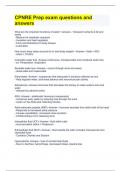
CPNRE Prep exam questions and answers What are the important functions of water? -Answer-- Transport nutrients & 02 and waste - Medium for metabolic reactions - Insulation and heat regulation - Form and Substance to body tissues - Lubrication How much does water account for in total body weight> -Answer-- Adult = 60% - Infant = 70-80% Insensible water loss -Answer-continuous, immeasurable and unnoticed water loss - ex: Perspiration, respiration Sensible water loss -Answer-- occurs through urine and sweat - observable and measurable Electrolytes -Answer-- substances that dissociate in solutions referred as ions - Help regulate water, acid-base balance and neuromuscular activity Aldosterone -Answer-Hormone that stimulates the kidney to retain sodium ions and water - released by adrenal cortex ADH -Answer-- antidiuretic hormone (vasopressin) - conserves body water by reducing loss through the urine - works on the distal and collecting tubules Atrial natriuretic peptide (ANP) -Answer-- hormone secreted from atrial cells of the heart - Responds to increased atrial pressure - Causes vasodilation, increased urine excretion - inhibits kidneys from releasing renin Intracellular fluid (ICF) -Answer-- fluid within cells - most prevalent cation = Potassium Extracellular fluid (ECF) -Answer-- fluid outside the cells; includes intravascular and interstitial fluids - Contains Chloride and Sodium Hypovolemia -Answer-- loss of normal body fluids - Due to: diarrhea, hemorrhage, decreased intake, plasma loss - replaced with isotonic solution (Intravenous or orally) Hypervolemia -Answer-- excessive blood volume - result from: increased intake, abnormal retention, interstitial loss to plasma fluid shift - treatment: diuretics, fluid restriction, sodium restriction What to assess and monitor for fluid volume deficits? -Answer-- intake and output - Cardiovascular changes - Respiratory changes - Daily weights - Skin and mucous membranes - Neurological status Why are older adults at risk for fluid volume deficit? -Answer-- Decrease muscle mass (decrease total body water) - Delayed thirst response - Sweat gland atrophy and less elastic skin - decreased ability to concentrate urine - GI and cardiovascular changes True or False: Infants have a larger amount of ECF thus causing more frequent electrolyte disturbances -Answer-- TRUE
Escuela, estudio y materia
- Institución
- CPNRE
- Grado
- CPNRE
Información del documento
- Subido en
- 31 de enero de 2024
- Número de páginas
- 117
- Escrito en
- 2023/2024
- Tipo
- Examen
- Contiene
- Preguntas y respuestas
Temas
-
cpnre prep exam questions and answers
-
what are the important functions of water answe
-
how much does water account for in total body weig
-
insensible water loss answer continuous immeasur

Documento también disponible en un lote