
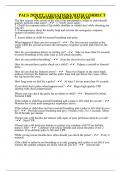
Pals 2020 Pt 1 Questions With Correct Answers Graded To Pass
The first rescuer who arrives at the side of an unresponsive infant or child should quickly perform what steps? - 1. Verify scene safety 2. Check for responsiveness (Tap childs shoulder or infants heel while shouting are you ok) 3. If unresponsive shout for nearby help and activate the emergency response system via mobile device 4. 5. Assess infant or child for normal breathing and pulse What happens if there are two rescuer's? - The first rescuer remains at the scene while the second activates the emergency response system and retrieves the AED How do you minimize delays in starting cpr? - Take no more than 10 seconds to assess breathing at the same time as you check the pulse. How do you confirm breathing? - Scan the chest for rise and fall How do you perform a pulse check on a child? - Palpate a carotid or femoral pulse. How do you find the femoral artery? - Place two fingers in the inner thigh, midway between the hipbone and the pubic bone and just below the crease where the leg meets the torso. How long must we feel for a pulse? - At least 5 but no more than 10 seconds. If you don't feel a pulse what happens next? - Begin high quality CPR starting with chest compressions Where can you check the pulse for an infant or child? - Brachial for infant Femoral Child If the infant or child has normal breathing and a pulse is felt what do you do? - Monitor the victim until emergency responders arrive. If the infant or child does not have normal breathing and a pulse is felt what do you do? - Provide rescue breathing and give 1 breath every 2 to 3 seconds. About 20-30 breaths per minute If heart rate is 60 breaths per minute with signs of poor perfusion what do you do? - Start CPR If heart rate is 60 beats per minute or greater you continue with? If no definite pulse is felt? - Continue with rescue breaths and check the pulse every 2 minutes. If no definite pulse is felt start CPR While giving rescue breaths how often should you check the pulse? - Every 2 minutes If the child or infant is not breathing or is only gasping and a pulse is not felt if you witness the sudden collapse are alone what do you do? - Activate the emergency response system and retrieve the AED If the child or infant is not breathing or is only gasping and a pulse is not felt, and you did not witness the sudden collapse and you are alone what do you do? - Start High quality CPR for 2 minutes The universal rate for compressions in all cardiac arrest victims is what? - 100 to 120/min Compression to ventilation ratio for a SINGLE rescuer is what? - 30:2 (same as adults) If TWO rescuers are present for resuscitation attempt of an infant or child what compression to ventilation ratio should be used? - 15:2 What compression technique should be used for children? - Use either 1 or 2 hands to compress the chest for most children the compression technique will be the same as? - Same as the adult technique. For very small children how many hands can you use? How far should the chest be compressed? - 1 handed compressions to achieve the desired compression depth. Chest should be compressed at least 1/3 the anteroposterior diameter of the chest. approximately 1 1/2 to 2 inches or 5 cm with each compression How should 1 rescuer infant compressions be delivered? - 2 fingers or 2 thumbs on the sternum below the nipple line What is the preferred technique for infant compressions when there are 2 or more rescuers present? - 2 thumb encircling hands technique Some AEDs can deliver what kind of shock dose? - Adult or children shock What pt age group uses the child shock dose of an AED? - The child dose is used for children under eight Can you use adult AED pads on a child? Can you use child pads for an adult? - Yes you can use adult aed pads on a child. Never use child pads on an adult (Shock dose will be to small) For infants and children where should AED pads be placed? - One on the chest and one on the back Four steps for using an AED are what? - 1. Turn on the AEA 2 Apply pads to pt 3 Analyzing the heart rhythm 4 Delivering the shock What does PAT stand for? - Pediatric assessment Triangle The PAT uses A-B-C Which stands for what? - A-B-C Stands for Appearance, Breathing, and Circulation Apperance - Observe Childs appearance and level of consciousness Breathing - This determines whether a child has increased wob by assessing the patients position (Tripoding or sniffing position). Assessing if the pt is retracting, and adventitial breath sounds (Stridor or sonorous respirations) sniffing position - An upright position in which the patient's head and chin are thrust slightly forward to keep the airway open. Tripoding - An abnormal position to keep the airway open; involves leaning forward onto two arms stretched forward. sonorous respirations - snoring; partial upper airway obstruction stridor - Harsh or high-pitched respiratory sound, caused by an obstruction of the air passages Circulation - Circulatory status is based on general color. Pale, mottled or cyanotic. mottled skin - having spots or patches of color on the skin due the heart no longer able to pump blood effectively. When is the Pediatric Assessment Triangle performed to make an initial assessment? - During the "From the doorway" observation evaluate-identify-intervene sequence - Is used when caring for seriously ill or injured children to help you determine the best treatment intervention at any point Evaluate - If no life threatening condition is present, evaluate childs condition by using Primary assessment, Secondary assessment, and Diagnostic assessment Primary assessment - Rapid hands on ABCDE approach to evaluate respiratory, cardiac, and neurologic functions; includes vital signs and pulse ox checks Secondary assessment - Focused medical history and physical exam Diagnostic assessment - Laboratory, radiographic, and advanced tests that help identify the childs physiologic condition and diagnosis Identify - The type and severity of the childs problem Intervene - Once youve identified the childs clinical condition, intervene with appropriate actions What is the ABCDE approach? - Airway, breathing, circulation, disability, and exposure Airway - Want to make sure the upper airway is patent and maintainable How is the airway assessed? - Determining if the airway is open/patent Respiratory rates Infant Toddler Preschooler School age child Adolescent - Infant 30-53 Toddler 22-37 Preschooler 20-28 School age child 18-25 Adolescent 12-20 Chest wall expansion. In normal infants what happens - Chest rise during inspiration should be symmetrical. In normal infants abdomen may move more than the chest What causes decreased or asymmetrical chest expansion? - May result from inadequate effort, airway obstruction, atelectasis, pneumothorax, hemothorax, pleral effusion, mucus plug, or foreign body aspiration Decreased chest excursion or decreased air movement during auscultation comes with what? - Comes with poor respiratory effort. In a child with with normal or increased respiratory efforts diminished distal air entry suggests airflow obstruction or lung tissue disease stridor - strained, high-pitched sound heard on inspiration caused by obstruction in the pharynx or larynx grunting - abnormal, short, audible, deep, hoarse sounds in exhalation that can be confused as a soft cry. occurs against a partially closed glottis gurgling - The bubbling sound of fluid obstructing the airway on inspiration and expiration. Secretion's, vomit or blood Wheezing - High pitched sound heard in the lungs with asthmatics or lung disease. lower airway obstruction heard with expiration mostly. crackles - (rales) abnormal, discontinuous, adventitious lung sounds heard on inspiration adventitious breath sounds - Adventitious sounds refer to sounds that are heard in addition to the expected breath sounds mentioned above. The most commonly heard adventitious sounds include crackles, rhonchi, and wheezes. Stridor and rubs will also be discussed here. Stridor: Diseases, Signs/Symptoms - Diseases: Croup, epiglottitis crackles disease - patients with pneumonia, atelectasis, pulmonary fibrosis, acute bronchitis, bronchiectasis, acute respiratory distress syndrome (ARDS), interstitial lung disease or post thoracotomy or metastasis ablation. Pulmonary edema secondary to left-sided congestive heart failure can also cause crackles. Wheezing: Diseases, signs and Symptoms - Diseases: Asthma, COPD, CHF, pulmonary edema, Pneumonia, Bronchitis, Anaphylaxis Signs/Symptoms: Dyspnea, productive/nonproductive cough, dependant edema, pink, frothy sputum, fever, pleuritic chest pain, Clear/white sputum, hives and stridor, non productive cough Carbon dioxide elimination is also known as what? - Known as ventilation pulse oximetry - An assessment tool that measures oxygen saturation of hemoglobin in the capillary beds. Oxygen saturation less than what indicates hypoxemia? - O2 saturation 94% if hypoxemia increased respiratory effort is caused by what? Diseases? - Results from conditions that increase resistance to airflow ( Asthma, bronchiolitis) Or that cause lungs to be stiffer and difficult to inflate (pneumonia, pulmonary edema, or pleural effusion) nasal flaring - Enlargement of nostrils with inhalation (sign of respiratory distress)LEADS TO FATIGE AND RESPIRATORY FAILURE Retractions - Retractions signify that the child is trying to move air into the lungs by using the chest muscles. but air movement is impaired by increased airway resistance or stiff lungs. LEADS TO FATIGE AND RESPIRATORY FAILURE head bobbing - The child lifts the chin and extends the neck during inspiration. sign of respiratory failure Seesaw respirations - Present when the chest retracts and the abdomen expands during inspiration. During expiration, the movement reverses: chest expands and abdomen moves inward. LEADS TO FATIGE AND RESPIRATORY FAILURE What characterizes muscle weakness? - Seesaw breathing Conditions that increase RAW or airway resistance lead to increased respiratory - Failure Children with neurologic problems may have irregular? - Irregular respiratory pattern Causes of Bradypnea - 1. medication (narcotics) 2. overdose 3. hypothermia 4. head injury 5. Hypoxia 6. SHock 7. Respiratory muscle fatigue apnea - Breathing stops for longer than 20 seconds The normal systolic blood pressure for children 1-10 years of age is 90 millimeters of mercury plus 2 times the childs age in years. - Hypotension for children 1 to 10 years of age is a systolic blood pressure of what? - Hypotension for children 1-10 years of age is a systolic blood pressure of less than 70 millimeters of mercury plus 2 times their age in years a small blood pressure cuff can cause what? - too small of a blood pressure cuff can cause a patient's systolic blood pressure measurement to increase 10 to 40 mmHg. A big blood pressure cuff can cause what? - too large will give falsely low readings, Automated blood pressure cuffs may provide what when the child is in shock? - Inaccurately high readings capillary refill time - The time it takes for the vessels in the mucous membranes to return to normal after being pressed What increases capillary refill time? WHat is normal capillary refill time? Prolonged capillary refill time means? - It increases as skin perfusion decreases.
Document information
- Uploaded on
- January 15, 2024
- Number of pages
- 8
- Written in
- 2023/2024
- Type
- Exam (elaborations)
- Contains
- Questions & answers


