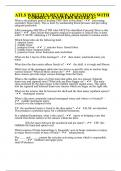
ATLS WRITTEN REVIEW QUESTIONS WITH CORRECT ANSWERS RATED A+
What is the primary goal of treating TBI? How is this done? - preventing secondary brain injury. This is done by maintaining blood pressure and providing adequate profusion. After managing ABCDEs of TBI what MUST be identified if present? How is this done? - mass lesion that requires surgical evacuation is critical! this is done with CT. NOTE: obtaining a CT should not delay patient transfer to trauma center. Which brain lobes do the following hold: 1. anterior fossa: 2. middle fossa: 3. posterior fossa: - 1. anterior fossa: frontal lobes 2. middle fossa: temporal lobes 3. posterior fossa: lower brainstem and cerebellum What are the 3 layers of the meninges? - dura mater, arachnoid mater, pia mater What does the dura mater adhere firmly to? - the skull. it is tough and fibrous What layer of the meninges splits into two leaves as specific sites to enclose large venous sinuses? What do these sinuses do? - dura mater. these sinuses provide major venous drainage from the brain. What is the midline sinus of of the brain that splits into two sinuses: bilateral transverse and sigmoid sinus? What side are these bigger on? - The main sinus enclosed by the dura major is the midline superior sagital sinus. This splits into the sigmoid and bilateral transverse sinuses which are larger on the right side. What are the arteries that lie between the skull and the dura mater (epidural space)? - meningeal arteries. What is the most commonly injured meningeal artery and where is it located? - middle meningeal artery. Located over the temporal fossa T/F: the arachnoid mater is fused to the dura mater? - FALSE: not attached. This produces a potential space for a subdural hematoma In a subdural hematoma, what is the cause? - injury to bridging veins that extend from brain surface to the sinuses within the dura. _______ fills the space between the arachnoid and pia mater? - CSF. this cushions the brain and spinal cord. What location of brain hemorrhage is frequently seen in brain contusion or injury to major blood vessels at base of brain? - subarachnoid. The ____ and _____ contain the reticular activating system which is responsible for ____. - midbrain and upper pons state of alertness What important function resides in the medulla? - cardiorespiratory centers. What important functions are in the following brain segments: 1. left hemisphere: 2. frontal lobe: 3. parietal lobe: 4. temporal: - 1. left hemisphere: language center 2. frontal lobe: executive function, emotions, motor 3. parietal lobe: sensory function/spatial orientation 4. temporal: memory functions What divides the brain into supratentorial and infratentorial compartments? - tentorium cerebelli. (tent over cerebellum) What is the physiology behind a blown pupil? - blown pupil: dilation of pupil -CN III runs along the tentorium cerebelli. parasympathetic fibers that constrict the pupil run along CN III (oculomotor). When temporal lobe is herniated, it can compress these fibers. Unapposed sympathetic activity causes pupillary dilation. What is the tentorial notch/hiatus - this is where the midbrain passes through into the infratentorial compartment. what part of the brain most commonly herniates through the tentorial notch? - Uncus (medial part of temporal lobe) does weakness occur on the same or opposite side of the uncal herniation? - OPPOSITE. the corticospinal tract of the midbrain is compressed and then crosses at the foramen magnum. state: Ipsilateral/contralateral ____ pupillary dilation associated with _____ hemiparesis is the classic sign of uncial herniation. - ipsi contra average ICP is _____ mmHg. - 10 The monro-kellie doctrine states that the total volume of intracranial contents must remain constant, because the cranium is ___ - a rigid, non expandable container. The monro-kellie doctrine states that _____ and _____ may be compressed out of the skull providing a degree of buffering. - CSF and venous blood. Once the CSF and venous blood reach a certain level of displacement the ICP rapidly increases. What is the equation for CPP (cerebral perfusion pressure)? - CPP=MAP-ICP in TBI, Every effort should be made to reduce ______, while normalizing ____, ___, and _____. - ICP MAP, oxygenation, intravascular volume What GCS ranges for the following classes: 1. Minor 2. Moderate 3. Severe - 1. 13-15 2. 9-12 3. 3-8 What nerve palsy may occur with basilar skull fracture? - seventh nerve. A GCS of ___ is accepted definition of coma? - 8 or less How do you assess a GCS of someone with asymmetric responses? - Use the best possible because this will be the best predictor of outcome Basilar fractures of the skull usually require what type of imaging? - this requires CT with bone-window setting. What are the typical clinical signs of basilar skull fractures? - rbital ecchymosis (raccoon eyes) 2. retroauriculor ecchymosis (battle sign) 3. CSF leak from nose or ears 4. 7th or 8th CN dysfunction (facial paralysis and hearing loss) What should be a primary consideration for any patient with a skull fracture, especially a linear skull fracture? - hematoma. linear skull fracture increases likelihood of intracranial hematoma by about 400x What mechanism is common with diffuse axonal injury and what is the likely outcome? - these injury often occur with high velocity or deceleration injures. They appear as diffuse cerebral hemorrhage often between grey and white matter. These are associated with variable but often poor outcomes. Epidural hematomas often occur in the _____ area of the skull and result from a tear of the _______ arteries. - temporal middle meningeal artery What is the classic presentation of a epidural hematoma? - a lucid interval between time of injury and neurologic a deterioration. What are more common brain injury: epidural or subdural? - subdural 30% epidural 0.5% Subdural hematoma occur from tear of _________. - bridging vessels of the cerebral cortex Contusion occur in ___% of TBI. They often occur in _____ or ______ lobes of brain. They may coalesce to form ______ in as many as 20$%. - 20-30% frontal or temporal intracerebral hematoma. What is the imaging protocol for a patient with cerebral contusion? - get CT at presentation. then get another within 24 hours to assess for coalesced hematoma. What factors would require a CT in minor brain injury? - 1. suspected open skull frac 2. basilar frac 3. 2 episode vomitting 4. pt older than 65 5. LOC 5 min 6. amnesia before impact of 30 min How long after discharge should patient with mild brain injury be observed by friend? - 24 hours What type of brain injury requires serial GCS? - ALL. minor. moderate. major What imaging is done in all patient with moderate brain injury? - CT What factor of ABCDE must be monitored closely in moderate brain injury? - Airway and breathing. rapid deterioration may occur. hypoventilation and hypercapnia may ensue requiring intubation. close monitoring in ICU is required. What should immediately follow the secondary survey in major/severe brain injury? - CT. REMEMBER: CT should never delay patient transfer When assessing ABCDE of severe brain injury, when does DPL or FAST come before neuro exam? - if the systolic blood pressure cannot be brought above 100, DPL or FAST is done first as to assess source of hypotension Spinal cord injury has what result in blood pressure? - hypotension. This may also occur in terminal brain injury with medullary failure What needs to be cleared before Doll's eye testing is conducted? - cervical spine must cleared. What tests should be performed before sedation? - GCS and pupillary rxn A midline shift of _____mm or greater on the CT is indicative of need for neurosurgery to evacuate the clot or contusion causing the shift - 5mm What type of fluids should be used? - hypertonic (ringers lactate or normal saline). NO GLUCOSE. What electrolyte abnormality is associated with brain edema and must be monitored? - hyponatremia What are the physiologic consequences of PaCO2 45? PaCO2 30? - f PaCO2 45 = vasodilation = inc ICP PaCO2 30 (hyperventilation) = constriction = ischemia What is the preferred PaCO2 in brain injury? - 35 mm Hg If ICP is rapidly increasing, what can be done while preparing for craniotomy? - hyperventilation. NOTE: this must be monitored closely and is only done very short periods at a time Does hypertonic saline lower ICP in hypovolemia? Does mannitol lower ICP in hypovolemia? - No NO After administration of mannitol what should be monitored closely? - ICP! mannitol has a substantial rebound effect on ICP What is the role of muscle relaxants (vecuronium or succinylcholine) in seizures with TBI? - NONE. these may mask tonic-clonic seizures and prevent anticonvulsant intervention (30-60 min of seizure = secondary brain injury) What meningeal tear would a CSF leakage of a head laceration indicate? - dural tear What is the treatment of any intracranial mass lesion? - Must be evacuated by neurosurgeon. transfer if not available. for a penetrating object such as an arrow or screw driver into the skull, test should be performed and what should be done with the object? - need CT, Xray for trajectory, and angiography. leave the object in place. Removing the object lead to fatal vascular injury. What clinical signs are the criteria for brain death? - GCS of 3, nonreactive pupil, absent brainstem reflexes, no spontaneous ventilatory effort Which vertebrae is most susceptible to injury? - Cervical. NOTE: in peds this accounts for only 1% of vertebral injury What nerve and cervical spine level would cause apnea and results in death in 1/3 of patient with upper cervical spine injury - phrenic nerve C1 At what age do cervical spine differences begin to normalize? at what age does cervical spine look like that of an adult? - marked differences in cervical spine occur until age 8 and steadily decline until age 12 when they are similar When a dislocation-fracture of the vertebrae occurs, almost always the result is _____. - complete spinal cord injury T/F: the thoracolumbar junction is extremely strong and rarely incurs injury? - FALSE: the flexible thoracic meeting the rigid lumbar make this area a common place for injury (15% of all spinal injuries) At what levels do the spinal cord begin and end? - begins at foramen magnum at terminal end of the medulla oblongata and end at L1 What is sacral sparing? - this is a sign of incomplete spinal cord injury where some sensation below an injury to spinal cord is preserved. In the case of sacral sparing, sensation and rectal sphincter tone is preserved. What function does the dorsal column have? What tests can be done to assess function? - position, vibration, light touch, all from same side of body. TESTS: positioning of bent toes/fingers, vibration with tuning fork. What function does the spinothalamic tract have? what tests can be done to assess function? - pain and temperature to opposite side of body TESTS: pinprick and light touch What function does the corticospinal tract have? what tests can be done to assess function? - Motor power on same side of body TESTS: voluntary muscle contract or involuntary response to pain What type of gastric tube should be placed when cribiform plate fx or mid face fracture is present? - orogastric. nasopharyngeal intrumentation is potentially dangerous When fluids must be administered what is the best route, and which type of catheter is best? - -peripheral route it preferred with antecubital or forearm. -if peripheral route is not accessable central vein access in any of the typical areas is acceptable. (in this case a short fat catheter should be used) What anatomical change is common in the third trimester of pregnancy? - widening of the symphasis pubis What pulmonary complication is common with blunt trauma and PaCO2 35? - pulmonary contusion. Chest tube is indicated for which of the following? -tension pneumo -hemothorax -ruptured bronchus -pulmonary contusion -mass hemothorax - All EXCEPT pulmonary contusion What is the initial bolus for fluid resuscitation when a small child is in shock? - 20mL/kg ringers lactate What are the chest tube blood volume output parameters that would require a thoracotomy? - 1500mL immediatley evacuated OR 200mL/hr for 2-4hrs NOTE: thoractomy is not indicated unless a surgeon qualified by training and experience is present How can one determine the appropriate tube depth for pediatric intubation? - ETT tube size x 3 Ex: 4.0 ETT would be properly positioned at 12 cm from the gums In pediatrics: once past the glottic opening, the ETT should be positioned __ to ___ cm below the level of the vocal cords and then carefully secured. - 2-3 cm Fluid resuscitation of an infant begins with _______(amount and type). And then progresses to ______. (amount and type) - 20mL/kg Ringers lactate. (may give up to three of these boluses initially) For the third bolus consider PRBCs at 10mL/kg For a patient who is not breathing what intervention is indicated? - orotracheal intubation What should be used when vocal chords cannot be visualized on direct laryngoscopy? - gum elastic bougie. in place when you feel clicks. can be inserted blindly beyond epiglottis What is the acronym BURP? - backward, upward and rightward pressure used in external laryngeal manipulation with orotracheal intubation what is the most common life threatening injury in children? - tension pneumothorax What is the most common acid-base disturbance in the injury child and what is it caused by? - Respiratory acidosis caused by hypoventilation. What are the options to establish an airway when bag-mask ventilation and attempts at orotracheal intubation fail for a child? - LMA, or intubating LMA, or needle cricothyroidotomy. -needle-jet insufflation is an appropriate temporizing technique for oxygenation but does not provide adequate ventilation. NOTE: surgical cric is RARELY indicated for infants an small children. usually it is an adoption when the cricothyroid membrane is easily palpable around the age of 12.
Escuela, estudio y materia
- Institución
- ATLS
- Grado
- ATLS
Información del documento
- Subido en
- 7 de enero de 2024
- Número de páginas
- 10
- Escrito en
- 2023/2024
- Tipo
- Examen
- Contiene
- Preguntas y respuestas
Temas
- atls written review
- atls written review
-
atls written review questions

Documento también disponible en un lote