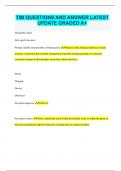
TIM QUESTIONS AND ANSWER LATEST UPDATE GRADED A+
TIM QUESTIONS AND ANSWER LATEST UPDATE GRADED A+ Responder safety Safe, quick clearance Prompt, reliable interoperable communications Purpose of the strategic highway research program 2 national traffic incident management responder training program is to promote consistent training of all responders and achieve three objectives Drunk Drugged Drowsy Distracted Just plain dangerous D drivers Secondary crashes Those crashes that occur within the incident scene or within the queue or back up, including the opposite direction, resulting from an original incident TIM traffic incident management The planned and coordinated multi-disciplinary process to detect, respond to, and clear traffic incidents so the traffic flow may be restored as safely and quickly as possible Roadway Clearence time The time between the first recordable awareness of an incident by responding agency and first communication that all travel lanes are open Incident Clearence time The time between the first recordable awareness and the time at which the last responder has left the scene Enhance the safety of responders and motorists Minimize motorist delay through traffic control and opening up lanes Restore the roadway to its pre-incident capacity as safely and quickly as possible Safe, quick clearance is the practice of rapidly, safely, and aggressively removing temporary obstructions from the roadway to: Move over laws Require drivers approaching a scene where emergency responders are present to either change lanes when possible and/or reduce vehicle speed Driver removal laws Require motorist involved in minor crashes (where there are no serious injuries and the vehicles can be driven) to move their vehicles out of the travel lanes to the shoulder or other safe area Authority removal laws Provide authority (and immunity from liability in general) for designated public agencies to remove vehicles and/or spilled cargo from the roadway to restore traffic flow MUTCD Manual on uniform traffic control devices Promotes the uniformity of traffic control signs, signals, and markings from state to state. This uniformity improves safety and driver expectancy Common response terminology using plain English When describing highway lanes left and right are determined from the perspective of the flow of traffic Lane designation terminology: Lane numbering Numbering system that assigns numbers 1, 2, 3, etc. from left to right lane again from the perspective of the flow of traffic Upstream Approaching traffic Downstream Departing traffic Queue The back up of traffic that results from an incident or blocked lanes Detection The discovery of an incident is the first step in the TIM process. Can be a call from the parties involved, a call from a passing motorist, or by responders who happen upon them Verification Collecting as much information as possible from the individual reporting the incident including the exact location, the make, model, and color of the involved vehicles, and a callback number in case more information is needed Notification Occurs when the communication center dispatches the appropriate response Scene size up report Includes the following: Unit identification Exact location of incident Number and type of vehicles involved Degree of damage Number of lanes closed Hazards or unique safety concerns Establishment of command 15 minute detailed size up report or regular progress reports Should include: On scene safety concerns-dangerous location, limited visibility, presence of hazardous materials Traffic conditions-length of traffic Q, traffic control needs, detour/alternate route needs Injured persons-Number and extent of injuries, need for extrication Additional resources needed-towing and recovery, helicopter EMS services, crash investigation/reconstruction, medical examiner/corner Minor : < 30 minutes Intermediate: 30 minutes to 2 hours Major : > 2 hours Three general incident classes based on anticipated duration Move it Refers to moving vehicles involved in an incident to a safer location before being worked Work it Refers to a situation where the vehicles involved cannot be moved before being worked Safe-positioned Where emergency vehicles at an incident: Protect the responders performing their duties Protect road users traveling through the incident scene Minimize to the extent practical, disruption of the adjacent traffic flow Initial block The first emergency vehicle that arrives at an incident scene is responsible for positioning their vehicle as an _____ Blocking The act of positioning a responder vehicle upstream of an incident to obstruct the flow of moving traffic in one or more lanes, and/or the shoulder Lane +1 blocking When responders block the involved Lane, including the shoulder, plus one additional lane to provide a protective lateral space for safety Conspicuity The ability of a vehicle to draw attention to its presence, even when other road users are not actively looking for it High visibility safety apparel HVSA Traffic stops When uniformed law Enforcemeant personnel are used to direct traffic, to investigate crashes, or to handle lane closures, obstructed roadways, and disasters, HVSA shall be worn, but not for routine ______ Zero buffer When there is limited or no buffer space between on scene vehicles and any active lane of traffic Public information officer Responsible for serving as the go-between for command and the media, and for relaying information on the incident and response efforts Safety officer Responsible for monitoring scene safety and developing preventative safety measures. The safety officer has the ability to immediately stop any action that is deemed unsafe or too high a risk. The incident commander can override the orders after consultation with the safety officer and involved personnel. Liaison officer Responsible for coordinating with representatives from cooperating and assisting agencies and organizations Single command When one individual is designated as incident commander and has complete responsibility for incident management Unified command A joint management and authority structure in which two or more individuals share the role of command Incident command post The field location at which the primary tactical level, on scene incident command functions are performed Staging area The location established where resources can be placed while awaiting a tactical assignment Advanced warning area Established upstream of the incident to alert drivers of the upcoming incident scene. All advanced warning devices should also be upstream of any traffic queues so that warning is given to road users before encountering stopped traffic Transition area Section of roadway where drivers are redirected out of their normal path; usually involve the strategic use of tapers, which can be set up using cones or flares Activity area Section of the roadway where incident response activities take place Upstream buffer space Separates the transition area from the incident space and provides a recovery area for errant vehicles. No vehicles should be positioned within this space. Incident space Location where the incident has occurred and emergency responders are working. A blocking vehicle should be positioned at the upstream end of this space to protect workers from impacts by errant vehicles Termination area Used to notify drivers that the traffic incident management area is ending and they may resume normal driving; Includes the downstream buffer space and taper, which is in place to protect emergency responders working at the end of the incident space Labels, markings, placard, bill of lading, or shipping papers How to identify what hazardous material is being transported Short-lived evidence Evidence that will most likely be lost, destroyed, or compromised once the scene has been cleared. Examples include tire marks, debris field, gouges, scrapes, fluid trails, blood, Hair, and fibers Year, make, and model of vehicle DOT classification Location and scene access Reason for tow Additional vehicle or crash details Information that towing dispatchers need to secure the appropriate towing vehicle
Escuela, estudio y materia
- Institución
- National Traffic Incident Management
- Grado
- National Traffic Incident Management
Información del documento
- Subido en
- 17 de diciembre de 2023
- Número de páginas
- 10
- Escrito en
- 2023/2024
- Tipo
- Examen
- Contiene
- Preguntas y respuestas
Temas
-
tim questions and answer latest update graded a

Documento también disponible en un lote