Econ 102 Exam 1 WSU Latest 2023 Graded A
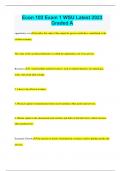
Econ 102 Exam 1 WSU Latest 2023 Graded A opportunity cost sacrifice the value of the output the person would have contributed to the civilian economy. The value of the sacrificed alternative is called the opportunity cost of an activity. Resources 1. Land includes natural resources, such as mineral deposits, oil, natural gas, water, and actual land acreage. 2. Labor is the effort of workers. 3. Physical capital is manufactured items used to produce other goods and services. 4. Human capital is the educational achievements and skills of the labor force (which increase labor productivity). Economic Growth An increase in factors of production: resources used to produce goods and services. Better technology: the technical means for producing goods and services. market a group of buyers and sellers of a particular product. competitive market one with many buyers and sellers, each has a negligible effect on price. perfectly competitive All sellers produce identical products Buyers & sellers so numerous that no one can affect market price—each is a "price taker quantity demanded of any good is the amount of the good that buyers are willing and able to purchase at a given price. Law of demand the claim that the quantity demanded of a good falls when the price of the good rises, other things equal normal good positively related to income. Increase in income causes increase in quantity demanded at each price, shifts D curve to the right inferior good negatively related to income. An increase in income shifts D curves for inferior goods to the left substitutes they are viewed as alternatives by consumers. complements if they tend to be consumed together. quantity supplied any good is the maximum amount that sellers are willing and able to sell at a given price. Law of supply the claim that the quantity supplied of a good rises when the price of the good rises, other things equal Equilibrium P has reached the level where quantity supplied equals quantity demanded Equilibrium price the price that equates quantity supplied with quantity demanded Equilibrium quantity the quantity supplied and demanded at the equilibrium price Surplus (a.k.a. excess supply) when quantity supplied is greater than quantity demanded Shortage (a.k.a. excess demand): when quantity demanded is greater than quantity supplied Change in supply : a shift in the S curve different Q at every P occurs when a non-price determinant of supply changes (like technology or costs) Change in the quantity supplied a movement along a fixed S curve Different Q caused by change in P occurs when P changes Change in demand a shift in the D curve different Q at every P occurs when a non-price determinant of demand changes (like income or # of buyers) Change in the quantity demanded a movement along a fixed D curve different Q due to change in P occurs when a non-price determinant of demand changes (like income or # of buyers) Recessions (contractions) periods of economic downturn, when output and employment are falling Expansions (recoveries) periods of economic upturn, when output and employment are rising Business cycle the short-run alternation between recessions and expansions. Stock a share in the ownership of a company held by a shareholder. These stocks can pay dividends (shares of profit). Bond an IOU that pays interest. Suppose you buy a Treasury bond. You - the buyer of the bond - are lending to the Treasury. The Treasury - the issuer of the bond - is borrowing from you. The bond is an asset to you, but a liability to the Treasury Government transfer payment by the government to individuals for which no good or service is provided in return (Social Security). Disposable income GDP + Government transfers - Taxes; The amount households have available to spend on consumption or to save. Private savings disposable income minus consumer spending (disposable income that is not spent on consumption). (GDP + Transfers - Taxes) - Consumption Financial markets the banking, stock, and bond markets, which channel private savings and foreign lending into investment spending, government borrowing, and foreign borrowing. Government borrowing the total amount of funds borrowed by federal, state, and local governments in the financial markets. Government purchases of goods and services total expenditures on goods and services by federal, state, and local governments. Exports goods and services produced here, but sold to buyers in other countries. Imports goods and services purchased here but produced in other countries. Trade balance Exports - Imports If Exports > Imports, trade surplus If Exports < Imports, trade deficit Inventories stocks of goods and raw materials held to facilitate business operations - or accumulated by accident due to sluggish sales. Investment spending 1) all new private-sector construction; 2) purchases of machinery and equipment by firms; 3) changes to inventories final goods GDP is a measure of the market value produced within the boundaries of the country in a given year those purchases made by the ultimate consumers (i.e., not intended for resale or consumed in a subsequent production process.) intermediate goods which are used up in the production of other goods in the same period they themselves were produced. Calculating Gross Domestic Product Expenditure Approach: Add up all spending on domestically produced final goods and services. This results in the equation GDP = C + I + G + (X - IM) Income approach: Add up all income paid to factors of production. This results in the equation GDP = Total Factor Income = wages + interest + rent + profit Value-Added Approach: Add up the value added by all producers. Value added = Sales Revenue - purchases of intermediate goods from other firms Nominal GDP is output valued at current prices. ("(final - initial)" )/"initial" x 100 amount of item * current price = amount of item * current price= Norminal GDP Real GDP amount of item( any year) * base year price+ amount of item ( any year)* base year price this year's output, valued at base year prices.' The base year is the arbitrary year whose prices are used as a basis of comparison for all the other years. GDP Info GDP does not fall when the physical capital stock and resources deteriorate. GDP excludes home production of cleaning, cooking, and child care done in the household GDP does not capture transactions conducted in the underground economy. GDP does not fall when pollution, noise, and crime reduce the quality of life. GDP does not rise when we have more leisure. GDP deflator (
Escuela, estudio y materia
- Institución
- Econ 102
- Grado
- Econ 102
Información del documento
- Subido en
- 6 de diciembre de 2023
- Número de páginas
- 11
- Escrito en
- 2023/2024
- Tipo
- Examen
- Contiene
- Preguntas y respuestas
Temas
-
econ 102 exam 1 wsu latest 2023 graded a

Documento también disponible en un lote