Human Genetics Concepts and Applications.pdf
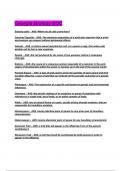
Multiple Choice Questions 1. The cellular basis of muscular dystrophy is that some of a child's muscle cells A. have combined into a structure that cannot contract. B. lack DNA. C. lack a protein that enables them to withstand the force of contraction. D. have too much of a contractile protein and become weak. Bloom's Level: 02. Understand Learning Outcome: 02.01 Explain why it isimportant to know the cellular basis of a disease. Section: 02.01 Topic: Cell parts 2. A researcher identifies an abnormality in a protein that causes a particular inherited illness. To develop a treatment, it would be most helpful to know A. which cells are affected and how to replace the protein's function in them. B. the sequence of the gene that encodes the protein. C. the other types of molecules that cause or contribute to the disease. D. the type of mutation that affects the protein. Bloom's Level: 03. Apply Learning Outcome: 02.01 Explain why it isimportant to know the cellular basis of a disease. Section: 02.01 Topic: Cell parts 3. Which of the following statements is true? A. Somatic cells are diploid, meaning that they have two copies of the human genome. B. Somatic cells are haploid, meaning that they have one copy of the human genome. C. Sperm and egg cells are diploid, meaning that they have two copies of the human genome. D. Stem cells are haploid, meaning that they have one copy of the human genome. Bloom's Level: 02. Understand Learning Outcome: 02.02 Define differentiated cell. Section: 02.01 Topic: Cell parts 4. Which of the following types of components aggregate and interact to form the epithelial, connective, muscle, and nerve tissues in the human body? A. Prokaryotic cell B. Secondary meristems C. Differentiated cell D. Stem cell Bloom's Level: 01. Remember Learning Outcome: 02.02 Define differentiated cell. Section: 02.01 Topic: Differentiation 5. Humans belong to domain , which is distinguished by cells that have . A. Prokarya; organelles B. Archaea; ancient organelles C. Eukarya; organelles D. Prokarya; proteins Bloom's Level: 02. Understand Learning Outcome: 02.04 Describe how organelles interact. Section: 02.02 Topic: Cell parts
Escuela, estudio y materia
- Institución
- Nursing pharmacology
- Grado
- Nursing pharmacology
Información del documento
- Subido en
- 15 de noviembre de 2023
- Número de páginas
- 23
- Escrito en
- 2023/2024
- Tipo
- Examen
- Contiene
- Preguntas y respuestas
Temas
- human genetics concepts a
-
human genetics concepts and applicationspdf
-
human genetics concepts and applicationspdf
-
human genetics concepts and applicationspdf