Structure determination
32.1 Nuclear magnetic resonance (NMR): 32.3 Interpreting proton NMR spectra:
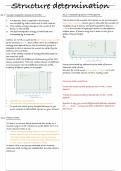
1. A magnetic field is applied to the sample The are shows the number of H atoms in an environment.
surrounded by radio waves and a radio receiver. Spin-spin coupling allows you to calculate the number of
2. This creates energy change in the nuclei of the neighbouring H atoms, the splitting pattern follows n +
atoms in the sample. 1. N = the number of hydrogen atoms on the adjacent
3. The electromagnetic energy is admitted and carbon atom. If there’s only one H atom it will give 2
interpreted by a computer. peaks of equal height.
Eg.
Carbon-13 NMR, is used as the odd mass mass number
gives the atom a spin, each carbon atom as a different
energy level depending on the functional group it’s
attached to this is because the nuclei are shield by the
electrons around them.
C13 NMR creates a graph of energy absorbed against
the chemical shift.
Chemical shift: the difference of frequency of the C13
atoms compared to TMS (0), carbon atoms in different
environments will have different chemical shifts, Group calculated by referencing the table of known
creating different peaks in the graph. chemical shift values.
Solvent for NMR must not contain H atoms or it will
produce unreliable results CCl4 is mostly used.
Common exam questions:
“Draw the molecule that produced this NMR / CMR
spectra”
“Name the molecule that produced this NMR / CMR
spectra”
• one peak per environment
• The chemical shift changed per environment Explain a way you could differentiate between samples
• To work out which group the peak belongs to you of … , … and … using scientific methods to determine
must compare to the booklet (given in your exams) structure”
32.2 Proton NMR:
It’s the H-1 nucleus being examined but works in a
similar way to CMR. However it works better as H-1 is
more common than C-13.
• there’s a peak for every different environment of H
atoms depending on the groups they are attached to
• The area of each peak shows how many H atoms
there are in that environment, may sometimes be in
a ratio, shown by the integration trace
H atoms with more groups attached give a smaller
chemical shift as they are shielded but the other atom’s
electrons.
32.1 Nuclear magnetic resonance (NMR): 32.3 Interpreting proton NMR spectra:
1. A magnetic field is applied to the sample The are shows the number of H atoms in an environment.
surrounded by radio waves and a radio receiver. Spin-spin coupling allows you to calculate the number of
2. This creates energy change in the nuclei of the neighbouring H atoms, the splitting pattern follows n +
atoms in the sample. 1. N = the number of hydrogen atoms on the adjacent
3. The electromagnetic energy is admitted and carbon atom. If there’s only one H atom it will give 2
interpreted by a computer. peaks of equal height.
Eg.
Carbon-13 NMR, is used as the odd mass mass number
gives the atom a spin, each carbon atom as a different
energy level depending on the functional group it’s
attached to this is because the nuclei are shield by the
electrons around them.
C13 NMR creates a graph of energy absorbed against
the chemical shift.
Chemical shift: the difference of frequency of the C13
atoms compared to TMS (0), carbon atoms in different
environments will have different chemical shifts, Group calculated by referencing the table of known
creating different peaks in the graph. chemical shift values.
Solvent for NMR must not contain H atoms or it will
produce unreliable results CCl4 is mostly used.
Common exam questions:
“Draw the molecule that produced this NMR / CMR
spectra”
“Name the molecule that produced this NMR / CMR
spectra”
• one peak per environment
• The chemical shift changed per environment Explain a way you could differentiate between samples
• To work out which group the peak belongs to you of … , … and … using scientific methods to determine
must compare to the booklet (given in your exams) structure”
32.2 Proton NMR:
It’s the H-1 nucleus being examined but works in a
similar way to CMR. However it works better as H-1 is
more common than C-13.
• there’s a peak for every different environment of H
atoms depending on the groups they are attached to
• The area of each peak shows how many H atoms
there are in that environment, may sometimes be in
a ratio, shown by the integration trace
H atoms with more groups attached give a smaller
chemical shift as they are shielded but the other atom’s
electrons.