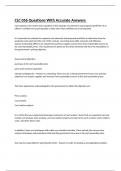
CLC 056 Questions With Accurate Answers
Cost analysis is the review and evaluation of the separate cost elements and proposed profit/fee of an offeror's certified cost or pricing data or data other than certified cost or pricing data. It is important to evaluate the separate cost elements and proposed profit/fee to determine how the proposed costs represent the cost of the contract, assuming reasonable economy and efficiency. - Answer Contracting Officers are required to purchase supplies and services from responsible sources at fair and reasonable prices. This requirement is based on the three elements that form the foundation of the government's pricing objective. Government Objective: purchase at fair and reasonable price price each contract separately exclude contingencies - Answer In contracting, when you act as the government's buyer, your primary objective is to acquire supplies and services from responsible sources at fair and reasonable prices. The three approaches acknowledged by the government to attain this objective are: Price analysis Cost analysis Cost realism analysis It is critical that you understand techniques and terms of cost analysis. Terms that are important not only include cost analysis, price analysis, and cost realism analysis, but also terms such as direct costs, indirect costs, and other direct costs. In addition, there are techniques with which you should be familiar. These include the various price analysis techniques and procedures that help the government to ensure a fair and reasonable price. You may be responsible for selecting the techni - Answer In order to develop a prenegotiation position, you will analyze contract costs and price using contract analysis techniques. Prenegotiation objectives establish the government's initial negotiation position. The Contracting Officer establishes prenegotiation objectives before the negotiation of any pricing action. There are many methods for estimating costs in an equitable and consistently applied way. Some cost estimating texts identify ten or more! Some common methods are: Round-table Comparison Detailed - Answer Round Table In a round table, experts are brought together to develop cost estimates by exchanging views and making judgments based on knowledge and experience. This method is most commonly used when there is little or no cost experience or detailed product information (e.g., specifications, drawings, or bills of material). Comparison With the comparison method, costs for a new item are estimated using comparisons with the cost of completing similar tasks under past or current contracts. Any differences are isolated and cost elements applicable to the differences are deleted from or added to experienced costs. Comparisons may be made at the cost element level or total price level. Adjustments may also be made for possible upward or downward cost trends. This method is most commonly used when specifications for th - Answer Detailed The detailed method is characterized by a thorough review of all components, processes, and assemblies. It requires detailed information to arrive at estimated costs and typically uses cost data derived from the accounting system, statistical records, and other sources. This method is most commonly used when the required information is available and future production potential warrants the cost of the detailed analysis required. It is the most accurate of the three methods for estimating direct cost. As you can imagine, it is also the most time consuming and expensive. Fairness to seller Sellers need to be concerned about an unrealistic low price because of the risk. Sellers need to be concerned about the market implications of a price that is too high. Sellers need to be concerned about major mistakes in estimating costs. Sellers need to be concerned about recovering buy-in losses. - Answer The three market conditions are Competition, Supply and Demand, and General Economic Conditions. Pricing contracts separately Business conditions can change the specifics of government contracting. Market forces like competition and supply and demand must be considered. Balancing of one contract against another contract in financial results is not allowed. - Answer The final government objective is Exclude Contingencies. This objective requires that contracts exclude contingencies that cannot be reasonably estimated at the time of the award. The definition of a contingency is a possible future event or condition arising from presently known or unknown causes and the outcome cannot be determined at the present time. - Answer There are three types of analyses associated with analyzing contract costs. They are: Price Analysis Cost Realism Analysis Cost Analysis adequate price competition, which is a form of price analysis. Adequate price competition is an exception to obtaining certified cost or pricing data - Answer he detailed cost estimating method estimates based on an analysis of the methods and materials required to complete each element of the work required by the contract At the heart of this module is the Truth in Negotiations Act, which you will usually hear referred to as "TINA."TINA is a public law enacted in 1962 for the purpose of providing full and fair disclosure by contractors in the conduct of negotiations with the government. TINA requires: Contractors and subcontractors submit certified cost or pricing data for negotiated procurements over $2 million. Downward adjustment to the contract price, including profit or fee, where it is determined that the - Answer While TINA protects the government, the same laws that establish requirements for certified cost or pricing data also provide for mandatory exceptions. Never require certified cost or pricing data when an exception applies. Refer to FAR 15.403-1 and DFARS 215.403-1 to learn more. Generally, except a procurement from TINA requirements if: The negotiated price is based on adequate price competition The price is set by law or regulation The item is considered a "commercial" item (see FAR 2.101), unless it is a non-commercial modification of a commercial item where the modification exceeds the greater of $2 million or 5% of the contract price The head of the contracting activity waives the requirement TINA helps you as a Contracting Officer because it requires offerors to certify that their certified cost or pricing data is current, accurate, and complete. The certification TINA requires establishes information parity for the government when having to negotiate fair and reasonable prices based on cost analysis, which in turn, helps you achieve your ultimate goal of negotiating a fair and reasonable price. For this reason, you must ensure that the certified cost or pricing data the contracto - Answer To obtain certified costs or pricing data The FAR requires that certified cost or pricing data be submitted in one of three formats: The format outlined in FAR Table 15-2, which you can review under the Resources tab An alternate format outlined in the solicitation/contract A format selected by the offeror Certified cost or pricing data, cost or pricing data, and data other than certified cost or pricing data are key terms associated with TINA - Answer While the initial award amount exceeded the TINA threshold of $2 million, the Contracting Officer determined through market research that adequate price competition would exist for this requirement. Therefore, the exception at FAR 15.403-1(b)(1) applied. Offerors were not required to submit certified cost or pricing data. Since the initial estimate of this modification is $20.9M, well over the threshold of $2 million, and no exceptions apply, we will require the offeror to submit certified cost or pricing data. - Answer Unless an exception applies, TINA and FAR 52.215-21 require the submission of certified cost or pricing data for any modification expected to exceed the current threshold, regardless of whether or not certified cost or pricing data were initially required FAR 52.215-11, Price Reduction for Defective Certified Cost or Pricing Data - Modifications provides a remedy to the government in the event the contractor submits defective certified cost or pricing data on this modification - Answer Cost Accounting Standards are used for estimating, accumulating, and reporting costs associated with pricing, administration, and settlement of negotiated national defense prime contracts and subcontracts in excess of $2 million. There are three types of CAS coverage for noncommercial contracts and subcontracts: Full (all 19 standards) Modified (CAS 401, 402, 405, and 406) Foreign Concerns (CAS 401 and 402 only) nce you determine what level of CAS coverage applies, you need to determine whether or not the contractor must provide a signed Disclosure Statement.The Disclosure Statement defines a contractor's cost accounting practices and procedures. It is made by the contractor using a Disclosure Statement Form (CASB Form DS-1). - Answer A cost is allocable if it is assignable or chargeable to one or more cost objectives on the basis of relative benefits received or other equitable relationship. A cost is reasonable if, in its nature and amount, it does not exceed that which would be incurred by a prudent person in the conduct of competitive business. A cost is allowable only when the cost complies with all of the following requirements: Reasonableness Allocability Standards promulgated by the CAS Board, if applicable, or appropriate accounting principles and practices Terms of the contract Any limitations set forth in FAR 31.201-2 To assist you with determining CAS exemptions as defined in 48 CFR 9903.201-1(b), the CAS Coverage and Disclosure Statement Determination flowchart has been developed that walks you through the process to determine: If CAS applies When CAS applies, what level of coverage (Modified or Full) If a Disclosure Statement is required - Answer Exemptions to the Cost Accounting Standards are if contracts are based on established or market prices or fixed by law or regulation, small businesses, and all contracts awarded using sealed bidding. The BBOMS contract is subject to CAS. None of the listed exemptions apply. Since this is a negotiated procurement in excess of $7.5M, the contract is covered by the Cost Accounting Standards - Answer The BBOMS contract is for $202,017, 683.00 for the base and 4 option years. Consider the total of the basic and option years when calculating the value of the contract. See FAR 1.108 (c) for additional information. In accordance with FAR 52.230-1, the contractor is required to submit the disclosure statement as part of the proposal and certify that a copy has been provided to the CFAO and cognizant auditor concurrently - Answer FAR 31.205 provides a set of cost principles for contracts with commercial organizations to assist you in determining if a cost is allowable, unallowable or allowable with restrictions. There are 48 cost principles. Although you will focus primarily on commercial organizations, the FAR also identifies cost principles for contracts to include educational institutions; state, local, and Federally recognized Indian tribal governments; and nonprofit organizations Here are the categories identified by the cost principles. Each cost principle defines a type of cost and establishes whether that cost is allowable, unallowable, or allowable with some restrictions. Allowable cost Unallowable cost Allowable costs with restrictions Costs not specifically addressed Review the table in FAR 31.205, which summarizes the cost guidance provided by the cost principles. - Answer Allowable cost A cost that is expressly identified as allowable in the cost principles and meets the relevant tests for reasonableness, allocability, compliance with cost accounting principles, and the terms of the contract. Unallowable cost Do not allow any proposed or actual costs identified by the cost principles as unallowable. - Answer Allowable cost with restrictions Do not allow proposed or actual costs that exceed the limit set forth in the cost principle. Costs not specifically addressed The fact that a cost is not specifically mentioned does not imply that it is either allowable or unallowable. FAR 31.204(d) requires that the determination of allowability shall be based on the contract cost principles in FAR Part 31 and the treatment of similar or related selected items in FAR Part 31.205. - Answer A cost is allowable if it is reasonable, allocable, IAW CAS or GAAP as applicable, IAW the terms of the contract and IAW FAR Part 31. An allocable cost may be a direct cost or an indirect cost. The first choice is an example of a direct cost. The second choice is correct because there are many costs that cannot show a direct relationship (CEO salary, human resource department, legal staff) but are necessary to the overall operation of the business. The third choice is correct because although the costs may benefit commercial work, the costs are allocated on some reasonable basis of benefit received (for example, if 40% was for - Answer in order for a cost to be reasonable it must be, in both nature and amount, what a prudent business person would pay in the conduct of a competitive business and the burden of proof is on the contractor to demonstrate the reasonableness of the level of engineer and number of hours required why you need to use modeling to analyze proposals It enables you to compare and validate contractor costs and prices to ensure that the contractor's proposal is sound (computations are correct). It helps you strengthen a negotiation position - Answer There are various proposal modeling tools that you can use including commercial off-the-shelf (COTS) products. For this course, you will be using Excel with the data analysis add-in. If you are familiar with Excel, you can use this information as a refresher. For some of you, this may be your first exposure to data analysis and you should find this module to be very beneficial. There is also documentation available under the Resources tab to reference as you continue to use Excel for proposal modeling. Note: The approach presented in this module using Excel as the proposal modeling tool is just one way of modeling a proposal. One of the key documents that you need when performing proposal modeling is Table 15-2, located at FAR 15.408. This table contains instructions for submitting cost/price proposals when cost or pricing data are required. There is a clear distinction between submitting cost or pricing data and providing available books, records, and other documents without identification. The requirement for submission of cost or pricing data is met when all accurate cost or pricing data reasonably available to - Answer proposal modeling assists the contracting officer in achieving prenegotiation objectives by: Validates the contractor's computations Validates the contractor's proposal summary with detailed back-up data worksheets Allows real time calculation of offers and counteroffers during negotiations Facilitates update of prenegotiation position upon receipt of updates from the contractor (e.g., updated quotes, subcontractor submissions, change in rates) Allows the government to identify differences between the contractor's proposed amounts and the prenegotiation position due to fact-finding results, field pricing assistance, independent government estimates and analysis prenegotiation objective establishes the government's initial negotiation position and assists the contracting officer in determining a fair and reasonable price. - Answer As a reminder, Excel 2007 is the spreadsheet package that will be used throughout this module. Review the Excel 2007 Training Manual in the Resources tab as needed as you go through this module and specifically for the areas highlighted below. Here are some key areas of Excel that you should be familiar with: Starting Out - includes opening, interacting, and closing Excel Workbooks - discussed in more detail on the following screens Quick Access Toolbar - includes adding, removing buttons and customizing the toolbar Working with Excel 2007 - discussed in more detail on the following screens A workbook is a collection of individual spreadsheets or worksheets. When you open Excel 2007, you are actually opening a workbook that contains three spreadsheets or worksheets. This workbook is named Book1 by default. Saving your work is critical. Make sure to save your workbooks often. You can use the "Save As" option and enter a filename and then select the Save button to save the current workbook under that name. - Answer workbook is just a collection of worksheets. Within a workbook, you may need to switch worksheets or add more worksheets. The graphic below shows the area of Excel where you can select worksheets (spreadsheets) by selecting individual tabs labeled Sheet1, Sheet2, Sheet3, etc. Your main goal for using an Excel worksheet is to organize and analyze data as part of proposal modeling. You need to learn to work with the basic components found in every worksheet/spreadsheet, which consist of columns, rows, and cells. - Answer IAW DFARS 215.408 (1) use the clause at 252.215-7000, Pricing Adjustments, in solicitations and contracts that contain the following clauses: FAR 52.215-11, Price Reduction for Defective Certified Cost or Pricing Data--Modifications; FAR 52.215-12, Subcontractor Certified Cost or Pricing Data; or FAR 52.215-13, Subcontractor Certified Cost or Pricing Data--Modifications.
Escuela, estudio y materia
- Institución
- CLC 056
- Grado
- CLC 056
Información del documento
- Subido en
- 4 de noviembre de 2023
- Número de páginas
- 38
- Escrito en
- 2023/2024
- Tipo
- Examen
- Contiene
- Preguntas y respuestas
Temas
- clc 056 stuvia
-
clc 056 questions with accurate answers
-
cost analysis is the review and evaluation of the
-
government objective purchase at fair and reasona

Documento también disponible en un lote