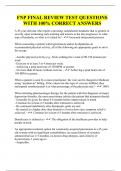
FNP FINAL REVIEW TEST QUESTIONS WITH 100% CORRECT ANSWERS
A 45-year-old man who reports a pressing, nonpulsatile headache that is greatest in severity upon awakening each morning and lessens as the day progresses. Is what type of headache, or what is it related to? - Increased intracranial pressure When counseling a patient with hypertension and/or dyslipidemia on recommended physical activity, all of the following are appropriate goals to strive for except: - Aerobic physical activity (e.g., brisk walking) for a total of 90-150 minutes per week - Exercise of at least 3 to 4 times per week. - Achieving a peak heart rate of 150 BPM or greater. - No more than 48 hours without exercise. - Achieving a peak heart rate of 150 BPM or greater. When a patient is seen by a nurse practitioner, the visit can be charged to Medicare using "incident-to" billing. If the criteria for this type of visit are fulfilled, then anticipated reimbursement is at what percentage of the physician rate? - 100% When initiating pharmacologic therapy for the patient with first diagnosis of major depression disorder, the nurse practitioner advises the patient that treatment should: - Generally be given for about 4-6 months before improvement is noted. - Continue for at least 4-5 months after remission is achieved. - Be continued indefinitely after therapeutic goals are met. - Be started at a higher dose then titrated to a lower dose once symptom relief is achieved. - Continue for at least 4-5 months after remission is achieved. Beneficence is defined as - The obligation of the healthcare provider to help people in need. An appropriate treatment option for community-acquired pneumonia in a 45-year-old woman with no significant comorbidities, no recent history of systemic antimicrobial use (3 months), no known drug allergies, and a history of hysterectomy 3 years ago is: - Ampicillin. - Doxycycline (Doryx®). - Cefuroxime (Ceftin®). - Moxifloxacin (Avelox® - Doxycycline Gary is a 26-year-old graduate student who is diagnosed with major depressive disorder (MDD) without psychotic features. His medical history is unremarkable and he states that he does not wish to undergo psychotherapy. An appropriate first-line medication is: - Sertraline (Zoloft®). - Risperidone (Risperdal®) - Amitriptyline (Elavil®). - Trazodone (Oleptro®). - Sertraline (Zoloft) The nurse practitioner is evaluating laboratory studies in a patient with newly-diagnosed type 2 diabetes mellitus. Which lipid abnormality is most likely? - Low total cholesterol - High triglycerides - Low LDL-C - High HDL-C - High triglycerides Mr. Woods is a 63-year-old man who presents for initial evaluation at your practice. He has a 45 pack-year smoking history and COPD that is currently being treated with daily oral theophylline and albuterol via MDI prn. He complains of shortness of breath and chronic cough with sputum production. He states, "I can barely walk to my car without getting out of breath." Spirometric assessment reveals an FEV1 of 45% predicted and a FEV1:FVC of 62%. His health history reveals 3 exacerbations in the past year. The best course of action for Mr. Woods to minimize COPD exacerbation risk is to: - Continue on theophylline therapy. - Advise using albuterol on a set schedule rather than prn. - Switch to a long-acting beta2-agonist as needed for shortness of breath. - Add therapy with a long-acting muscarinic antagonist uses on a set schedule. - Add therapy with a long-acting muscarinic antagonist uses on a set schedule. A 20-year-old male complains of being fatigued for the past week. The physical examination is significant for anterior and posterior cervical lymphadenopathy and right and left upper quadrant abdominal tenderness. A white blood cell differential is significant for lymphocytosis with reactive forms. Which of the following additional findings does the nurse practitioner anticipate? - Pharyngitis with exudate - Supraclavicular lymphadenopathy - Diffuse maculopapular rash - Marked sinus tenderness - Pharyngitis with exudate A 38-year-old woman presents complaining of weight loss, agitation, and new-onset tremor. The nurse practitioner suspects hyperthyroidism. Laboratory assessment will most likely include: - TSH=8.9 mIU/L (0.4-4.0 mIU/L), free T4 =15 pmol/L (10-27 pmol/L). - TSH0.15 mIU/L (0.4-4.0 mIU/L), free T4 =79 pmol/L (10-27 pmol/L). - TSH=24 mIU/L (0.4-4.0 mIU/L), free T4 =3 pmol/L (10-27 pmol/L). - TSH=1.9 mIU/L (0.4-4.0 mIU/L), free T4 =22 pmol/L (10-27 pmol/L). - TSH0.15 mIU/L (0.4-4.0 mIU/L), free T4 =79 pmol/L (10-27 pmol/L). Clinical evaluation of a 43-year-old man with a BMI=42 kg/m2 who presents with recurrent genital Candida albicans infection should include all of the following except: - Treatment with oral or topical antifungals. - Offering testing for HIV antibodies. - Avoidance of soap on the genitals. - Checking A1C. - Avoidance of soap on genitals
Escuela, estudio y materia
- Institución
- FNP
- Grado
- FNP
Información del documento
- Subido en
- 14 de octubre de 2023
- Número de páginas
- 20
- Escrito en
- 2023/2024
- Tipo
- Examen
- Contiene
- Preguntas y respuestas
Temas
- fnp final review
- fnp
-
fnp final review test questions

Documento también disponible en un lote