TEAS 6-Chemistry exam
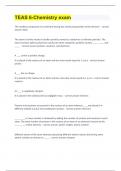
The smallest component of an element having the chemical properties of the element. Atom The atom is further made of smaller particles named as subatomic or ultimate particles. The atom has been split by physicists mainly into three subatomic particles namely ____, ____, and ____. protons, neutrons, and electrons A ___ carries a positive charge. It is placed in the nucleus of an atom and has mass nearly equal to 1 a.m.u proton A ___ has no charge. It is placed in the nucleus of an atom and has mass also nearly equal to 1 a.m.u neutron An ___ is negatively charged. It is placed in the orbital and has negligible mass. electron Protons and neutrons are present in the nucleus of an atom whereas ____are placed in 4 different orbitals (s,p,d,f) surrounding the nucleus. electrons ____ ____ or mass number is obtained by adding the number of protons and neutrons in each atom. The total number of protons in the nucleus of an atom of an element is known as the ____ ____ of that element. atomic weight, atomic number Different atoms of the same element possessing different atomic masses but having same atomic number are known as ____. isotopes Since the isotopes of an atom have the same atomic number, they must contain an equal number of protons. As their atomic masses are different, there must be a difference in the number of ___ they possess. neutrons They will show similar ___ properties but their ____ properties will be different due to different masses. Also since all isotopes of the same element have the same atomic number they occupy the same place in the periodic table. chemical properties, physical properties All neutral atoms have equal number of ____(positively charged) and ____(negatively charged) as a result of which the net charge in the atom is 0. protons, electrons But when any atom gains or loses one or more electrons we get atoms with imbalance charge, which are termed as ____. ions Ions that are positively charged (meaning loses electron) are called: cations Ions that are negatively charged (meaning gains electron) are called: anions The region in the space around the nucleus where there is maximum probability of finding an electron is known as an ____ of that electron. orbital Alkali metals examples: Group IA Sodium, potassium ; +1 Alkaline earth metals examples: Group IIA Magnesium, calcium ; +2 Halogens example: Group VII A chloride , iodine ; -1 Noble gases: Group O He,Ne,Ar; - The union of two or more atoms involving redistribution of electrons EITHER by transfer OR by sharing between themselves, so that all of them attain the stable noble gas configuration of minimum energy is called: chemical bonding The bonding may result in the formation of ____. The attraction between atoms w/in a ____ results in a chemical bond. molecule(s) A bond that involves complete TRANSFER of one or more electrons from one atom to another. Ionic bond Example of ionic bond: table salt; NaCl A bond that involves MUTUAL sharing of electrons between two atoms. Covalent bond Ex: Carbon making four bonds w/ hydrogen to make methane gas. Methane belongs to ____ ____ as FOUR COVALENT bonds are made by sharing four electrons with four hydrogen atoms. saturated hydrocarbon Chlorine w/ chlorine to form: chlorine gas Nitrogen atom w/ 3 hydrogen atoms to form: Ammonia ; NH3 Sometimes by sharing TWO or MORE ELECTRON PAIRS ___&___ bonds are formed. double & triple bonds Sharing of two electron pairs between two atoms results in ___ ___. Examples.. double bonds Oxygen gas O2,ethylene gas Sharing of THREE electron pairs between two atoms results in ___ ___. Examples.. triple bonds Nitrogen gas N2, and acetylene gas It is a saturated hydrocarbon w/ general formula: CnH2n+2 Methane It is an unsaturated hydrocarbon w/ one double bond and a general formula: CnH2n Ethylene It is also an unsaturated hydrocarbon w/ one triple bond and a general formula: CnH2n-2 Ethyne (commonly called Acetylene) It is defined as the relative ability of an atom to draw the bonding electrons towards its ____ nucleus ____ ____ developed an electronegativity scale to describe the attraction of the elements in a chemical bond for shared electrons. Linus Pauling
Escuela, estudio y materia
- Institución
- Ati teas chem
- Grado
- Ati teas chem
Información del documento
- Subido en
- 4 de septiembre de 2023
- Número de páginas
- 5
- Escrito en
- 2023/2024
- Tipo
- Examen
- Contiene
- Preguntas y respuestas
Temas

Documento también disponible en un lote