Lecture 1: What is self-regulation?
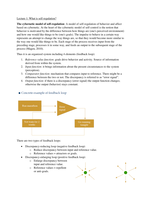
The cybernetic model of self-regulation: A model of self-regulation of behavior and affect
based on cybernetic. At the heart of the cybernetic model of self-control is the notion that
behavior is motivated by the difference between how things are (one's perceived environment)
and how one would like things to be (one's goals). The impulse to behave in a certain way
represents an attempt to change the way things are, so that they would become more similar to
the way one would like things to be. Each stage of the process receives input from the
preceding stage, processes it in some way, and feeds an output to the subsequent stage of the
process (Magen, 2010).
Thus it is an organized system including 4 elements (feedback loop):
1. Reference value function: goals drive behavior and activity. Source of information
derived from within the system.
2. Input function: it brings information about the present circumstances to the system
(perception).
3. Comparator function: mechanism that compares input to reference. There might be a
difference between the two or not. The discrepancy is referred to as “error signal”.
4. Output function: if there is a discrepancy (error signal) the output function changes;
otherwise the output (behavior) stays constant.
There are two types of feedback loops:
Discrepancy-reducing loop (negative feedback loop)
o Reduce discrepancy between input and reference value.
o Reference values = attractors or goals.
Discrepancy-enlarging loop (positive feedback loop)
o Enlarge discrepancy between
input and reference value.
o Reference values = repellent
or anti-goals.
The cybernetic model of self-regulation: A model of self-regulation of behavior and affect
based on cybernetic. At the heart of the cybernetic model of self-control is the notion that
behavior is motivated by the difference between how things are (one's perceived environment)
and how one would like things to be (one's goals). The impulse to behave in a certain way
represents an attempt to change the way things are, so that they would become more similar to
the way one would like things to be. Each stage of the process receives input from the
preceding stage, processes it in some way, and feeds an output to the subsequent stage of the
process (Magen, 2010).
Thus it is an organized system including 4 elements (feedback loop):
1. Reference value function: goals drive behavior and activity. Source of information
derived from within the system.
2. Input function: it brings information about the present circumstances to the system
(perception).
3. Comparator function: mechanism that compares input to reference. There might be a
difference between the two or not. The discrepancy is referred to as “error signal”.
4. Output function: if there is a discrepancy (error signal) the output function changes;
otherwise the output (behavior) stays constant.
There are two types of feedback loops:
Discrepancy-reducing loop (negative feedback loop)
o Reduce discrepancy between input and reference value.
o Reference values = attractors or goals.
Discrepancy-enlarging loop (positive feedback loop)
o Enlarge discrepancy between
input and reference value.
o Reference values = repellent
or anti-goals.