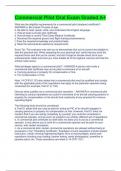
Commercial Pilot Oral Exam Graded A+
What are the eligbility requirements for a commercial pilot (airplane) certificate? - ANSWER-a. Be at least 18 years of age. b. Be able to read, speak, write, and understand the English language. c. Hold at least a private pilot certificate. d. Hold at least a current Third Class Medical Certificate. e. Received the required ground and flight training endorsements. f. Pass the required knowledge and practical tests. g. Meet the aeronautical experience requirements. Exam Tip: The evaluator may ask you to demonstrate that you're current and eligible to take the practical test. When preparing for your practical test, verify that you have the required hours and that you're current, and don't forget to double-check all of your endorsements. Make sure that you have totaled all of the logbook columns and that the entries make sense. What privileges apply to a commercial pilot? - ANSWER-A person who holds a commercial pilot certificate may act as pilot-in-command of an aircraft: a. Carrying persons or property for compensation or hire. b. For compensation or hire. Note: 14 CFR 61.133 also states that a commercial pilot must be qualified and comply with the applicable parts of the regulations that apply to the particular operation being conducted (for example, Part 91 or 135). Discuss what qualifies as a commercial pilot operation. - ANSWER-A commercial pilot intending to conduct operations as a pilot-in-command of an aircraft carrying persons or property for compensation or hire should look cautiously at any proposal for revenue operating flights. The following facts should be considered: a. Part 61 states that you may be paid for acting as PIC of an aircraft engaged in carrying persons or property for compensation or hire. However, Part 61 does not mention that if you are acting completely by yourself, you could be considered a commercial operator, and as such, be subject to an entirely different set of regulations. b. A commercial pilot certificate by itself does not allow you to act as a commercial operator. It only allows you to work for a commercial operator and be paid for your service, with certain exceptions. c. As a commercial pilot, certain commercial operations are allowed without being in possession of an "Operating Certificate." Examples of such operations include student instruction, certain nonstop sightseeing flights, ferry or training flights, aerial work operations including crop dusting, banner towing, aerial photography, powerline or pipeline patrol, etc. These operations are listed in 14 CFR 119.1. Exam Tip: During the practical test, your knowledge of commercial pilot privileges and limitations will be evaluated. Know the pertinent regulations well, with emphasis on 14 CFR 61.133, 91.147, 119.1, 135.1 and Part 136. Also recommended is a review of FAA Advisory Circular (AC) 120-12, Private Carriage versus Common Carriage of Persons or Property, located in Appendix 1 of this guide. What does the term "commercial operator" refer to? - ANSWER-Commercial operator means a person who, for compensation or hire, engages in the carriage by aircraft in air commerce of persons or property, other than as an air carrier or foreign air carrier or under the authority of 14 CFR Part 375. Where it is doubtful that an operation is for "compensation or hire," the test applied is whether the carriage by air is merely incidental to the person's other business or is, in itself, a major enterprise for profit. Define the term "common carriage." - ANSWER-Common carriage refers to the carriage of passengers or cargo as a result of advertising the availability of the carriage to the public. A carrier becomes a common carrier when it "holds itself out" to the public, or a segment of the public, as willing to furnish transportation within the limits of its facilities to any person who wants it. There are four elements in defining a "common carrier": a. A holding out or a willingness to b. transport persons or property c. From place to place d. For compensation. Define "holding out." - ANSWER-Holding out implies offering to the public the carriage of persons and property for hire either intrastate or interstate. This holding out that makes a person a common carrier can be done in many ways, and it does not matter how it is done. a. Signs and advertising are the most direct means of holding out but are not the only ones. b. A holding out may be accomplished through the actions of agents, agencies, or salesmen who may obtain passenger traffic from the general public and collect them into groups to be carried by the operator. c. Physically holding out without advertising, yet gaining a reputation to "serve all," is sufficient to constitute an offer to carry all customers. For example, the expression of willingness to all customers with whom contact is made that the operator can and will perform the requested service is sufficient. It makes no difference if the holding out generates little success; the issue is the nature and character of the operation. d. A carrier holding itself out as generally willing to carry only certain kinds of traffic is nevertheless a common carrier. Define the term "private carriage." - ANSWER-Carriage for hire that does not involve holding out is "private carriage." Private carriage for hire is a carriage for one or several selected customers, generally on a long-term basis. The number of contracts must not be too great, otherwise it implies a willingness to make a contract with anybody. A carrier operating with 18 to 24 contracts has been labeled a common carrier because it
Escuela, estudio y materia
- Institución
- Commercial Pilot Oral
- Grado
- Commercial Pilot Oral
Información del documento
- Subido en
- 14 de julio de 2023
- Número de páginas
- 107
- Escrito en
- 2022/2023
- Tipo
- Examen
- Contiene
- Preguntas y respuestas
Temas
- commercial pilot oral
-
commercial pilot oral exam graded a

Documento también disponible en un lote