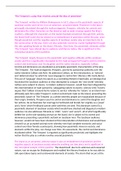
‘The Tempest is a play that revolves around the idea of pessimism’
‘The Tempest’ written by William Shakespeare in 1611, plays on the pessimistic aspects of
Jacobean society and mirrors it on an unknown, unnamed island. Pessimism in the play is
principally elucidated through the male protagonist, Prospero, whereby he controls and
dominates the other characters on the island as well as seeks revenge against the King’s
courtiers. Although the characters on the island elucidate pessimism through their actions,
the island itself could also be viewed as an embodiment of pessimism within the play. even
though pessimism and the negative aspects of Jacobean society play an important role in
the construction of the play, there are also optimistic moments, mainly highlighted through
the sole-speaking female on the island, Miranda. Over time, the pessimistic elements within
‘The Tempest’ have altered due to audience and literary milieu, this is significant in the
conceptual analysis of this question.
‘The Tempest’ largely focuses on the pessimistic and negative attitudes within Jacobean
society and this is significantly elucidated by the male protagonist Prospero and his need for
control and dominance over his daughter and the native islanders, especially Caliban.
Control and dominance are elucidated as principally pessimistic characteristics of the play
‘The Tempest’. The male protagonist, Prospero, asserts his patriarchal authority over the
native islanders Caliban and Ariel. He addresses Caliban, on first introduction, as ‘tortoise’
and ‘abhorred slave’ by which he ‘uses language to control him’ (literary critic Cecily Berry).
This use of ‘language’ shows his nature as a controlling Western Imperialist, an ideology that
fascinated the Jacobean audience as they attempted to conquer the ‘new world’ whereby
natives were subject to slavery. A modern audience however, would have been disgusted by
this representation of male patriarchy, subjugating natives to slavery. Literary critic Traversi
argues that ‘Caliban is bound by his nature to service’ whereby his ‘nature’ as an island man
ultimately puts him under Prospero’s control as dominant male on the island, presenting the
pessimistic nature of ‘The Tempest’ as a whole whereby people are marginalised because of
their origin. Similarly, Prospero uses his control and dominance to control his daughter and
her actions. He orchestrates her marriage to Ferdinand and brands her virginity as a ‘jewel’
and a ‘knot’ which Ferdinand cannot untie until they are wed. This dominant control is a
pessimistic element of Jacobean society which would have shocked and disgusted a modern
audience. He also addresses Miranda as ‘child’, ‘worm’ and ‘wench’, all of which significantly
belittle her as the sole-speaking woman on the island, she is subject to his control and
dominance presenting a pessimistic outlook on Jacobean men. The Jacobean audience
however, would not have been shocked at this interpretation of dominance and would have
viewed it as an accepted societal norm whereby men had complete economic and social
control over their female counterparts, showing how pessimistic views on society. and
elements within the play, can change over time. On assessment, the control and dominance
elucidated within ‘The Tempest’ is regarded as significantly pessimistic and highlights the
notion that the play as a whole revolves around pessimism.
The island as an unnamed, unknown place is also an embodiment of pessimism and the
negative aspects of Jacobean society whereby anything can take place and is significant in
the conceptual analysis of this question. The island itself, due to its unknown and unnamed
nature, was an escape for Shakespeare and enabled him literary freedom as he was able to
talk upon taboo topics and controversial elements of society. The storm that occurs at the
‘The Tempest’ written by William Shakespeare in 1611, plays on the pessimistic aspects of
Jacobean society and mirrors it on an unknown, unnamed island. Pessimism in the play is
principally elucidated through the male protagonist, Prospero, whereby he controls and
dominates the other characters on the island as well as seeks revenge against the King’s
courtiers. Although the characters on the island elucidate pessimism through their actions,
the island itself could also be viewed as an embodiment of pessimism within the play. even
though pessimism and the negative aspects of Jacobean society play an important role in
the construction of the play, there are also optimistic moments, mainly highlighted through
the sole-speaking female on the island, Miranda. Over time, the pessimistic elements within
‘The Tempest’ have altered due to audience and literary milieu, this is significant in the
conceptual analysis of this question.
‘The Tempest’ largely focuses on the pessimistic and negative attitudes within Jacobean
society and this is significantly elucidated by the male protagonist Prospero and his need for
control and dominance over his daughter and the native islanders, especially Caliban.
Control and dominance are elucidated as principally pessimistic characteristics of the play
‘The Tempest’. The male protagonist, Prospero, asserts his patriarchal authority over the
native islanders Caliban and Ariel. He addresses Caliban, on first introduction, as ‘tortoise’
and ‘abhorred slave’ by which he ‘uses language to control him’ (literary critic Cecily Berry).
This use of ‘language’ shows his nature as a controlling Western Imperialist, an ideology that
fascinated the Jacobean audience as they attempted to conquer the ‘new world’ whereby
natives were subject to slavery. A modern audience however, would have been disgusted by
this representation of male patriarchy, subjugating natives to slavery. Literary critic Traversi
argues that ‘Caliban is bound by his nature to service’ whereby his ‘nature’ as an island man
ultimately puts him under Prospero’s control as dominant male on the island, presenting the
pessimistic nature of ‘The Tempest’ as a whole whereby people are marginalised because of
their origin. Similarly, Prospero uses his control and dominance to control his daughter and
her actions. He orchestrates her marriage to Ferdinand and brands her virginity as a ‘jewel’
and a ‘knot’ which Ferdinand cannot untie until they are wed. This dominant control is a
pessimistic element of Jacobean society which would have shocked and disgusted a modern
audience. He also addresses Miranda as ‘child’, ‘worm’ and ‘wench’, all of which significantly
belittle her as the sole-speaking woman on the island, she is subject to his control and
dominance presenting a pessimistic outlook on Jacobean men. The Jacobean audience
however, would not have been shocked at this interpretation of dominance and would have
viewed it as an accepted societal norm whereby men had complete economic and social
control over their female counterparts, showing how pessimistic views on society. and
elements within the play, can change over time. On assessment, the control and dominance
elucidated within ‘The Tempest’ is regarded as significantly pessimistic and highlights the
notion that the play as a whole revolves around pessimism.
The island as an unnamed, unknown place is also an embodiment of pessimism and the
negative aspects of Jacobean society whereby anything can take place and is significant in
the conceptual analysis of this question. The island itself, due to its unknown and unnamed
nature, was an escape for Shakespeare and enabled him literary freedom as he was able to
talk upon taboo topics and controversial elements of society. The storm that occurs at the