NU606_W10_Endocrine_Disorders_Guided_Notes and marking scheme
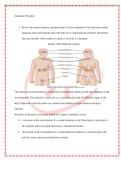
Endocrine Disorders 1. Review the normal anatomy and physiology of each component of the endocrine system. Knowing what each hormone does will help you to understand the disorders. Remember that each disorder will be either too much or too little of a hormone. Glands of the Endocrine System The endocrine system performs a crucial role in metabolism, human growth and adaptation in the environmental. The endocrine system acts as a communication path for different organs in the body. Endocrine system disorders are common and manifest as hyper function and hypo function. Secretion of hormones is basically guided by a negative feedback system: • A decrease in the concentration of a certain hormones in the blood leads to activation of the regulator endocrine gland releasing its stimulator hormones. • An increase in the concentration of a certain hormone in blood as a result of target cell activity causes a decrease in hormone secretion. Endocrine disorders are secondary to deficiency of a hormone or excess production of a hormone. It can be either primary, secondary or tertiary: Primary— state where the secreting gland produce either high or low hormones as a result of diseased secreting gland. Secondary— state where the secreting gland produce either high or low hormones as a result of a diseased regulator gland. Tertiary— state where the secreting gland produce either high or low hormones as a result of dysfunction of the hypothalamus leading to abnormal function of the regulator gland. 2. Type 1 diabetes Describe It Pathophysiology of It Risk Factors Signs and Symptoms Specific Lab Values Also known as juvenile diabetes and results from decreased or no insulin production. Results from autoimmune destruction of pancreatic beta cells of the islets of Langerhans. It sets in mainly during adolescence or after an infection. Family history Genetics Age Increased urination Bedwetting in children who has no bedwetting history Unintended weight loss Feeling hungry more than normal Fasting blood sugars higher than 7.0 Mmol/L Random blood sugar concentration higher than 11.1 mmol/l HbA1c levels above 6.5% 3. Type 2 diabetes Describe It Pathophysiology of It Risk Factors Signs and Symptoms Specific Lab Values Too many sugars flow into the bloodstream as a result of insulin resistance. High blood sugar levels may eventually result in issues with the immune, neurological, and circulatory systems. Results from increased insulin resistance resulting from obesity or alcohol use alcohol or cigarette smoking. It leads to high blood sugar in the blood. High blood sugar levels may eventually result in issues with the immune, neurological, and circulatory systems. Age Prediabetes Family history Obesity Cigarette smoking Chronic alcoholism. Increased urination Increased thirst. Unintended weight loss Blurred vision Feeling hungry more than normal Fasting blood glucose concentration higher than 7.0 mmol/l Random blood sugar concentration higher than 11.1 mmol/l HbA1c levels above 6.5%
Escuela, estudio y materia
- Institución
- NU606
- Grado
- NU606
Información del documento
- Subido en
- 17 de enero de 2023
- Número de páginas
- 14
- Escrito en
- 2022/2023
- Tipo
- Examen
- Contiene
- Preguntas y respuestas
Temas
- nu606 quest
-
nu606w10endocrinedisordersguidednotes
-
nu606w10endocrinedisordersquestions with correct answers
-
nu606w10endocrinedisordersmarking scheme
-
nu606w10endocrinedisorders
-
nu606w10

Documento también disponible en un lote