Conservation Genetics
Application of genetics to preserve species as dynamic entities, capable of coping
with environmental change (Frankham et al, 2002)
Most causes anthropogenic? Extinction rates rise 1000 fold? (check)
- Habitat destruction, hunting
- Environmental stochasticity: fires, harsh winters, climate change (non-
anthropogenic)
- Genetics plays a role: degree of significance debated
To conserve species – need to identify, tackle with problems of inbreeding
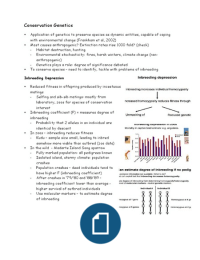
Inbreeding Depression
Reduced fitness in offspring produced by incestuous
matings
- Selfing and sib-sib matings: mostly from
laboratory, zoos for species of conservation
interest
Inbreeding coefficient (F) = measures degree of
inbreeding
- Probability that 2 alleles in an individual are
identical by descent
In zoos – inbreeding reduces fitness
- Kudu – sample size small, leading to inbred
somehow more viable than outbred (zoo data)
In the wild - Madarte Island Song sparrow
- Fully marked population: all pedigrees known
- Isolated island, stormy climate: population
crashes
- Population crashes – dead individuals tend to
have higher F (inbreeding coefficient)
- After crashes in ‘79/’80 and ‘88/’89 –
inbreeding coefficient lower than average -
higher survival of outbred individuals
- Use molecular markers – to estimate degree
of inbreeding
,Inbreeding increases disease susceptibility in
California sea lions (Acevedo-Whitehouse et
al., 2003)
Inbreeding estimated using 11
microsatellite markers
High internal relatedness denotes low
heterozygosity
Relatedness higher in groups suffering
from diseases, relative to control group (trauma
due to eg. gunshot, net trapping)
Inbred – sea lions are the ones carrying more
infections
Low genetic diversity and extinction vortex
Low genetic diversity caused by inbreeding and/or
genetic drift in a small population
In context of genetic diversity and fitness
a) Scandinanvian wolves – hunted to extinction (Vila et al,
2003)
- 1980: 1 Eastern Russian female founded new population, all
progeny fathered by 1 ER male
- Sibling mating drop in heterozygosity
- Wolf heterozygosity drops then decline is halted at~1991 –
new immigrant ER wolf, brings new alleles: population recovery
New alleles from immigrant Russian ER wolf N=90-100 – 11
breeding packs
b) Florida panther
- Distribution and number of individuals
– sharp decrease
- Limited success – cost and
management issues
c) Cheetah
, - Juvenile mortality observed to be very high
- Low variation at allozyme loci
- Skin grafts not rejected - indicative of low diversity
- Concerns about long-term survival of cheetah
- BUT further data showed that juveniles subject to extreme predation rates – an
ecological stress not genetic
- Other genetic loci showed higher variation
- Cautionary tale: low genetic diversity not inevitably linked to low fitness
Conservation, taxonomy, genetics
Taxnomony important in conservation –
unrecognised, endangered species might
not be protected and become extinct
Conservation often based on species
Morphology often not enough to
distinguish taxonomic units
DNA barcoding
Identification of species using DNA
sequences
Short sequences – specifically using ~650bp of mitochondrial COI cytochrome
oxidase I gene in animals – small portion of single gene
In plants – use 1 of 2 regions in the chloroplast – matK and rbcl
Novel: use small portion of single gene to identify species from a taxonomic range
But is it reliable? Traditional taxonomists use multiple traits often combining
morphological and DNA-based information
The general method
1. Sequence barcoding region from various individuals
2. Analyse sequence data to create phylogenetic tree
3. Similar, putatively related, individuals are clustered together
Application in forensics
Application of genetics to preserve species as dynamic entities, capable of coping
with environmental change (Frankham et al, 2002)
Most causes anthropogenic? Extinction rates rise 1000 fold? (check)
- Habitat destruction, hunting
- Environmental stochasticity: fires, harsh winters, climate change (non-
anthropogenic)
- Genetics plays a role: degree of significance debated
To conserve species – need to identify, tackle with problems of inbreeding
Inbreeding Depression
Reduced fitness in offspring produced by incestuous
matings
- Selfing and sib-sib matings: mostly from
laboratory, zoos for species of conservation
interest
Inbreeding coefficient (F) = measures degree of
inbreeding
- Probability that 2 alleles in an individual are
identical by descent
In zoos – inbreeding reduces fitness
- Kudu – sample size small, leading to inbred
somehow more viable than outbred (zoo data)
In the wild - Madarte Island Song sparrow
- Fully marked population: all pedigrees known
- Isolated island, stormy climate: population
crashes
- Population crashes – dead individuals tend to
have higher F (inbreeding coefficient)
- After crashes in ‘79/’80 and ‘88/’89 –
inbreeding coefficient lower than average -
higher survival of outbred individuals
- Use molecular markers – to estimate degree
of inbreeding
,Inbreeding increases disease susceptibility in
California sea lions (Acevedo-Whitehouse et
al., 2003)
Inbreeding estimated using 11
microsatellite markers
High internal relatedness denotes low
heterozygosity
Relatedness higher in groups suffering
from diseases, relative to control group (trauma
due to eg. gunshot, net trapping)
Inbred – sea lions are the ones carrying more
infections
Low genetic diversity and extinction vortex
Low genetic diversity caused by inbreeding and/or
genetic drift in a small population
In context of genetic diversity and fitness
a) Scandinanvian wolves – hunted to extinction (Vila et al,
2003)
- 1980: 1 Eastern Russian female founded new population, all
progeny fathered by 1 ER male
- Sibling mating drop in heterozygosity
- Wolf heterozygosity drops then decline is halted at~1991 –
new immigrant ER wolf, brings new alleles: population recovery
New alleles from immigrant Russian ER wolf N=90-100 – 11
breeding packs
b) Florida panther
- Distribution and number of individuals
– sharp decrease
- Limited success – cost and
management issues
c) Cheetah
, - Juvenile mortality observed to be very high
- Low variation at allozyme loci
- Skin grafts not rejected - indicative of low diversity
- Concerns about long-term survival of cheetah
- BUT further data showed that juveniles subject to extreme predation rates – an
ecological stress not genetic
- Other genetic loci showed higher variation
- Cautionary tale: low genetic diversity not inevitably linked to low fitness
Conservation, taxonomy, genetics
Taxnomony important in conservation –
unrecognised, endangered species might
not be protected and become extinct
Conservation often based on species
Morphology often not enough to
distinguish taxonomic units
DNA barcoding
Identification of species using DNA
sequences
Short sequences – specifically using ~650bp of mitochondrial COI cytochrome
oxidase I gene in animals – small portion of single gene
In plants – use 1 of 2 regions in the chloroplast – matK and rbcl
Novel: use small portion of single gene to identify species from a taxonomic range
But is it reliable? Traditional taxonomists use multiple traits often combining
morphological and DNA-based information
The general method
1. Sequence barcoding region from various individuals
2. Analyse sequence data to create phylogenetic tree
3. Similar, putatively related, individuals are clustered together
Application in forensics